Belgian-German foundation, then extensive Soviet rebuilding
The federal institute traces White Giant foundations to selection of albino Flemish or Belgian Giants in Belgium near Ghent and northern Germany around the turn of the twentieth century. The population reached the USSR from Germany in 1927–1929; this is an import date, not proof of Ukrainian origin or worldwide recognition. Early animals were small and constitutionally weak—the institute records a 3.9 kg average in one 1933 population. From 1937, B. G. Menshov, A. I. Kaplevsky and N. I. Muravyeva selected stronger stock at Somovsky. War interrupted the work; postwar improvement used Flemish, Chinchilla and Angora input followed by selection among white albinos. The current Eastern population therefore has a documented development history beyond its Western foundation.
A red-eyed albino giant with a 5.1–5.3 kg average
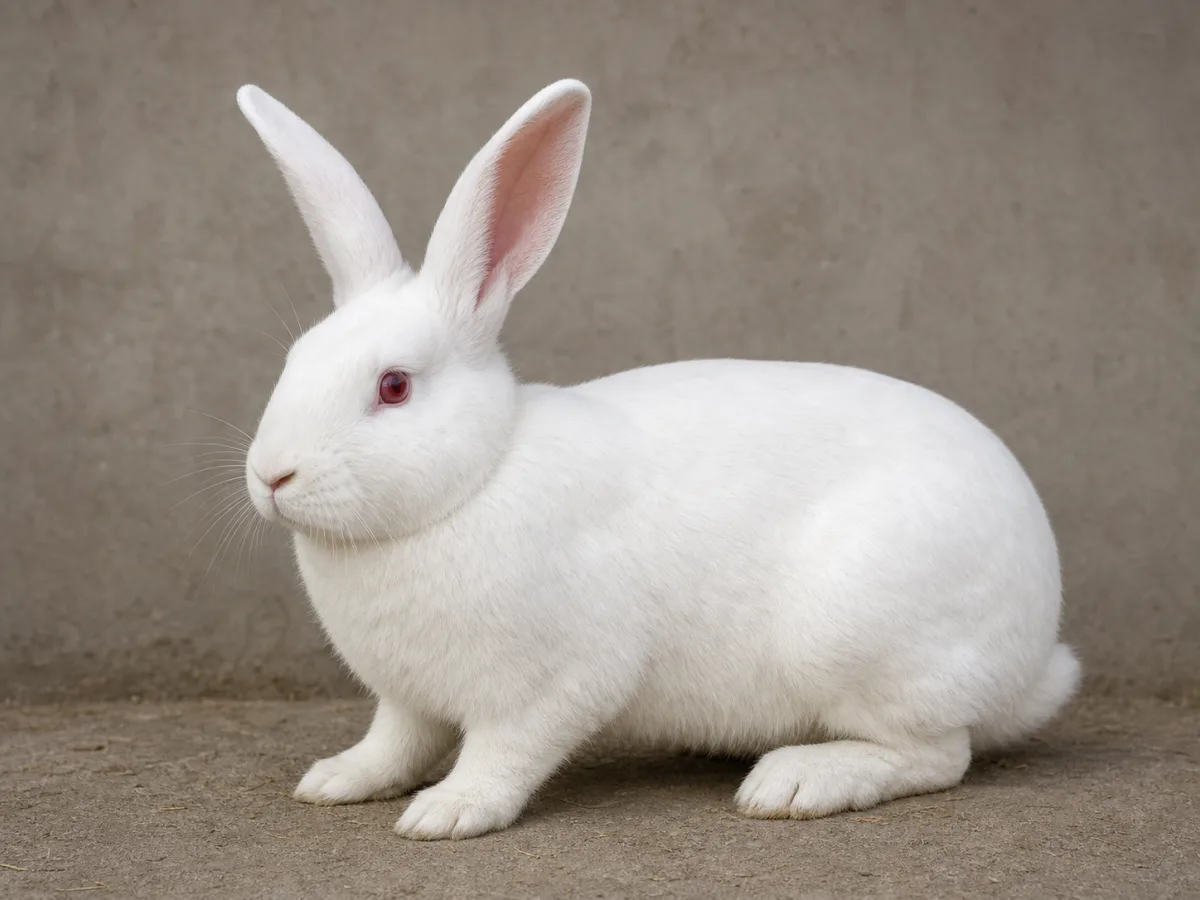
GOST R 70141-2022 defines White Giant as a large normal-haired dual-purpose breed with average live weight 5.1–5.3 kg, white glossy fluffy coat and classical genotype ccBBDDEEAA. The institute’s desired type is about 5.1 kg; its observed 8.3 kg maximum is exceptional, not the standard range. It describes a large but not coarse head, long broad erect ears diverging slightly upward, an elongated strong body, deep chest with only a small dewlap, broad straight back, rounded broad rump and long strong widely set limbs. Reference measurements are about 62 cm body and 36 cm chest. Eyes look red because pigment is absent and vessels show; claws should be white.
Large size and albinism do not predict personality
No cited standard or controlled behavioral study proves that every White Giant is calm, docile, maternal or easy to handle. Behavior depends on pain, hormones, previous handling, housing and individual history. Provide predictable routines, secure hides, foraging, a compatible rabbit companion and a permanently connected area large enough for several full hops, running, upright standing, stretching and retreat. Interact on the floor and reward voluntary contact. A large rabbit requires secure support under the chest and entire hindquarters if lifting is unavoidable; never lift by ears or loose skin. Sudden behavior change warrants a health check.
A giant body needs generous space and stable footing
Size housing to the actual rabbit, not a single minimum cage number. Use permanently connected living and exercise areas with dry, stable, non-slip flooring, cushioned resting places, shade and shelters; the rabbit must turn, lie fully extended and move normally without contacting roof or fittings. Feed unlimited grass hay and constant fresh water, suitable leafy greens and a measured complete pellet adjusted to age, body condition and reproduction. Track weight and body condition rather than chasing maximum size. Groom during moults and inspect the white coat, tail underside, joints and broad weight-bearing feet for dampness, urine staining, hair loss or sores.
Monitor giant-rabbit mechanics without inventing a syndrome
The reviewed sources do not establish one disease unique to every White Giant or special immunity from the breed’s history. Large body mass makes sound flooring, stable body condition, functional limbs and regular foot checks especially important; albinism is a pigment phenotype, not by itself a diagnosis. Reduced eating or feces, drooling, weight loss, diarrhea, swelling, breathing difficulty, eye discharge, head tilt, urine scald, altered gait, sore feet, pain or lethargy require prompt rabbit-experienced veterinary assessment. Quarantine new animals and document examinations, treatments, teeth, eyes, feet, movement and reproductive recovery.
Select the current population, not historical performance claims
Use the current applicable standard and verified pedigree because White Giant, White Flemish, German White Giant and white Continental naming can overlap across countries. Record mature weight around the GOST population context, body length, chest, ears, straight back, rump, limbs, white coat and claws, red eyes, bite, feet, body condition, health, matings, every birth and loss, growth and doe recovery. The 2024 institute study analyzed a large production selection program and a newer separate Velikorodskaya White population; its molecular clusters and results do not describe every White Giant. Historical litter, yield, gain, first-mating, weaning and cage figures must be measured locally rather than advertised as fixed breed outcomes.
- Verify registry, pedigree and the exact White Giant population.
- Record functional giant type, average context, feet, movement and health.
- Track every reproductive outcome instead of reusing historical guarantees.
Frequently asked questions
Where did the White Giant rabbit originate?
Institute and encyclopedia sources trace its foundation to albino Flemish/Belgian Giant selection in Belgium and northern Germany; the USSR imported stock from Germany in 1927–1929.
How much does a White Giant rabbit weigh?
The current GOST gives 5.1–5.3 kg as the average live weight. An institute-recorded 8.3 kg is an exceptional observed maximum, not a normal target.
Is the White Giant an albino breed?
Yes. The reviewed standard describes a pure white coat, red eyes and classical recessive cc color context, unlike blue-eyed Vienna White.
Was the White Giant created in the USSR in 1927?
No. 1927–1929 is the documented import period. The Eastern population was substantially selected and rebuilt afterward.
- Breed standardFederal Research Institute of Fur-Bearing Animal and Rabbit Breeding — White Giant
- GovernmentGOST R 70141-2022 — White Giant breed definition and average live weight
- Breed standardGreat Russian Encyclopedia — White Giant rabbit
- Peer reviewedVestnik of the Russian Agricultural Science — White Giant selection and the Velikorodskaya White population (2024)
- Peer reviewedApplied Sciences — The Genetic Resources of Domestic Rabbits
- VeterinaryMSD Veterinary Manual — Noninfectious Diseases of Rabbits
- Animal welfareRSPCA — What should I feed my rabbits?
- Animal welfareRSPCA — How to keep rabbits healthy
- Animal welfareRSPCA — The ideal home for rabbits
- VeterinaryMSD Veterinary Manual — Management of Rabbits
- VeterinaryMSD Veterinary Manual — Nutrition of Rabbits
- VeterinaryMSD Veterinary Manual — Routine Health Care of Rabbits
This profile represents the cited Eastern White Giant population and does not authenticate breed from white color, replace a current local standard, predict production or diagnose disease. Use records and a rabbit-experienced veterinarian.