From the 1919 imports to two documented milestones
ARBA and ACRBA trace the US story to Chinchilla rabbits shown after imports in 1919. ACRBA says Edward H. Stahl enlarged the type with larger breeds including New Zealand, Flemish Giant and Beveren, then introduced the American Heavyweight Chinchilla standard at the 1925 Colorado Convention. The Livestock Conservancy dates standards-book adoption to 1924 and notes the later American Chinchilla name. These statements are reported with their labels rather than collapsed into one recognition date.
Commercial body and a layered chinchilla coat
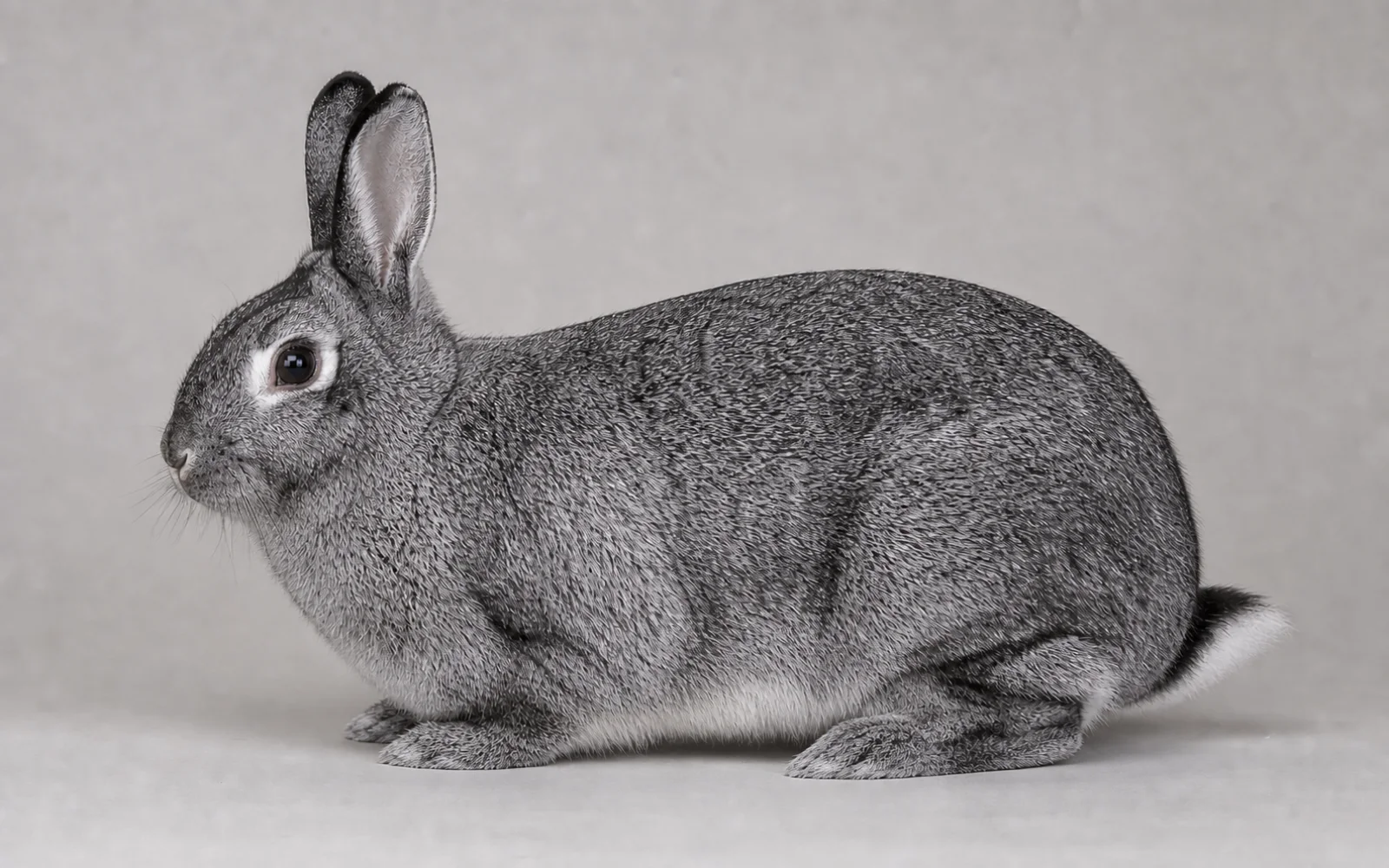
ACRBA describes a medium-length commercial body with rounded hips, filled loin and ribs, slight taper from shoulders and a gradual arc over the hindquarters. Senior bucks are 4.08–4.99 kg and does 4.54–5.44 kg. Erect ears carry dark lacing. The coat’s black, pearl and silver surface depends on layered agouti bands and ticking, with pale belly and eye markings. This labelled AI illustration supports description but cannot prove breed identity or pedigree.
Gentle reputation is not an individual guarantee
The Livestock Conservancy describes the breed as gentle, but a population description cannot guarantee how one rabbit reacts. Assess health, fear, handling history and response to people and other rabbits. Use gradual reward-based habituation and provide room to run, stand, stretch, hide and rest with a compatible companion.
Manage body condition, movement and the coat beneath the ticking
Provide unlimited grass hay and fresh water, suitable leafy greens and measured complete pellets. Use touch to track ribs, spine and hindquarter condition instead of feeding toward a standard maximum. Offer dry, non-slip resting areas and enough space for full movement. Check teeth, nails, feet, hocks, skin, underside and coat; visual silver color does not reveal health.
Show faults are not proven disease predispositions
A breed standard may disqualify poor teeth, feet or condition, but that does not establish a disease unique to American Chinchillas. Monitor appetite, faeces, weight, teeth, breathing, eyes, nose, skin, urine staining and feet. Reduced eating or droppings, abdominal swelling, severe pain, breathing difficulty or lethargy requires prompt assessment by a rabbit-experienced veterinarian.
Measure outcomes instead of publishing fixed production claims
Verify pedigree and use the current standard; a chinchilla-colored rabbit is not automatically an American Chinchilla. Record sex-specific mature weight, condition, commercial structure, movement, coat ring and ticking, teeth, feet, illness, matings, kindlings, kit survival and doe recovery. A peer-reviewed crossbreeding experiment found growth and carcass outcomes varied with genetic type and cross under its conditions; it does not justify a universal 60% yield, 12-week slaughter age or nine-kit litter.
- Keep the 1924 standards-book and 1925 Convention records separate.
- Use sex-specific adult ranges instead of one invented target weight.
- Do not turn one experiment into a universal yield or litter promise.
Frequently asked questions
How much does an American Chinchilla weigh?
ACRBA lists senior bucks at 9–11 lb (4.08–4.99 kg) and senior does at 10–12 lb (4.54–5.44 kg).
Was the American Chinchilla recognized in 1924 or 1925?
The Livestock Conservancy records standards-book adoption in 1924; ACRBA records presentation of the heavyweight standard at the 1925 Colorado Convention.
Is every chinchilla-colored rabbit this breed?
No. Coat color alone cannot distinguish American Chinchilla from other chinchilla breeds or crosses; pedigree and standard evaluation are needed.
Does the breed guarantee fast meat production?
No. Growth and carcass outcomes depend on genetics, line, feeding, health, age and the production system.
- Breed standardAmerican Rabbit Breeders Association — American Chinchilla
- Breed standardAmerican Chinchilla Rabbit Breeders Association — Breed History
- Breed standardAmerican Chinchilla Rabbit Breeders Association — Commercial Qualities
- Breed standardThe Livestock Conservancy — American Chinchilla Rabbit
- Peer reviewedWorld Rabbit Science — Genetic effects on rabbit growth and carcass traits (2011)
- VeterinaryMSD Veterinary Manual — Noninfectious Diseases of Rabbits
- Animal welfareRSPCA — What should I feed my rabbits?
- Animal welfareRSPCA — How to keep rabbits healthy
- Animal welfareRSPCA — The ideal home for rabbits
- VeterinaryMSD Veterinary Manual — Management of Rabbits
- VeterinaryMSD Veterinary Manual — Nutrition of Rabbits
- VeterinaryMSD Veterinary Manual — Routine Health Care of Rabbits
This profile does not diagnose an animal or replace the current ARBA/ACRBA standard. Ask a rabbit-experienced veterinarian about health, feeding or breeding.