An old European name and a modern Canadian population
AABRC says the older breed appeared in late-1800s France, disappeared and was recreated by H.D.H. Dowle in Britain from 1939 to 1941. North America’s present line began accidentally in 2005 when Ed White found a chocolate male in a Canadian Champagne d’Argent litter and later more chocolate kits. Canada accepted the breed in 2008. Charmaine Wardrop obtained an ARBA Certificate of Development in 2009, completed the third presentation in 2015 and secured official recognition on 1 February 2016.
Commercial body under an even silvered chocolate coat
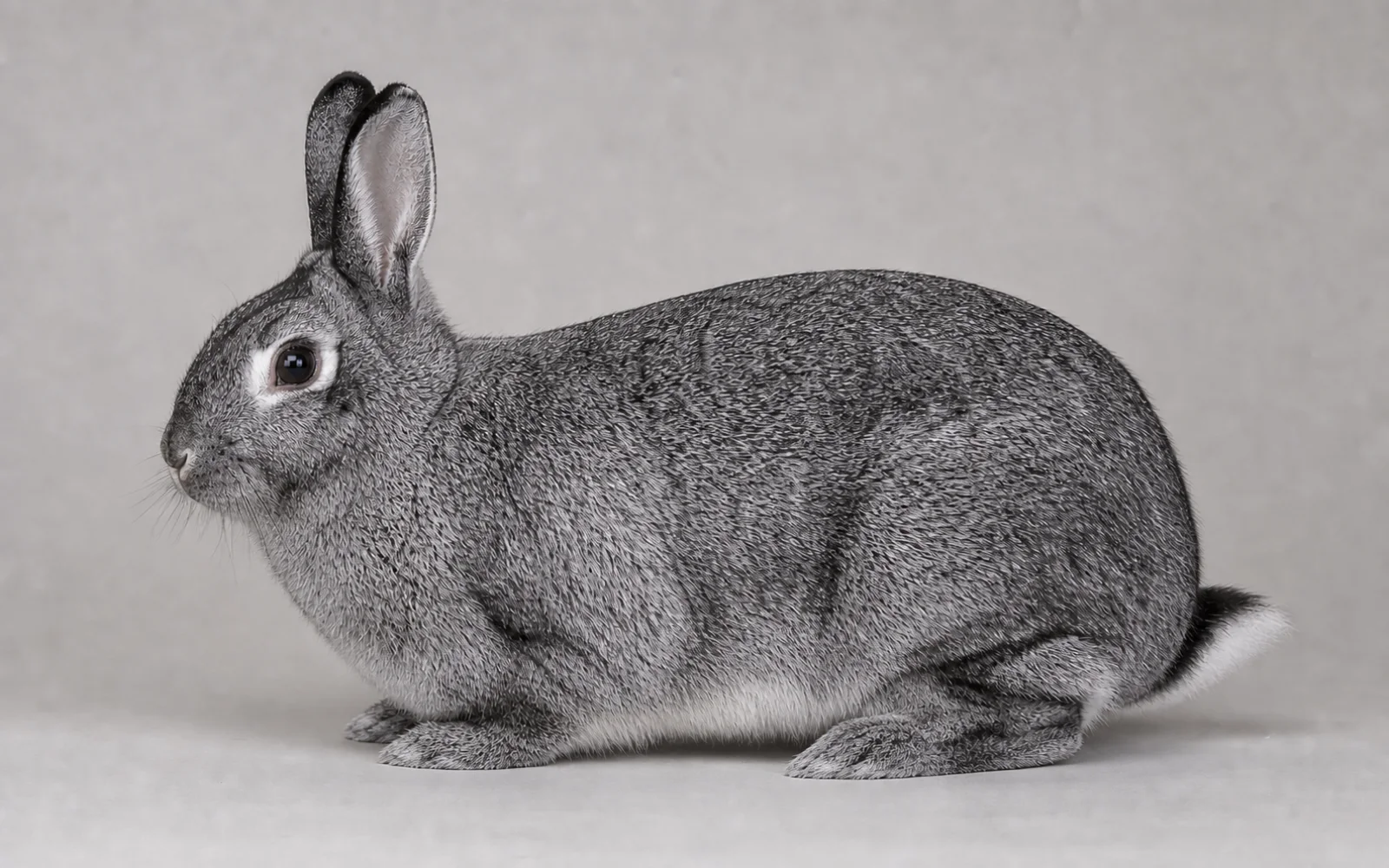
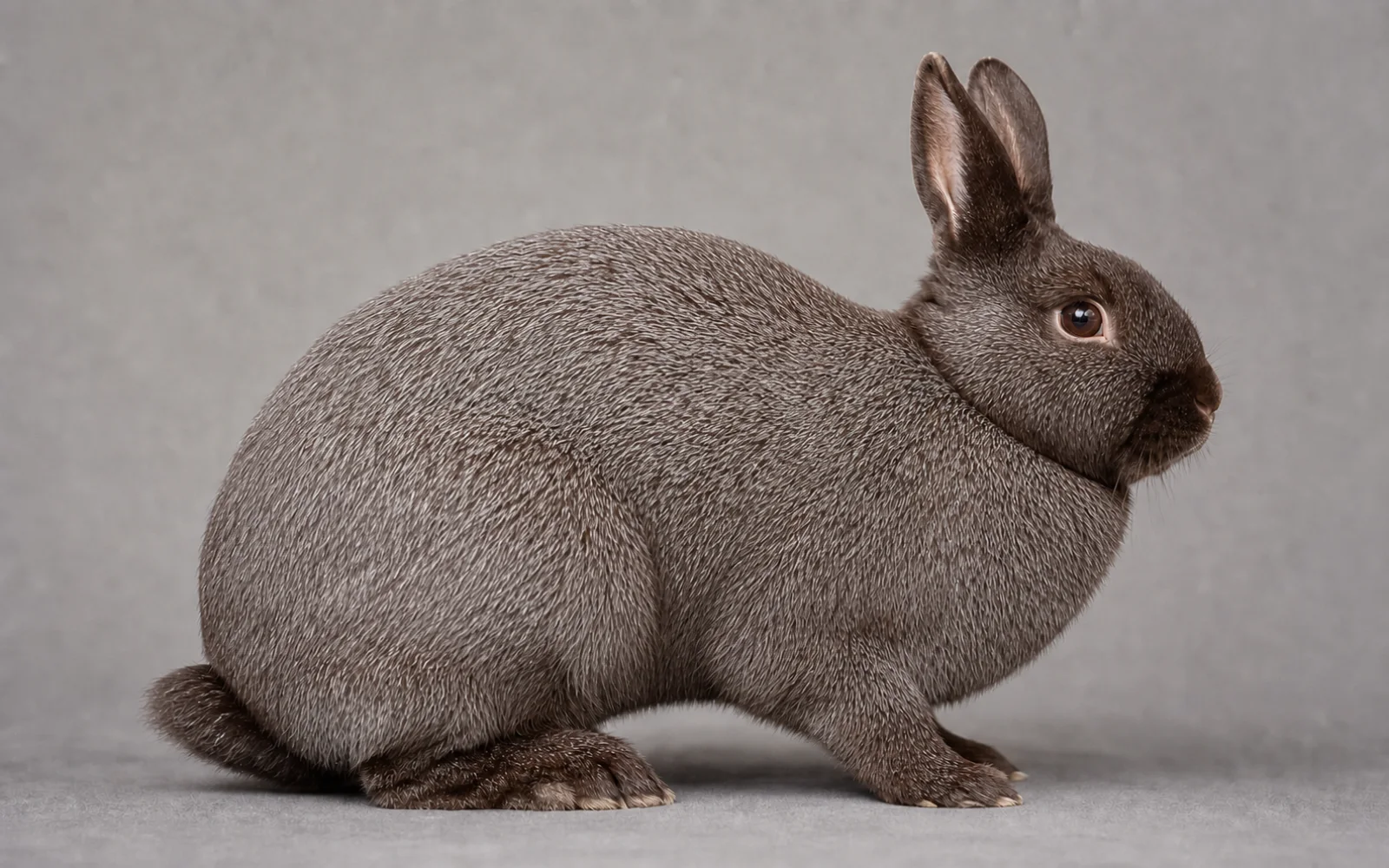
The club-hosted standard calls for moderate body length, deep shoulders and hindquarters, a well-arched back highest over the centre and hindquarters slightly wider than the shoulders. Ideal adults are 4.08 kg bucks and 4.54 kg does, with a 4.76 kg maximum. The surface should be evenly frosted chocolate, with longer dark-brown guard hairs, rich chocolate to the skin, dark-brown eyes and slightly darker muzzle, ears and feet. This labelled AI illustration is descriptive, not pedigree evidence.
A friendly reputation depends on the individual
The club and Livestock Conservancy describe a friendly or docile reputation, especially with early handling, but this cannot guarantee every rabbit’s response. Assess pain, fear and history; habituate with rewards and support the body securely. Provide room to run, stand, stretch, hide and rest with a compatible companion.
Keep the dense flyback coat dry and inspect beneath it
The standard describes dense, medium-length flyback fur. Keep resting areas dry, remove loose hair during moulting and inspect skin, underside, feet and hocks; wet or dirty fur is a husbandry warning, not a normal breed trait. Offer unlimited grass hay and fresh water, suitable leafy greens and measured complete pellets. Track ribs, spine and hindquarters by touch rather than feeding toward the maximum.
Show faults do not prove breed-specific disease
Poor teeth, feet, condition or coat can be faults in evaluation without being unique Argente Brun disorders. Monitor appetite, faeces, weight, teeth, breathing, eyes, nose, skin, urine staining and feet. Reduced eating or droppings, abdominal swelling, severe pain, breathing difficulty or lethargy requires prompt assessment by a rabbit-experienced veterinarian.
Select even silvering without replacing health records
Verify pedigree because a chocolate or silvered rabbit is not automatically Argente Brun. Record mature sex-specific weight, body structure and firmness, coat undercolor, even frosting and guard hairs, teeth, feet, illness, behaviour, matings, kindlings, kit survival and doe recovery. Use relatedness records in this reconstructed population. The standard does not guarantee seven kits, 14-week slaughter, 58% yield or one doe-to-buck ratio.
- Keep the old European history distinct from the 2005 Canadian line.
- Use the 4.08/4.54 kg ideals and 4.76 kg maximum in context.
- Select color, body, health and genetic diversity together.
Frequently asked questions
How much does an Argente Brun weigh?
The club-hosted Dominion standard gives 4.08 kg ideal for senior bucks, 4.54 kg for senior does and 4.76 kg maximum.
When did ARBA recognize the Argente Brun?
The third presentation passed in 2015, and official ARBA recognition took effect on 1 February 2016.
What color is an Argente Brun?
It has rich chocolate undercolor with even silver frosting and longer dark-brown guard hairs.
Is the database Champagne d’Argent photo correct?
No. Its source identifies Champagne d’Argent kits, so this page replaces it with a clearly labelled reference illustration.
- Breed standardAmerican Rabbit Breeders Association — Argente Brun
- Breed standardAmerican Argente Brun Rabbit Club — Rediscovering an Ancient Treasure
- Breed standardAmerican Argente Brun Rabbit Club — Argente Brun Dominion Standard
- Breed standardThe Livestock Conservancy — Argente Brun Rabbit
- VeterinaryMSD Veterinary Manual — Noninfectious Diseases of Rabbits
- Animal welfareRSPCA — What should I feed my rabbits?
- Animal welfareRSPCA — How to keep rabbits healthy
- Animal welfareRSPCA — The ideal home for rabbits
- VeterinaryMSD Veterinary Manual — Management of Rabbits
- VeterinaryMSD Veterinary Manual — Nutrition of Rabbits
- VeterinaryMSD Veterinary Manual — Routine Health Care of Rabbits
This profile does not diagnose an animal or replace the current ARBA standard. Confirm show requirements with ARBA/AABRC and health decisions with a rabbit-experienced veterinarian.