Wilhelm Mucke’s Vienna project, first shown in 1907
Arche Austria credits railway employee Wilhelm Mucke of Vienna with creating the White Vienna and records its first exhibition in 1907. His objective was a medium-sized, blue-eyed white rabbit aligned with the useful Vienna type. The conservation account names Dutch rabbits, White Giants and White Lops among the source stock. That is more specific and materially different from the database’s simple Blue Vienna × Dutch claim, for which the reviewed standard sources provide no support. Later selection made the population lighter and finer than the White New Zealand. National naming and details can vary, so the relevant local standard—not the breed name alone—governs exhibition and registration.
Blue eyes, pure white coat and a 4–5 kg ideal
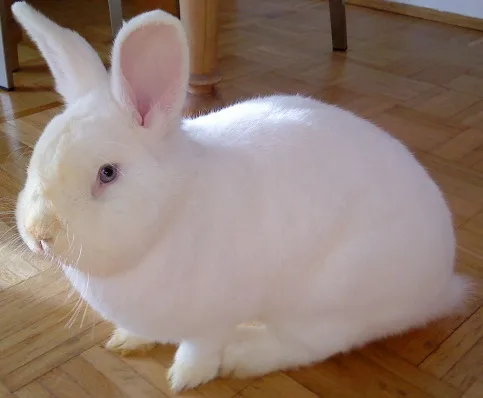
The ZDRK-derived 2018 standard card sets 3.5 kg as the minimum and 4.0–5.0 kg as ideal. It describes a lightly elongated, cylindrical body of even breadth with a rounded rear, dense undercoat, medium-length hair, a short broad head and 10.5–12 cm ears. Top and undercolor should be pure glossy white; eyes are blue. Arche Austria classifies this as leucistic, not the red-eyed albino phenotype. Peer-reviewed Vienna-locus work explains a recessive blue-eyed-white mechanism in another rabbit population, but does not let a photograph prove Vienna White pedigree or the exact molecular state of this individual breed.
Eye color does not determine temperament
No cited breed standard or controlled behavioral trial establishes one universal Vienna White personality. Calmness, fear and handling tolerance vary with pain, hormones, housing, learning and social history. Give predictable routines, secure hides, forage opportunities, a compatible rabbit companion and enough connected space for several hops, running, upright standing, stretching and retreat. Work at floor level and reward voluntary contact. When lifting is necessary, support the chest and entire hindquarters; never lift by ears or loose skin. Treat a sudden behavioral change as a possible health signal.
White fur makes dirt visible, not care optional
Provide permanently connected living and exercise areas with dry, stable, non-slip flooring, comfortable rest surfaces, shade and shelters. Feed unlimited grass hay and constant fresh water, appropriate leafy greens and a measured complete pellet adjusted to age, body condition and reproduction. Brush gently during moults and inspect the white coat, tail underside and feet; yellowing may reveal urine or dampness rather than a color fault. Track appetite, feces, weight, movement, teeth, nails, skin and soles. Blue eyes do not justify keeping the rabbit in darkness, but all rabbits need protection from heat and intense direct sun.
Blue-eyed white is a color phenotype, not a diagnosis
The reviewed evidence does not show a disease unique to every Vienna White, nor does it support declaring every blue-eyed white rabbit deaf, visually impaired or unusually healthy. The Vienna-locus study concerns inheritance of color, not a clinical certificate for this breed. Reduced eating or feces, drooling, weight loss, diarrhea, swelling, breathing difficulty, head tilt, eye discharge, urine scald, sore feet, pain or lethargy need prompt rabbit-experienced veterinary assessment. Quarantine new animals, document examinations and select sound eyes, teeth, feet and movement rather than color alone.
Preserve type and blue-eyed white identity with records
Use the current standard of the registry where the rabbits will be shown or sold. Record pedigree, mature weight, cylindrical type, ears, coat density, white top and undercolor, blue eyes, bite, feet, body condition, veterinary findings, matings, births, losses, growth and doe recovery. Do not classify a red-eyed albino White Giant, New Zealand White or an unpedigreed blue-eyed white cross as Vienna White by appearance. Color inheritance can help plan matings, but the cited locus study does not replace pedigree or testing. The database’s fixed litter, growth, yield and one-buck-to-eight-does figures lack a controlled breed basis and should remain individual-farm metrics.
- Verify pedigree and use the current national Vienna White standard.
- Record blue eyes, pure-white undercolor, type, weight and functional health.
- Measure every mating and outcome instead of promising fixed production.
Frequently asked questions
Are Vienna White rabbits albino?
Arche Austria describes the blue-eyed white phenotype as leucistic, distinct from the red-eyed albino phenotype of breeds such as White Giant.
How much does a Vienna White rabbit weigh?
The reviewed ZDRK-derived standard gives a 3.5 kg minimum and an ideal range of 4.0–5.0 kg.
Who developed the Vienna White?
Arche Austria credits Vienna railway employee Wilhelm Mucke and records the breed’s first exhibition in 1907.
Does a white rabbit with blue eyes prove the breed?
No. The phenotype occurs through a color pathway, but pedigree and the applicable standard are needed to identify Vienna White stock.
- Breed standardArche Austria — Weißer Wiener
- Breed standardZDRK Standard 2018 breed card — Weiße Wiener
- Peer reviewedHereditas — Genetic analysis of the blue-eyed white phenotype at the Vienna locus
- Peer reviewedApplied Sciences — The Genetic Resources of Domestic Rabbits
- VeterinaryMSD Veterinary Manual — Noninfectious Diseases of Rabbits
- Animal welfareRSPCA — What should I feed my rabbits?
- Animal welfareRSPCA — How to keep rabbits healthy
- Animal welfareRSPCA — The ideal home for rabbits
- VeterinaryMSD Veterinary Manual — Management of Rabbits
- VeterinaryMSD Veterinary Manual — Nutrition of Rabbits
- VeterinaryMSD Veterinary Manual — Routine Health Care of Rabbits
This profile does not replace a current national standard, authenticate breed or genotype from eye and coat color, predict production or diagnose disease. Use verified records and a rabbit-experienced veterinarian.