An English wild-colony find became a sleek running breed
ARBA and the national specialty club trace Tans to a wild rabbit colony in England in the late 1880s. Black was the first color, with Blue developed soon afterward. The first English Tan club formed in 1891. Chocolate appeared around the 1920s—Havana ancestry is suspected but not documented as certainty—and Lilac followed. Early Tans were cobby and Dutch-like. US selection shifted strongly during the 1990s toward the longer-limbed, sleek, medium-fine-boned full-arch animal seen today. The exact Brailsford discovery date sometimes repeated online is not established by the cited official summaries, so it should not be presented as a verified day or single founder.
Four colors, full arch and a verified 5.5 lb ceiling
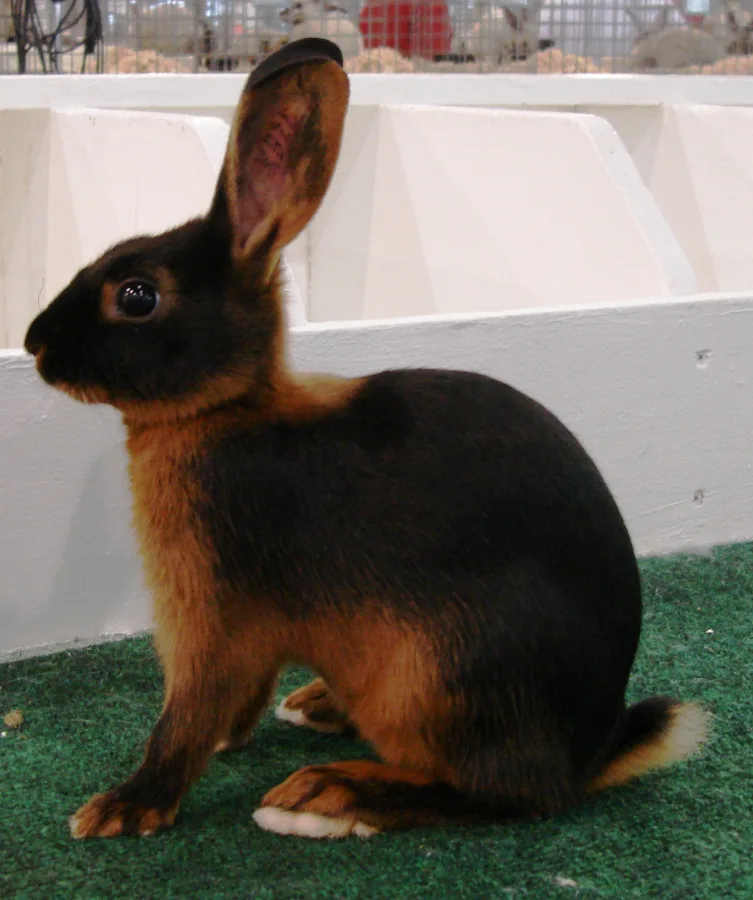
The January 2026 Breed ID Guide lists Black, Blue, Chocolate and Lilac as both showroom and registration varieties, judged in four classes. ARBA gives a 5.5 lb (2.49 kg) maximum. The specialty club describes a shorter full-arch running breed assessed while moving freely, with medium-fine bone, long clean limbs and sleek lustrous normal fur. The upper surface carries the named base color while contrasting tan markings occupy the belly and lower pattern areas. The club identifies Blue as dilute Black and Lilac as dilute Chocolate. OSU genetics describes tan-pattern ASIP aᵗ and dilution, but visual color cannot certify genotype, pedigree or breed identity.
Active breed reputation is not an individual guarantee
The breed club describes Tans as active and high-energy, but its promotional claims of friendliness and intelligence are not controlled behavioral evidence. Assess the individual rabbit’s pain, fear, hormones, handling history and responses. Give a full-arch runner permanent room to make several hops, sprint, turn, stand upright, explore, forage, hide and withdraw, plus compatible rabbit companionship. Work at floor level with reward-based habituation. Do not force cuddling or lift by the ears or skin; support the chest and entire hindquarters.
Small body size does not justify small housing
ARBA places Tan among breeds requiring species- and weight-appropriate housing, while welfare guidance requires an attached exercise area and enough room for normal movement. Use dry, stable, non-slip flooring with comfortable resting surfaces and shelters. Feed unlimited grass hay, constant fresh water, suitable leafy greens and a measured complete pellet adjusted to age and body condition. The sleek coat usually needs light grooming, especially during moults, but still inspect skin, feet, nails, teeth, eyes and the tan belly. Record weight, appetite, feces and movement instead of assuming an athletic-looking rabbit is fit.
Tan-pattern genes are not a health certificate
The reviewed sources do not establish a disease unique to the Tan breed or its four recognized colors. Coat-color genetics explains pigment distribution, not immunity, athletic capacity or temperament. Watch for reduced eating or feces, drooling, weight change, diarrhea, swelling, breathing difficulty, head tilt, urine scald, sore hocks, abnormal posture, pain or lethargy and seek prompt rabbit-experienced veterinary care. Slick fur can make body condition look deceptive, so use hands-on scoring and regular weighing. Quarantine new arrivals and document recurring disease and treatment outcomes.
Select movement, sound structure and complete pattern together
Use the current ARBA Standard of Perfection and verified pedigrees. Record Black, Blue, Chocolate or Lilac identity, mature weight under the 5.5 lb ceiling, full-arch profile, movement, bone, feet, bite, coat quality, base-color depth, tan-pattern placement, eye color, health examinations, matings, every birth and loss, growth and doe recovery. The club says all four varieties may be crossed without producing an unrecognized Tan color, but breeders often manage black/blue and chocolate/lilac families; treat that as a color-planning framework, not permission to ignore line health. A club-observed four-to-six-kit range is not a guaranteed litter size.
- Record exact variety, pedigree, adult weight, movement and markings.
- Select sound feet, bite and body function as well as color contrast.
- Track every birth, loss, growth result and the doe’s recovery.
Frequently asked questions
How much can a Tan rabbit weigh?
ARBA’s public breed profile sets the maximum at 5.5 lb, about 2.49 kg. Use the current Standard of Perfection for exact age and show-class requirements.
Which Tan rabbit colors does ARBA recognize?
The January 2026 guide lists Black, Blue, Chocolate and Lilac for both exhibition and registration.
Is every black-and-tan rabbit a Tan breed?
No. Tan pattern occurs in multiple breeds and mixed rabbits. Breed identity requires type, size, markings and documented ancestry, not color alone.
Are Tan rabbits always friendly and easy to handle?
No. The club describes an active breed, but individual behavior varies with health, hormones, experience and handling. Evaluate each rabbit and use gradual reward-based habituation.
- Breed standardAmerican Rabbit Breeders Association — Tan
- Breed standardARBA — Breed ID Guide, updated January 2026
- Breed standardAmerican Tan Rabbit Specialty Club — Breed History
- Breed standardAmerican Tan Rabbit Specialty Club — The Four Varieties
- Breed standardAmerican Tan Rabbit Specialty Club — Why Tans?
- UniversityOregon State University Extension — Rabbit coat color genetics summary
- Peer reviewedApplied Sciences — The Genetic Resources of Domestic Rabbits
- Animal welfareARBA — Recommendations for the Care of Rabbits and Cavies
- VeterinaryMSD Veterinary Manual — Noninfectious Diseases of Rabbits
- Animal welfareRSPCA — What should I feed my rabbits?
- Animal welfareRSPCA — How to keep rabbits healthy
- Animal welfareRSPCA — The ideal home for rabbits
- VeterinaryMSD Veterinary Manual — Management of Rabbits
- VeterinaryMSD Veterinary Manual — Nutrition of Rabbits
- VeterinaryMSD Veterinary Manual — Routine Health Care of Rabbits
This profile does not replace the current ARBA Standard of Perfection, authenticate breed or genotype from color, predict behavior or diagnose disease. Use complete records and a rabbit-experienced veterinarian.