The 1913 French original behind three US breeds
An ARBA association account published in 1958 records M. Dybowski exhibiting Chinchilla rabbits in Paris in 1913 and M. W. Meek bringing the first to the United States in 1919. The Livestock Conservancy records the first American Chinchilla Rabbit Association and an ARBA-accepted standard in 1923. Registrations then surged: the historical ARBA account reported about 10,000 Chinchilla rabbits registered in 1928. Larger American and Giant Chinchilla populations were later developed from this foundation. “Granddaddy of all the Chins” is a historical slogan; the secure point is that Standard is the original French-origin breed, not a rodent hybrid.
Compact four-class type, rollback fur and 7.5 lb maximum
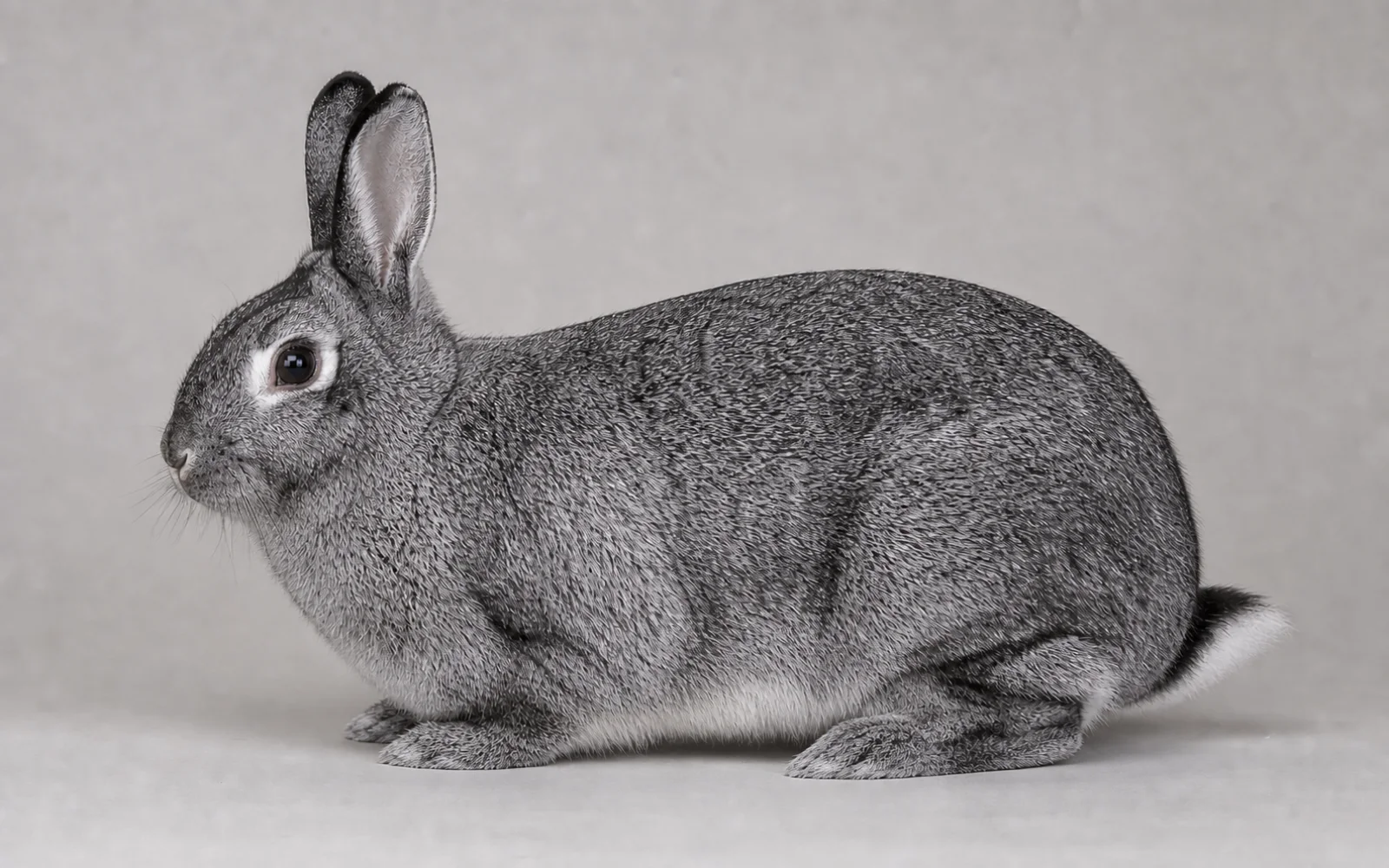
The January 2026 ARBA guide treats Standard Chinchilla as a four-class breed with one Standard exhibition and registration variety. ARBA’s public page sets a maximum of 7.5 lb (3.40 kg), and The Livestock Conservancy gives an adult average of 5–7 lb (2.27–3.18 kg), up to that maximum. Ohio 4-H identifies a compact profile; the dense normal coat rolls back gradually after stroking. Its sparkling gray surface comes from black guard hairs and banded shafts with slate-blue undercolor, a pearl-white intermediate band and dark tips. OSU and reviewed genetics sources place dark chinchilla in the TYR C series; color, a coat “rosette” or this photograph cannot authenticate pedigree.
A friendly reputation is not an individual guarantee
The Livestock Conservancy describes the breed as docile, sweet, friendly, intelligent and curious, but this is a breed profile, not a controlled prediction for every rabbit or proof of suitability for children. Behavior varies with health, hormones, early experience, housing and handling. Provide hiding places, foraging, predictable routines, permanent exercise space and a compatible rabbit companion. Interact at floor level and reward voluntary contact. Never lift by ears or loose skin; support the chest and entire hindquarters. Sudden withdrawal, aggression or reduced activity deserves a health and environment check.
Smaller than other Chinchillas, not a cage-saving exception
Provide connected living and exercise areas that allow several full hops, upright standing, stretching, turning, running, exploration and retreat. Use dry, stable, non-slip flooring and comfortable rest surfaces. Feed unlimited grass hay and constant fresh water, suitable leafy greens and a measured complete pellet adjusted for age, body condition and reproduction. Groom the rollback coat gently during moults and inspect the skin, belly and feet; do not pull healthy guard hairs to inspect color. Track weight and check appetite, feces, teeth, nails, soles, skin, coat and movement. Compact size does not justify reduced space or social isolation.
A pearl band is a pigment trait, not a health certificate
Current genetics links the chinchilla phenotype to pigment-pathway variation, including TYR, and does not establish a Standard Chinchilla-specific disease caused by the show color. That is not proof of special hardiness or freedom from ordinary rabbit illness. Patchy hair loss, scale, wounds, itching or a changing brown/yellow cast should be assessed with moult, diet, skin and health rather than treated only as a show fault. Reduced eating or feces, drooling, weight loss, diarrhea, swelling, breathing difficulty, head tilt, urine scald, sore feet or lethargy need prompt rabbit-experienced veterinary assessment.
Conserve the breed with complete records, not slogans
Use the current ARBA Standard of Perfection and record verified pedigree, mature weight, compact structure, rollback coat, surface color, undercolor and ring definition under consistent light, feet, bite, examinations, matings, every birth and loss, growth and doe recovery. Keep Standard separate from the larger American and Giant Chinchilla and from unrelated rabbits that merely carry chinchilla color. The Livestock Conservancy lists Standard Chinchilla as Threatened in 2026, so avoid bottlenecks and document transfers. A 1958 club advertisement claimed four-pound eight-week fryers and universal gentleness; it is historical promotion, not controlled evidence. Fixed six-kit litters, 56% yield, 14 weeks and a 5–7-month pelt peak are likewise unverified.
- Record pedigree, weight, compact type, ring color and coat response.
- Track health, matings, every birth and loss, growth and doe recovery.
- Keep the breed distinct from larger Chinchillas and color-only lookalikes.
Frequently asked questions
How much does a Standard Chinchilla rabbit weigh?
The Livestock Conservancy gives an adult average of 5–7 lb (2.27–3.18 kg). ARBA’s maximum is 7.5 lb, about 3.40 kg.
When did Standard Chinchilla originate?
M. J. Dybowski first exhibited the French breed in Paris in 1913. It reached the United States in 1919 and gained an accepted US standard in 1923.
Is Standard Chinchilla the same as American Chinchilla?
No. Standard is the smaller compact original. American Chinchilla is a separate, larger commercial breed developed in the United States from Standard stock.
Is a chinchilla-colored rabbit automatically this breed?
No. Many breeds and mixed rabbits can express chinchilla color. Breed identity requires documented ancestry and conformity beyond coat color.
- Breed standardAmerican Rabbit Breeders Association — Standard Chinchilla
- Breed standardARBA Digital Library — American Standard Chinchilla Association history (1958)
- Breed standardThe Livestock Conservancy — Standard Chinchilla Rabbit
- Breed standardThe Livestock Conservancy — 2026 Conservation Priority List
- Breed standardARBA — Breed ID Guide, updated January 2026
- UniversityOhio State University Extension 4-H — Standard Chinchilla breed profile
- UniversityOregon State University Extension — Rabbit coat color genetics summary
- Peer reviewedApplied Sciences — Rabbit genetic resources and coat-color diversity
- Breed standardWikimedia Commons — Documented Standard Chinchilla photograph
- Animal welfareARBA — Recommendations for the Care of Rabbits and Cavies
- VeterinaryMSD Veterinary Manual — Noninfectious Diseases of Rabbits
- Animal welfareRSPCA — What should I feed my rabbits?
- Animal welfareRSPCA — How to keep rabbits healthy
- Animal welfareRSPCA — The ideal home for rabbits
- VeterinaryMSD Veterinary Manual — Management of Rabbits
- VeterinaryMSD Veterinary Manual — Nutrition of Rabbits
- VeterinaryMSD Veterinary Manual — Routine Health Care of Rabbits
This profile does not replace the current ARBA Standard of Perfection, authenticate a rabbit by color, predict genotype or diagnose disease. Use complete records and a rabbit-experienced veterinarian.