A 1948–1963 research program, not a single simple cross
The federal rabbit institute records a small Chinchilla type imported from Germany in 1927 at 2.8–3.2 kg and a larger imported type at 3.8–4.1 kg. Prewar improvement work by B. G. Menshov and A. I. Kaplevsky tested Flandre and White Giant. The definitive Soviet Chinchilla was then built from 1948 to 1963 by the institute, Anisovsky state farm in the Saratov region and Cherepanovsky state farm in the Novosibirsk region under N. S. Zusman, using reproductive and upgrading crosses of small Chinchilla with White Giant plus sustained selection. Approval came in 1963. Calling the breed Ukrainian or reducing the history to French Chinchilla alone is inaccurate.
A 5 kg average with five-zone chinchilla banding
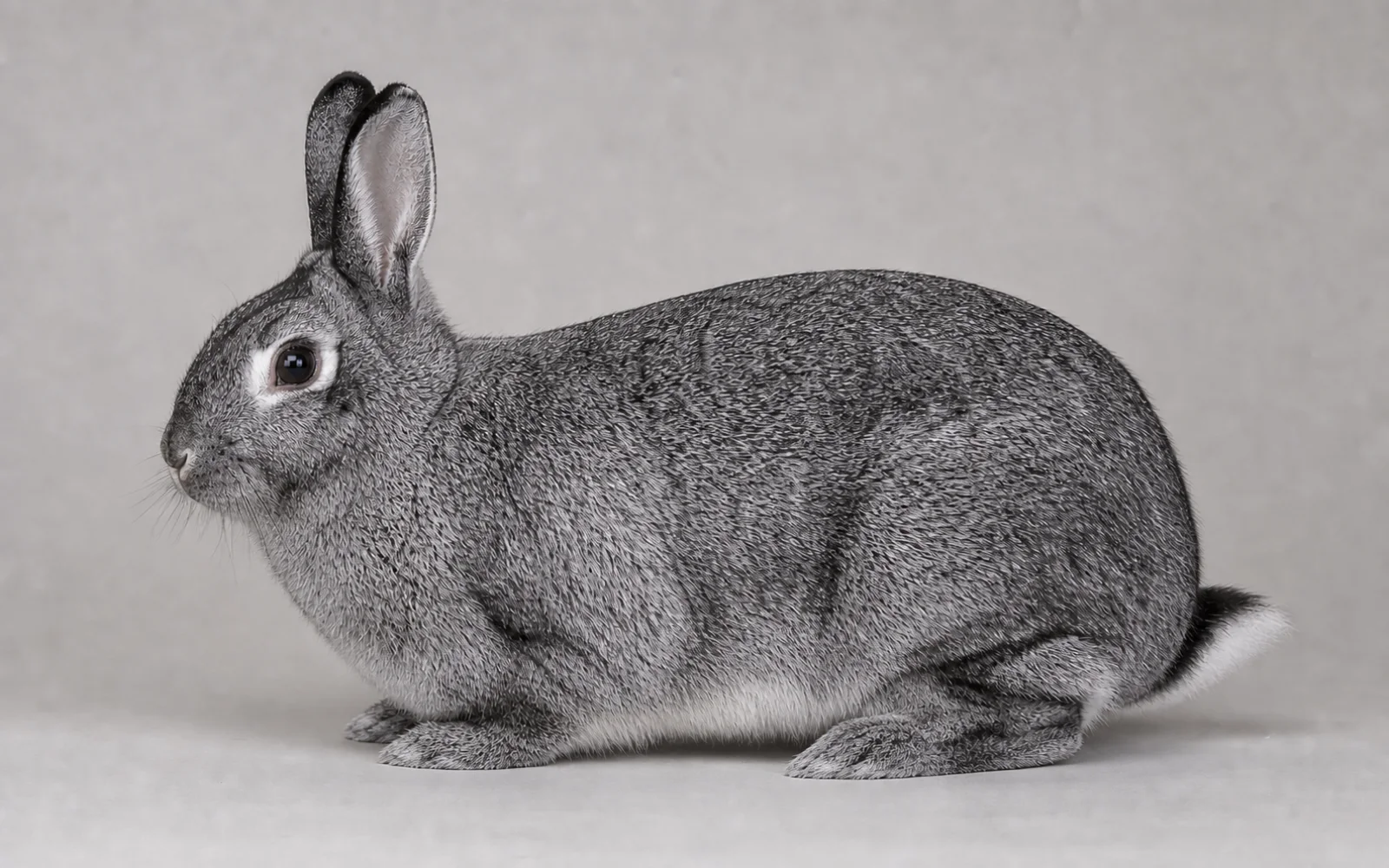
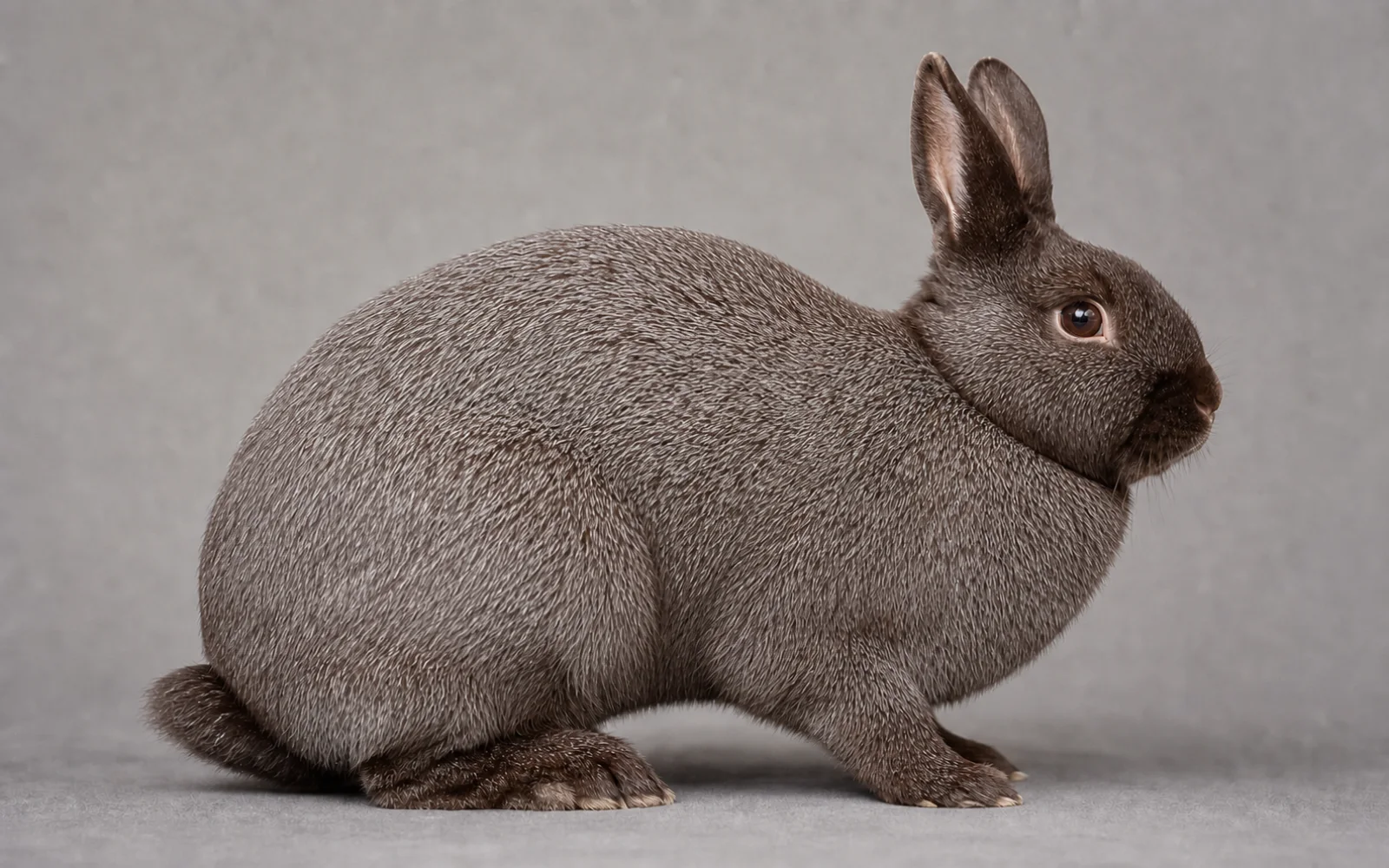
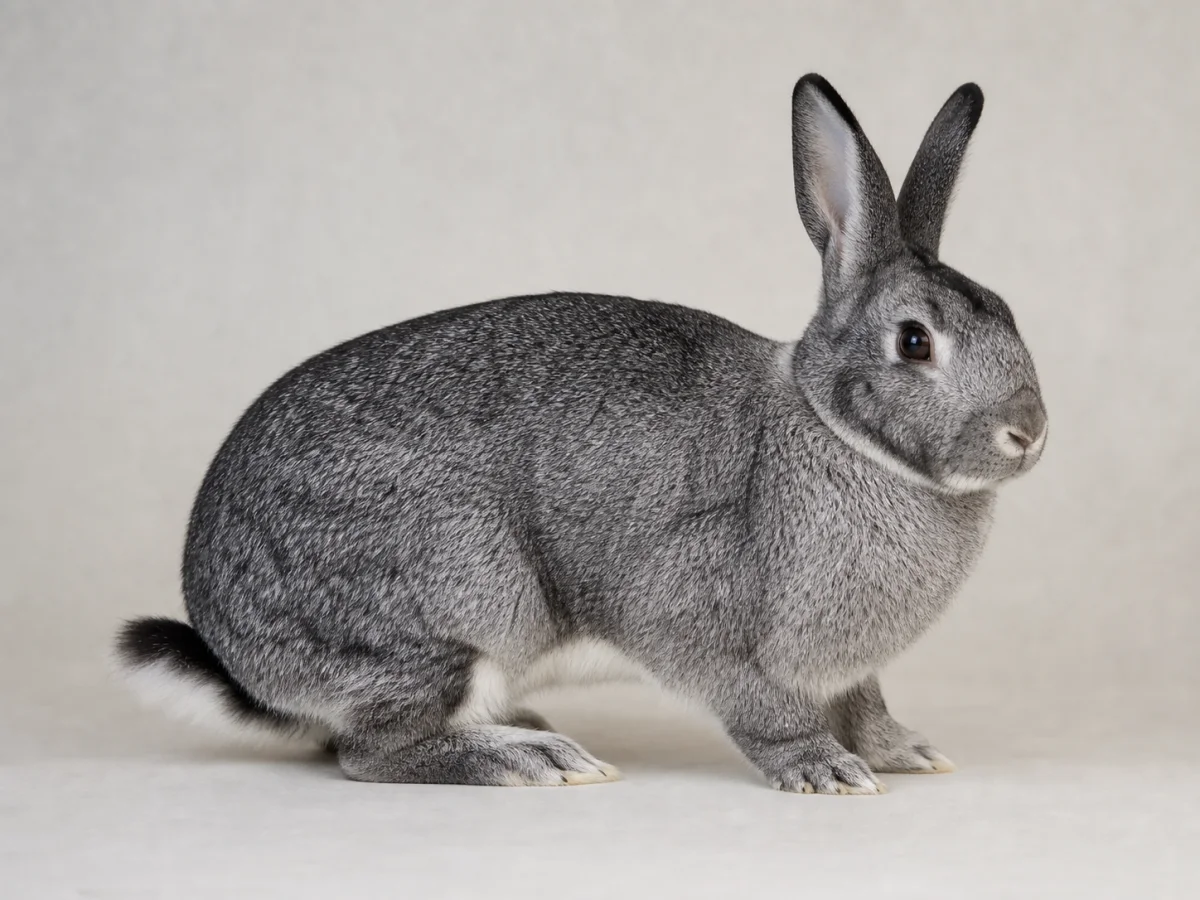
The institute describes a slightly elongated compact body, strong but not massive bone, broad deep chest, straight broad back, rounded wide hindquarters and upright medium ears. The adult average is 5 kg, body length 65 cm and chest girth 35 cm; up to 8 kg is an observed maximum, not an ideal target. Blowing into the back or side coat should reveal five zones: blue at the base, paler, dark, white, then black at the tip. Light, medium and dark shades occur; yellow or brown cast is undesirable. Modern genetics places dark chinchilla in the TYR C series, but the institute’s historic cˢʰⁱ notation is a different convention and should not be translated into a DNA certificate.
Hardiness claims do not guarantee behavior or welfare
The institute calls the population undemanding, hardy and adaptable to varied climates, but that breed-account wording is not a controlled guarantee that every animal is calm, cold-proof or suitable for any housing. Behavior depends on pain, hormones, experience, space and handling. Provide hiding places, foraging, predictable routines, substantial movement and a compatible rabbit partner. Work at floor level and reward voluntary contact. Never lift by ears or skin; support the chest and entire hindquarters. A sudden change in posture, appetite, activity or social response can indicate illness or stress.
Climate adaptation never replaces shelter and sound flooring
Provide permanently connected living and exercise space for several full hops, upright standing, stretching, turning, running, exploration and retreat. Protect from heat, precipitation, drafts, predators and sudden temperature change while maintaining ventilation. Flooring must be dry, stable, non-slip and include comfortable solid resting surfaces; the old instruction that the breed is “adapted to wire floors” is not a welfare exemption. Feed unlimited grass hay and constant fresh water, suitable leafy greens and a measured complete pellet adjusted for age, body condition and reproduction. Track weight, appetite, feces, teeth, nails, soles, skin, coat and movement.
Dense chinchilla fur is not evidence of immunity
Pigment genetics explains coat color, not immunity or disease resistance. A thick coat can conceal weight loss, wounds, parasites, urine scald and skin inflammation, while a heavy body increases the importance of traction, dry bedding and foot inspection. Reduced eating or feces, drooling, diarrhea, abdominal swelling, breathing difficulty, head tilt, sore feet, patchy hair loss or lethargy requires prompt rabbit-experienced veterinary assessment. Use regional vaccination, quarantine and biosecurity. Historic laboratory use and adaptation claims do not make an individual expendable or eliminate modern welfare obligations.
Use records, current welfare and within-herd comparisons
Record verified pedigree, mature weight and body condition, structure, five-zone rosette under consistent light, shade, eye and nail color, feet, bite, veterinary examinations, matings, every birth and loss, growth and doe recovery. The 1988 appraisal standard shows that live weight, conformation, fur density/evenness and color were evaluated together; one trait should not replace the others. Institute figures such as 8.7 young, age-specific growth and 56–58% historical yields describe past populations, not universal outcomes. The current gene-pool study also documents herd decline and variation. Do not prescribe fixed 7–10 kits, a 13-week slaughter age, 60% yield or 42–45-day remating cycle as breed guarantees.
- Record weight, condition, structure, coat rosette and health together.
- Track every mating, birth, loss, growth result and doe recovery.
- Treat historic production figures as population data, not promises.
Frequently asked questions
How much does a Soviet Chinchilla rabbit weigh?
The federal institute reports a 5 kg adult average. It notes exceptional adults up to 8 kg, but that is not a target or a guaranteed 5–7 kg range.
When was the Soviet Chinchilla created?
The definitive coordinated program ran from 1948 to 1963, and the breed was approved in 1963. Earlier improvement experiments began before the war.
Is Soviet Chinchilla the same as Standard Chinchilla?
No. Standard Chinchilla is the smaller French-origin breed. Soviet Chinchilla is a later, larger former-USSR population developed mainly with White Giant.
Can Soviet Chinchillas live on wire floors in cold sheds?
No breed name makes wire flooring or unprotected cold safe. Provide dry solid resting surfaces, traction, weather protection, ventilation and individual monitoring.
- Breed standardFederal Research Institute of Fur-Bearing Animal and Rabbit Breeding — Soviet Chinchilla
- Peer reviewedRabbit Breeding and Fur Farming — The rabbit gene pool of Russia (2020)
- GovernmentUSSR Agricultural Standard OST 10 114-88 — Rabbit breeding appraisal requirements
- UniversityOregon State University Extension — Rabbit coat color genetics summary
- Peer reviewedApplied Sciences — Rabbit genetic resources and coat-color diversity
- Animal welfareARBA — Recommendations for the Care of Rabbits and Cavies
- VeterinaryMSD Veterinary Manual — Noninfectious Diseases of Rabbits
- Animal welfareRSPCA — What should I feed my rabbits?
- Animal welfareRSPCA — How to keep rabbits healthy
- Animal welfareRSPCA — The ideal home for rabbits
- VeterinaryMSD Veterinary Manual — Management of Rabbits
- VeterinaryMSD Veterinary Manual — Nutrition of Rabbits
- VeterinaryMSD Veterinary Manual — Routine Health Care of Rabbits
This historical and husbandry profile does not replace an applicable national breeding standard, prove pedigree, guarantee production or diagnose disease. Use complete records and a rabbit-experienced veterinarian.