A Chinchilla-project sport became its own US breed
ARBA reports that US Chinchilla breeders introduced black-and-tan genetics and found unusual black young in litters during the early 1920s. The Livestock Conservancy dates the origin to 1921. Rather than discard the sports, breeders selected their contrasting markings as a new population. A working standard for Black and Chocolate was accepted in 1927, with Blue and Sable added in 1933. The name refers to the visual resemblance of the patterned fur to wild marten, not to a rabbit–marten hybrid. The Livestock Conservancy’s current 2026 list places the breed in Recovering.
Five varieties, four classes and a 9.5 lb maximum
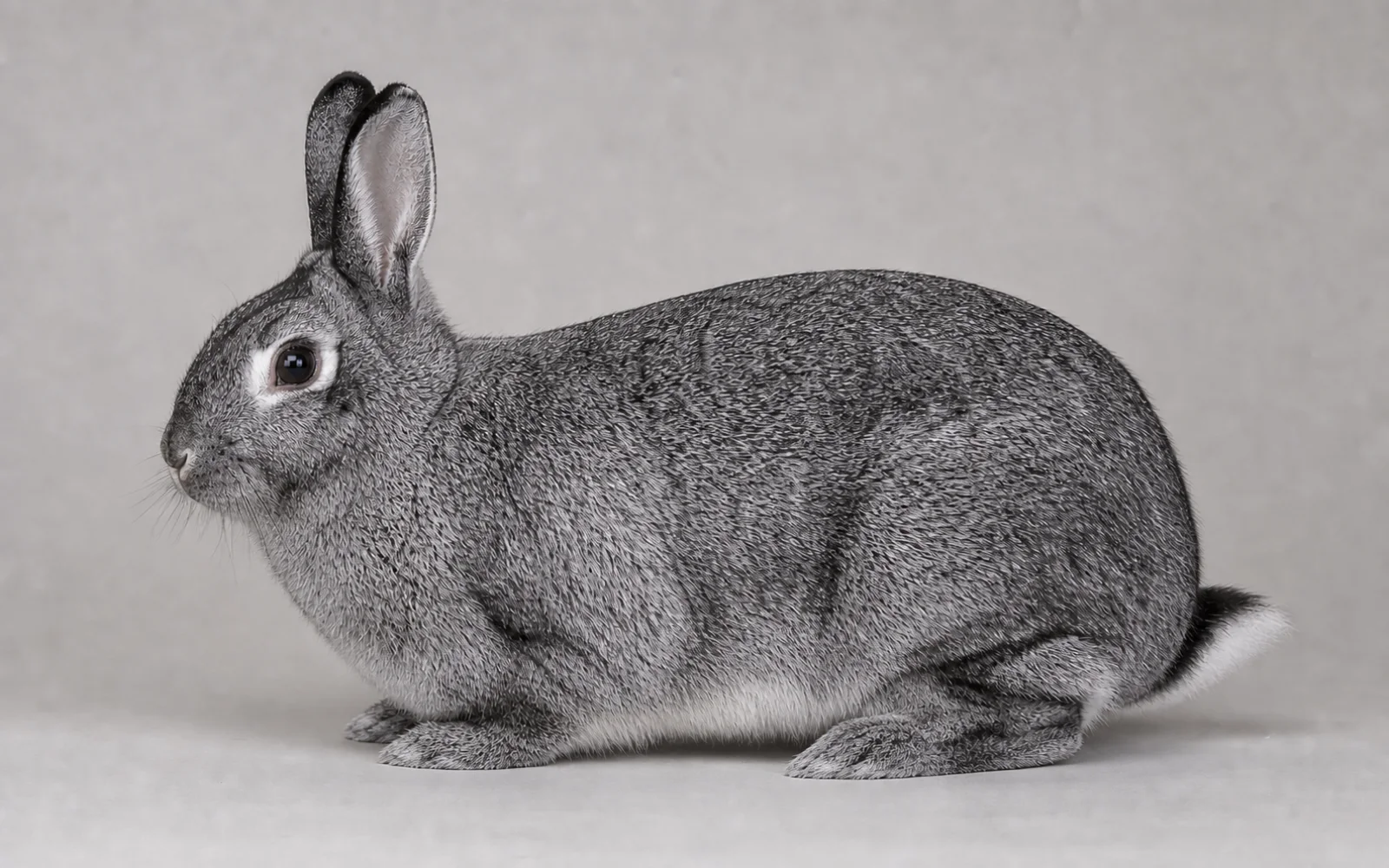
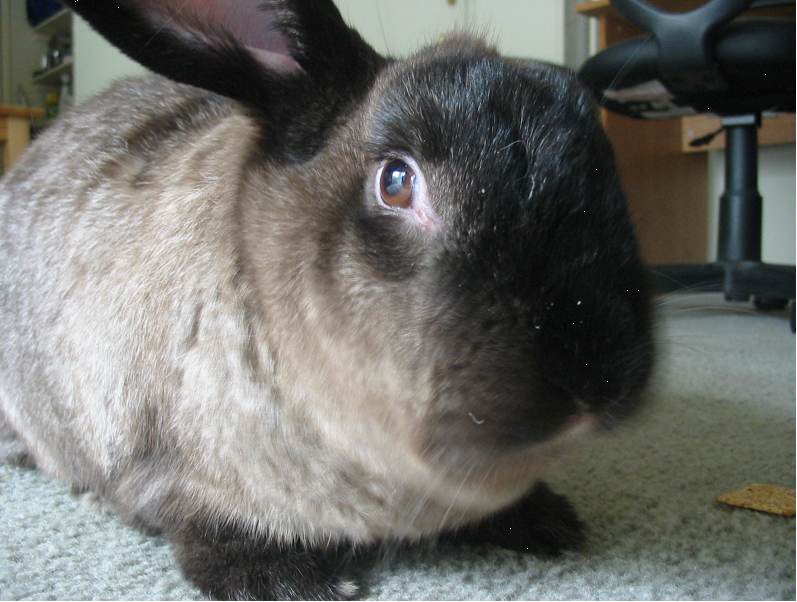
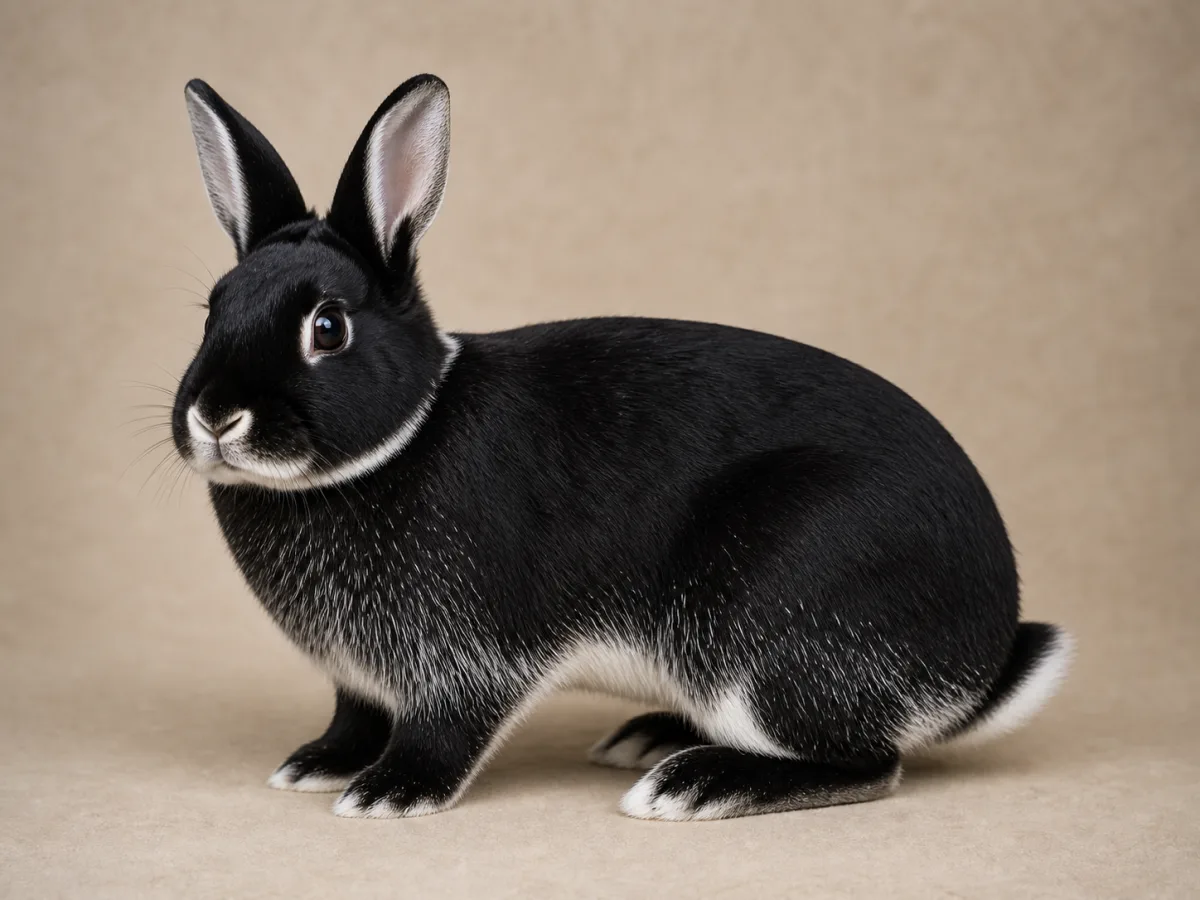
The January 2026 ARBA guide lists Black, Blue, Chocolate, Lilac and Sable for exhibition and registration. This newer document supersedes public summaries that still mention only four. Silver Marten is four-class; adults are 6–9.5 lb (2.72–4.31 kg), and ARBA sets 9.5 lb as the maximum. The colored upper surface contrasts with pale eye circles, chin, belly, underside of tail, inner ears and nostril markings; silver-tipped hairs rise along the lower sides. University and reviewed genetics sources explain black-and-tan patterning through ASIP aᵗ and chinchilla color restriction through TYR alleles, but phenotype alone cannot prove exact genotype or pedigree.
No coat pattern guarantees a calm personality
No cited standard or controlled behavioral study proves that every Silver Marten is calm, playful, friendly or suitable for children. Behavior varies with health, hormones, early handling, housing and learning. Provide secure hiding places, foraging, predictable routines, substantial exercise room and a compatible rabbit companion. Interact at floor level, use rewards and allow retreat. Never lift by ears or loose skin; support the chest and entire hindquarters. A sudden change in activity, posture, appetite or sociability should trigger a health and environment check.
A medium breed still needs permanent exercise space
Provide connected living and exercise areas that permit several full hops, upright standing, stretching, turning, running, exploration and withdrawal. Use dry, stable, non-slip flooring and comfortable rest surfaces. Feed unlimited grass hay and constant fresh water, suitable leafy greens and a measured complete pellet adjusted for age, body condition and reproduction. Groom the flyback coat gently during moults and inspect the pale belly, chin and lower sides rather than assuming every light patch is normal pattern. Track weight and check appetite, feces, teeth, nails, soles, skin, coat and movement.
Color genetics are not a diagnosis or health certificate
The cited genetics sources describe pigment pathways; they do not establish a Silver Marten-specific disease caused by the standard pattern. Nor does the absence of a proven color-linked disorder demonstrate special hardiness. Patchy hair loss, scale, wounds, intense itching or a new color change require examination rather than being dismissed as markings. Reduced eating or feces, drooling, weight loss, diarrhea, swelling, breathing difficulty, head tilt, urine scald, sore feet or lethargy need prompt rabbit-experienced veterinary assessment. Use quarantine and complete health records in a recovering population.
Record the exact variety and complete pattern, not averages
Use the current ARBA standard and record exact Black, Blue, Chocolate, Lilac or Sable identity, pedigree, mature weight, four-class body type, eye color, placement of pale markings and silver-tipped hairs, flyback coat, feet, bite, examinations, matings, every birth and loss, growth and doe recovery. Keep color records across generations; genetic notation is a prediction framework, not a substitute for phenotype, pedigree or laboratory validation. Separate the Silver Marten breed from the same named color in Netherland Dwarf, Mini Rex and Mini Satin. The cited sources do not validate fixed five-kit litters, 55% yield, 14-week processing or universal temperament.
- Record exact variety, pedigree, mature weight and full marking placement.
- Track health, examinations, every birth, loss and doe recovery.
- Do not confuse the breed with the Silver Marten color in other breeds.
Frequently asked questions
How much does a Silver Marten rabbit weigh?
The adult range is 6–9.5 lb, about 2.72–4.31 kg. ARBA publishes a 9.5 lb maximum.
Which Silver Marten colors are recognized?
The January 2026 ARBA guide lists Black, Blue, Chocolate, Lilac and Sable—five varieties.
Is Silver Marten a breed or a color?
Both terms exist. Silver Marten is a distinct breed, and its pattern was later introduced into breeds such as Netherland Dwarf, Mini Rex and Mini Satin.
Is Silver Marten the same as Silver Fox?
No. Silver Fox is larger and has long stand-up fur with broad silvering. Silver Marten has flyback fur and a defined light underside and point pattern.
- Breed standardAmerican Rabbit Breeders Association — Silver Marten
- Breed standardARBA — Breed ID Guide, updated January 2026
- Breed standardThe Livestock Conservancy — Silver Marten Rabbit
- Breed standardThe Livestock Conservancy — 2026 Conservation Priority List
- UniversityOregon State University Extension — Rabbit coat color genetics summary
- Peer reviewedApplied Sciences — The Genetic Resources of Domestic Rabbits
- Animal welfareARBA — Recommendations for the Care of Rabbits and Cavies
- VeterinaryMSD Veterinary Manual — Noninfectious Diseases of Rabbits
- Animal welfareRSPCA — What should I feed my rabbits?
- Animal welfareRSPCA — How to keep rabbits healthy
- Animal welfareRSPCA — The ideal home for rabbits
- VeterinaryMSD Veterinary Manual — Management of Rabbits
- VeterinaryMSD Veterinary Manual — Nutrition of Rabbits
- VeterinaryMSD Veterinary Manual — Routine Health Care of Rabbits
This profile does not replace the current ARBA Standard of Perfection, authenticate a rabbit by color, predict genotype or diagnose disease. Use complete records and a rabbit-experienced veterinarian.