
A sixteenth-century record with legends kept separate from facts
ARBA and the National Silver Rabbit Club describe Silver as one of the oldest recorded domestic breeds and place it in England by at least the 1500s. The Raleigh-from-Portugal and sailor-from-Siam stories are presented by those sources as legend or possibility, not documentary proof, so they cannot establish ancestry or a precise 1592 arrival. US timing is also inconsistent: the club says Silver was among breeds recognized by the National Pet Stock Association when it formed in 1910; ARBA says the breed reached America and was accepted around 1920. This profile preserves the uncertainty rather than combining both into a false exact date.
Four-class type, 4–7 lb and only Black, Brown or Fawn
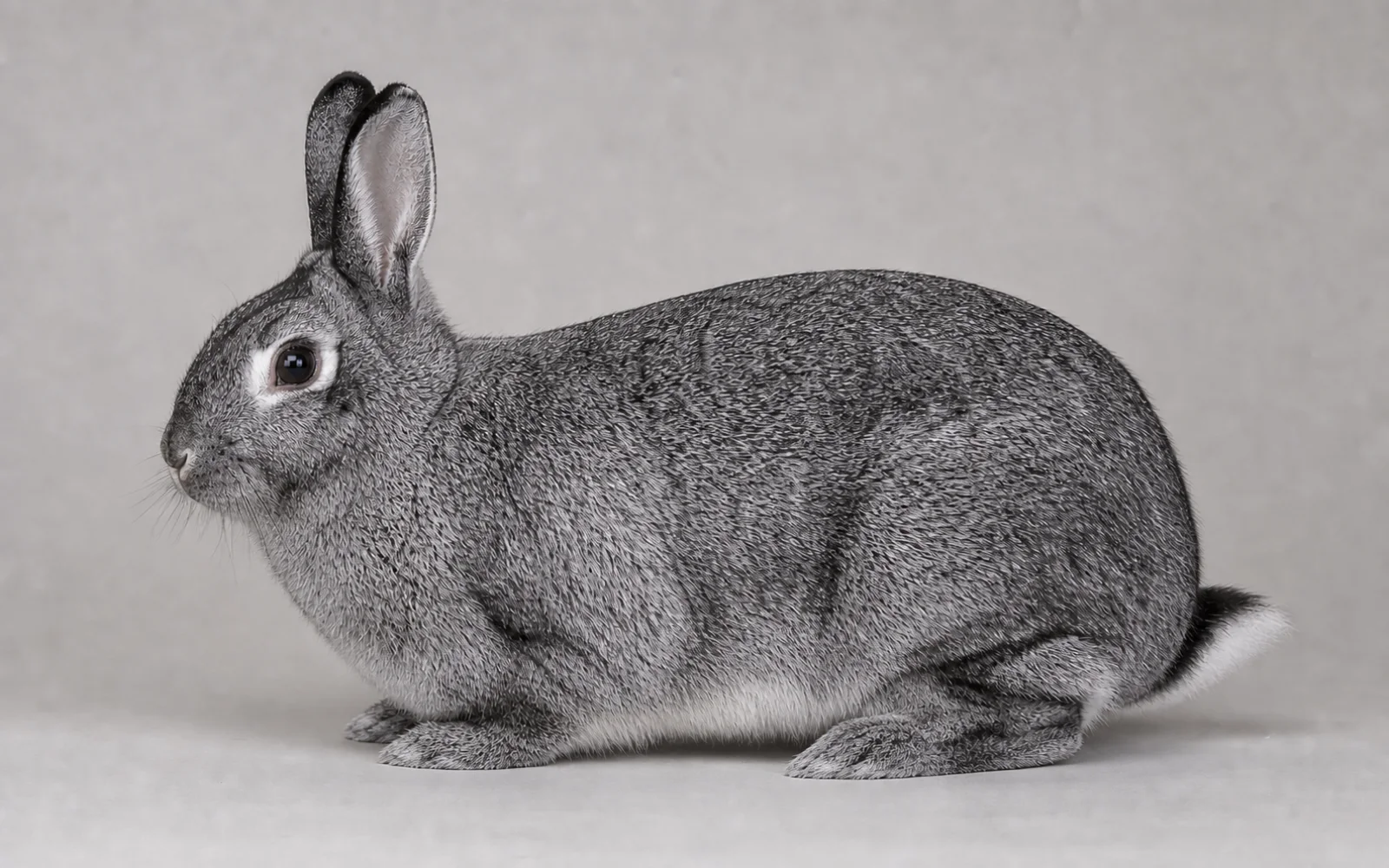
The January 2026 ARBA guide treats Silver as a four-class breed with Black, Brown and Fawn showroom and registration varieties. ARBA publishes a 7 lb (3.18 kg) maximum, while the specialty club gives an allowed adult range of 4–7 lb (1.81–3.18 kg) and says most adults are 4.5–6 lb. The short coat should have quick flyback, with silver-white hairs or tips distributed through the colored portion. Kits are born solid and silvering develops with age; no cited standard validates one universal completion month. Genomic research expects recessive si inheritance but has not identified the causal mutation. Visual silvering alone cannot authenticate this breed.
An active breed description is not a universal temperament
The specialty club describes Silver as active and athletic, but no controlled study proves that every individual has the same energy, friendliness or suitability for children. Provide secure room to run, hiding places, foraging, predictable routines and a compatible rabbit companion. Work at floor level and reward voluntary contact instead of restraining an alert animal. Never lift by the ears or loose skin; support the chest and entire hindquarters. Sudden withdrawal, aggression, altered posture or reduced activity can indicate pain, fear or environmental stress and deserves investigation.
Small adult weight still requires real exercise space
Provide permanently connected living and exercise areas for several full hops, upright standing, stretching, turning, running, exploration and retreat. Secure escape gaps while maintaining ventilation, and use dry, stable, non-slip flooring with comfortable rest surfaces. Feed unlimited grass hay and constant fresh water, suitable leafy greens and a measured complete pellet adjusted for age, body condition and reproduction. During moults, groom gently and observe how silvering changes without pulling healthy guard hairs. Track weight and check appetite, feces, teeth, nails, soles, skin, coat and movement.
Normal silvering should not hide signs of disease
The genomic study investigated hereditary silvering as a coat-color trait and did not establish a Silver-breed disease caused by it. That is not proof of special hardiness or freedom from ordinary rabbit illness. Evaluate coat change together with age, moult, skin and general health; patchy hair loss, scale, sores or intense itching are not simply “more silver.” Reduced eating or feces, drooling, weight loss, diarrhea, swelling, breathing difficulty, head tilt, urine scald, sore feet or lethargy need prompt rabbit-experienced veterinary assessment. Maintain quarantine and biosecurity for a rare breeding population.
Record silvering over time, not a fixed age or percentage
Use the current ARBA standard, exact Black, Brown or Fawn identity and complete pedigree records. Photograph each animal under consistent light at defined ages and moults; record birth color, distribution and progression of white hairs, mature weight, coat flyback, body structure, feet, bite, examinations, matings, every birth and loss, growth and doe recovery. Research supports a recessive Silver-locus model but not a confirmed causative variant or a generic commercial DNA test. The cited sources do not validate a fixed five-kit litter, 55% yield, 14-week processing target, mandatory seven-month first mating or universal six-to-eight-month pelt maturity.
- Record exact variety, age, moult stage and standardized coat photographs.
- Track structure, health, mature weight, births, losses and doe recovery.
- Do not equate silvering with pedigree or promise a fixed maturity schedule.
Frequently asked questions
How much does a Silver rabbit weigh?
ARBA publishes a 7 lb maximum, about 3.18 kg. The specialty club gives an allowed adult range of 4–7 lb, about 1.81–3.18 kg.
Which Silver rabbit colors are recognized?
Current US sources recognize three varieties only: Black, Brown and Fawn.
Are Silver rabbits born silver?
No. The specialty club says kits are born solid colored and silver-white hairs develop with age. The cited sources do not set one universal completion age.
Is a Silver rabbit the same as a Silver Fox?
No. The breeds differ in body type, weight and coat. Silver Fox is a separate, much larger breed; visible silvering is their main shared feature.
- Breed standardAmerican Rabbit Breeders Association — Silver
- Breed standardNational Silver Rabbit Club — About Silvers
- Breed standardARBA — Breed ID Guide, updated January 2026
- Peer reviewedBMC Genomics — Genomic diversity and selection in meat and fancy rabbit breeds
- Breed standardWikimedia Commons — Documented Silver rabbit photograph
- Animal welfareARBA — Recommendations for the Care of Rabbits and Cavies
- VeterinaryMSD Veterinary Manual — Noninfectious Diseases of Rabbits
- Animal welfareRSPCA — What should I feed my rabbits?
- Animal welfareRSPCA — How to keep rabbits healthy
- Animal welfareRSPCA — The ideal home for rabbits
- VeterinaryMSD Veterinary Manual — Management of Rabbits
- VeterinaryMSD Veterinary Manual — Nutrition of Rabbits
- VeterinaryMSD Veterinary Manual — Routine Health Care of Rabbits
This profile does not replace the current ARBA Standard of Perfection, authenticate a silvered rabbit, predict coat completion or diagnose disease. Use complete records and a rabbit-experienced veterinarian.