An early-1930s Havana mutation became one breed in 1956
ARBA dates Walter Huey’s unusual Havana litter in Pendleton, Indiana, to 1934; the specialty club dates the first appearance to 1930 and says Huey selected it through 1936. Both agree that the brilliant coat began as a recessive mutation in Havana stock. The rabbits were first called Satin Havanas, while breeders transferred the coat to other colors. The American Satin Rabbit Breeders Association formed in 1946. ARBA adopted a unified Satin standard with eight varieties in 1956, then accepted Siamese in 1965, Broken in 1985, Otter in 2001 and the latest Lilac and expanded pointed forms in 2022. The date conflict is preserved instead of choosing one official account without evidence.
Commercial six-class type, 11 lb maximum and 12 color groups
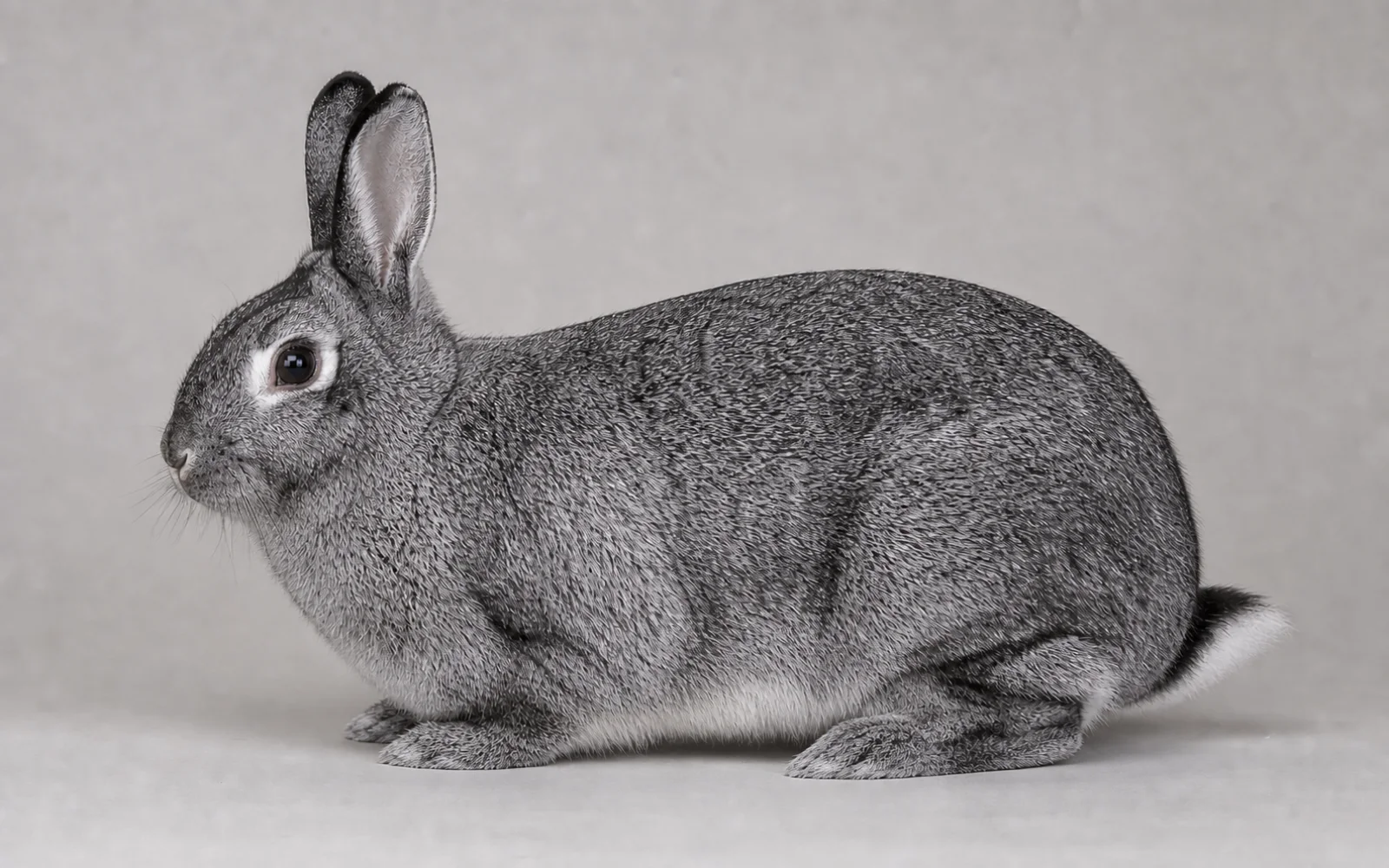
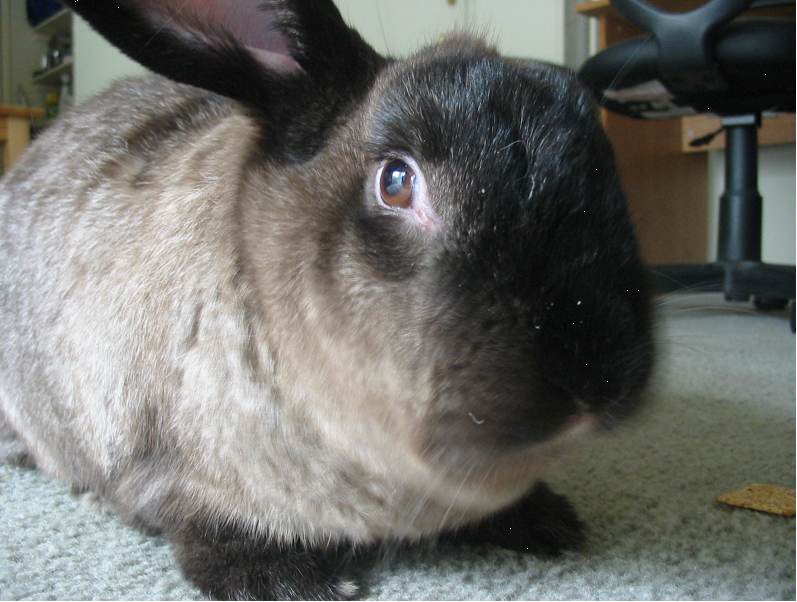
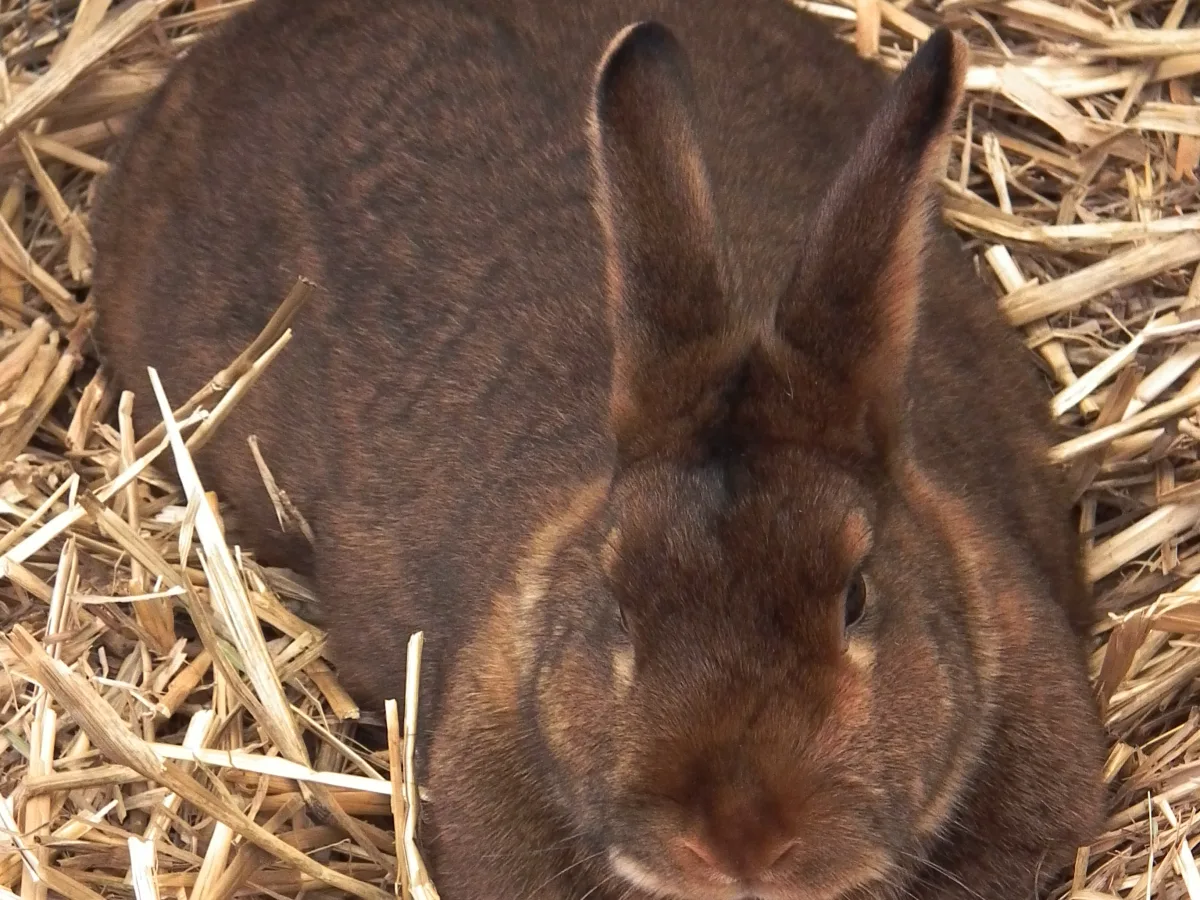
The January 2026 ARBA Breed ID Guide classifies Satin as a six-class commercial breed. ARBA gives an 11 lb (4.99 kg) maximum; the specialty club’s mature ideals are 9.5 lb (4.31 kg) for bucks and 10 lb (4.54 kg) for does. Current showroom groups are Black, Blue, Broken, Chinchilla, Chocolate, Copper, Himalayan, Lilac, Otter, Red, Siamese and White; some groups contain multiple base-color forms. The coat’s translucent hair structure changes light reflection and produces sheen. OMIA records autosomal-recessive inheritance with symbol sa but no confirmed causal variant. This photograph documents a Satin, not every accepted color or perfect standard type.
A breed reputation cannot guarantee a calm individual
No cited standard or controlled behavior study proves that every Satin is docile, friendly or suitable for children. Behavior varies with genetics, pain, hormones, early experience, housing and handling. Provide hiding places, foraging, predictable routines, room to move and a compatible rabbit companion. Work at floor level and reward voluntary contact. Never lift by the ears or loose skin; when lifting is necessary, support the chest and the entire hindquarters. A sudden change in sociability, posture, appetite or activity needs a health and environment review rather than attribution to breed.
A commercial body needs space, traction and condition control
Provide permanently connected living and exercise space for several full hops, upright standing, stretching, turning, running, exploration and retreat. Use dry, stable, non-slip flooring and a comfortable resting area to reduce pressure and falls. Feed unlimited grass hay and constant fresh water, appropriate leafy greens and a measured complete pellet adjusted for age, body condition and reproduction. Groom gently during moults without damaging the coat, but never treat sheen as a grooming target above skin health. Track weight and inspect appetite, feces, teeth, nails, soles, skin, coat and movement.
Satin sheen is a coat phenotype, not a health certificate
OMIA classifies satin as an autosomal-recessive phenotype rather than a disease, and the molecular cause remains unknown. That finding does not make the breed resistant to ordinary rabbit illness. Reduced eating or feces, drooling, weight loss, diarrhea, abdominal swelling, breathing difficulty, head tilt, urine scald, sore feet, skin lesions or marked lethargy require prompt assessment by a rabbit-experienced veterinarian. Prevent obesity and wet bedding, especially in a heavier commercial body. Inspect beneath the coat: a glossy surface cannot rule out parasites, dermatitis, poor body condition, dental disease or pain.
Record recessive sheen, exact variety and complete outcomes
Use the current ARBA Standard of Perfection and January 2026 Breed ID Guide. Record pedigree, exact registration variety, mature weight, commercial structure, coat texture and sheen under consistent light, feet, bite, health checks, matings, every birth and loss, growth and doe recovery. Recessive inheritance makes phenotypes and mating records useful, but the unknown causal variant does not support generic claims of a definitive Satin DNA test. Select health and sound structure before extreme shine. Neither ARBA nor the cited research validates the old profile’s fixed seven-kit litter, 59% yield, 12-week processing age or guaranteed temperament.
- Identify the exact current variety and distinguish Satin from Mini Satin.
- Record mature weight, coat phenotype, structure, health, births and losses.
- Do not market sheen as pedigree proof or promise fixed production numbers.
Frequently asked questions
How much does a Satin rabbit weigh?
ARBA publishes a maximum of 11 lb, about 4.99 kg. The specialty club gives mature ideals of 9.5 lb for bucks and 10 lb for does.
How many Satin rabbit colors are recognized?
The January 2026 ARBA guide lists 12 showroom groups: Black, Blue, Broken, Chinchilla, Chocolate, Copper, Himalayan, Lilac, Otter, Red, Siamese and White.
When was the Satin rabbit developed?
Official sources disagree between 1930 and 1934 for the first Havana mutation, so early 1930s is the most accurate wording. ARBA adopted the unified breed standard in 1956.
Is Satin the same breed as Mini Satin?
No. Satin is a commercial six-class breed with an 11 lb maximum; Mini Satin is a compact four-class breed with a 4.75 lb maximum.
- Breed standardAmerican Rabbit Breeders Association — Satin
- Breed standardAmerican Satin Rabbit Breeders Association — Satin history and varieties
- Breed standardAmerican Satin Rabbit Breeders Association — Satin breed overview
- Breed standardARBA — Breed ID Guide, updated January 2026
- Peer reviewedOMIA / University of Sydney — Satin coat in domestic rabbits
- Peer reviewedJournal of Heredity — Satin, a new hair mutation of the rabbit (1936)
- Breed standardWikimedia Commons — Documented Satin rabbit photograph
- Animal welfareARBA — Recommendations for the Care of Rabbits and Cavies
- VeterinaryMSD Veterinary Manual — Noninfectious Diseases of Rabbits
- Animal welfareRSPCA — What should I feed my rabbits?
- Animal welfareRSPCA — How to keep rabbits healthy
- Animal welfareRSPCA — The ideal home for rabbits
- VeterinaryMSD Veterinary Manual — Management of Rabbits
- VeterinaryMSD Veterinary Manual — Nutrition of Rabbits
- VeterinaryMSD Veterinary Manual — Routine Health Care of Rabbits
This profile does not replace the current ARBA Standard of Perfection, authenticate pedigree, diagnose coat or other disease, or guarantee production. Use complete records and a rabbit-experienced veterinarian.