
From Grevenbroich in 1902 to two US recognition periods
The breed club and Livestock Conservancy credit postman and rabbit fancier Josef Heintz of Grevenbroich, North Rhine-Westphalia. He combined Japanese/Harlequin and spotted stock, first showed the result in Germany in 1902 and gained a German standard under Rheinische Schecke in 1905. Rhinelanders entered the US in 1923 and the national standard in 1924, but disappeared there by 1932. Robert Herschbach brought four from West Germany in 1972, formed the US club in 1974 and obtained ARBA recognition again in 1975. The 2026 Conservancy list now calls the US population Recovering, which still warrants monitoring rather than claims that the breed is globally secure.
An athletic running arch with controlled tricolor markings
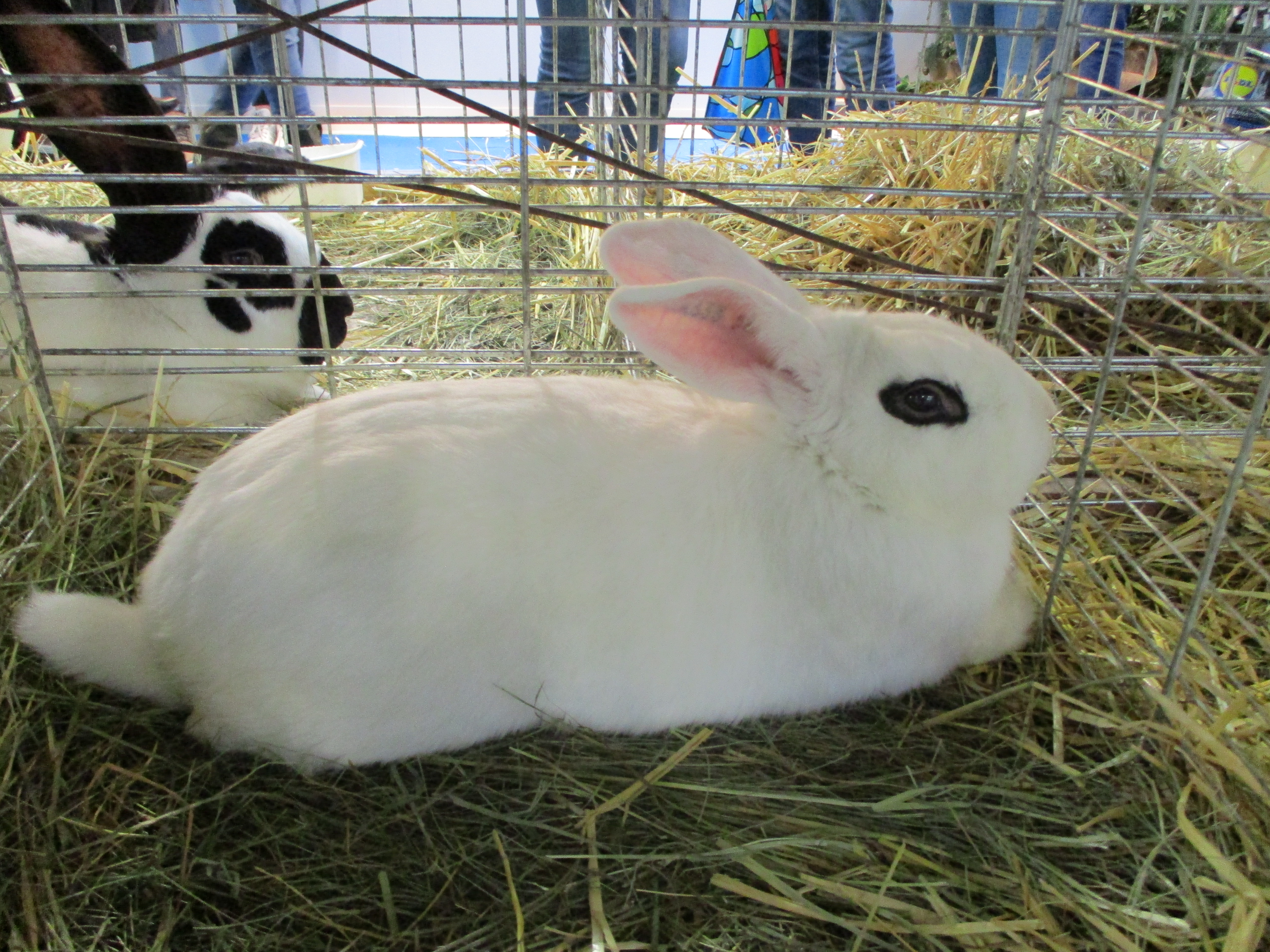
ARBA describes a trim, athletic medium arched breed that moves around the judging table instead of being statically posed. It publishes a 10 lb (4.54 kg) maximum. The January 2026 Breed ID Guide treats Rhinelander as four-class with Black and Blue showroom groups; the registration descriptions are Black/Orange Tri-color and Blue/Fawn Tri-color on white. Pattern elements include colored ears, eye circles, cheek spots, a butterfly nose, dorsal stripe and side markings, but the current Standard of Perfection controls exact points. The MC1R eJ-associated brindling and English spotting component create a genetic pattern, yet visual tricolor alone cannot prove breed identity.
A running breed is active, not guaranteed docile
Official descriptions call Rhinelander active, athletic or docile, but no cited controlled study proves a universal temperament or suitability for children. Its show pose involves movement, so secure space and gradual handling are more useful than expecting static compliance. Provide hiding places, foraging, predictable routines and a compatible rabbit companion. Build trust at floor level and reward voluntary contact. Never lift by ears or skin; support the chest and complete hindquarters. Sudden withdrawal, aggression or reduced movement can indicate pain or environmental stress.
Running type needs secure space and reliable traction
Provide permanently connected living and exercise space for several full hops, upright standing, stretching, turning, running, exploration and retreat. Use dry, stable, non-slip flooring; protect from falls and block escape gaps without compromising ventilation. Feed unlimited grass hay and constant fresh water, suitable leafy greens and a measured complete pellet adjusted to age, body condition and reproduction. Check body condition by touch beneath the patterned coat. Monitor appetite, feces, teeth, nails, soles, skin, weight trend and movement instead of treating activity or color as proof of health.
English spotting genetics require precise, cautious interpretation
A PLoS ONE study linked the incompletely dominant English spotting locus to KIT and found three sampled Rhinelanders heterozygous at an associated marker. In Checkered Giant experimental families, homozygous extreme-white animals had severe cecal and colonic abnormalities, while heterozygous normally spotted animals did not. This is important breeding evidence, but the small Rhinelander sample and Checkered Giant disease model do not prove that every lightly marked Rhinelander has megacolon. Any chronic poor growth, abnormal or reduced feces, abdominal distension, appetite loss or pain needs rabbit-experienced veterinary assessment, not diagnosis from markings alone.
Select pattern without reducing welfare to a percentage
Use the current ARBA or relevant national standard, complete pedigrees and exact Black/Orange or Blue/Fawn identity. Record mature weight, moving arch, markings photographed from standardized views, coat, bite, feet, gastrointestinal health, mating, every birth and loss, growth and doe recovery. MC1R and English spotting interact, so phenotype ratios depend on parental genotypes and do not guarantee a fixed percentage of show-marked kits. The cited sources do not validate the old 30% claim or a universal seven-kit litter. Because normally marked animals can carry the spotting allele, breeding plans should incorporate the published KIT evidence, welfare outcomes and expert registry guidance, not discard healthy non-show animals.
- Record Black/Orange or Blue/Fawn and standardized marking photographs.
- Track gastrointestinal health and every phenotype, birth and loss.
- Do not promise a 30% show-pattern rate or equate markings with pedigree.
Frequently asked questions
How much does a Rhinelander rabbit weigh?
ARBA publishes a maximum of 10 lb, about 4.54 kg. The Livestock Conservancy gives 6.5–10 lb, about 2.95–4.54 kg, as an adult reference.
Which Rhinelander colors does ARBA recognize?
The 2026 guide lists Black and Blue showroom groups, registered as Black/Orange Tri-color and Blue/Fawn Tri-color patterns on white.
When was the Rhinelander recognized?
It received a German standard in 1905, entered the US standard in 1924 and was recognized again by ARBA in 1975 after reintroduction.
Do only 30% of Rhinelander kits have correct markings?
No cited official or peer-reviewed source establishes a universal 30% rate. Pattern outcomes depend on parental genotypes and selection, and exact show quality is judged against the current standard.
- Breed standardAmerican Rabbit Breeders Association — Rhinelander
- Breed standardRhinelander Rabbit Club of America — History of the Rhinelander
- Breed standardARBA — Breed ID Guide, updated January 2026
- Breed standardThe Livestock Conservancy — Rhinelander rabbit
- Breed standardThe Livestock Conservancy — 2026 Conservation Priority List
- Peer reviewedBMC Genetics — MC1R deletion associated with Japanese brindling in rabbits
- Peer reviewedPLoS ONE — KIT, English spotting and congenital megacolon in rabbits
- Breed standardWikimedia Commons — Documented Rhinelander rabbit photograph
- VeterinaryMSD Veterinary Manual — Noninfectious Diseases of Rabbits
- Animal welfareRSPCA — What should I feed my rabbits?
- Animal welfareRSPCA — How to keep rabbits healthy
- Animal welfareRSPCA — The ideal home for rabbits
- VeterinaryMSD Veterinary Manual — Management of Rabbits
- VeterinaryMSD Veterinary Manual — Nutrition of Rabbits
- VeterinaryMSD Veterinary Manual — Routine Health Care of Rabbits
This profile does not replace the current ARBA or national standard, authenticate a tricolor rabbit or diagnose gastrointestinal disease from markings. Use complete records and a rabbit-experienced veterinarian.