
A Ukrainian breed selected from Champagne-derived stock
The National Academy of Sciences’ encyclopedia records that silver rabbits and later Champagne stock reached the former USSR in 1927–28. At the Petrovsky fur farm in Poltava region, Ukrainian selectors O. and Y. Kaplevsky and practising rabbit breeders used directed selection, complete feeding and improved management to create the approved Silver rabbit in 1952. A Mykolaiv university paper describes local black does crossed with Champagne males, while the encyclopedia and teaching material emphasize selection within Champagne-derived stock. Because the historical accounts differ in detail, Petrovsky, Champagne ancestry, Ukrainian selection and the 1952 approval are the secure common facts.
Blue undercolor, mixed hairs and three degrees of silvering
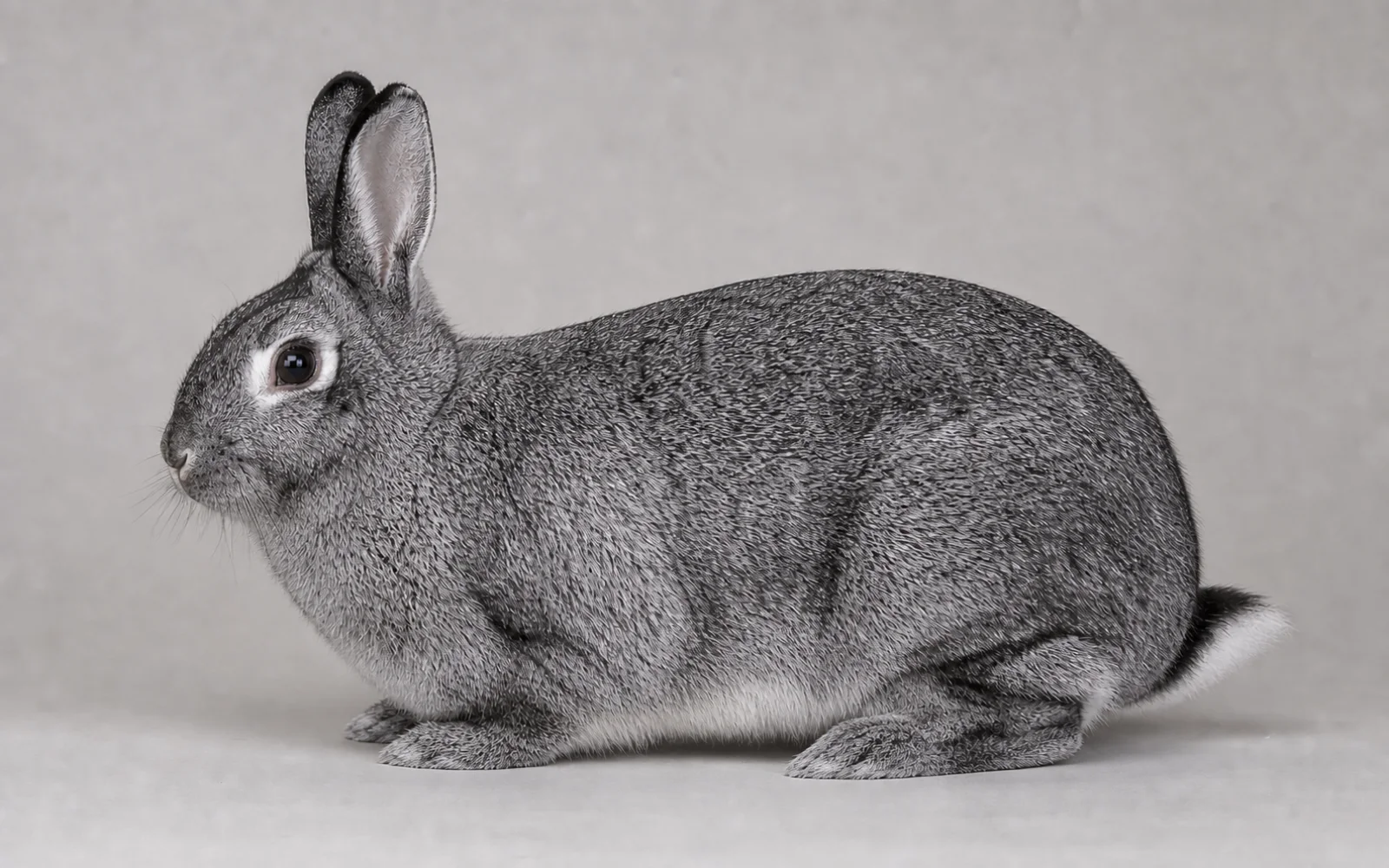
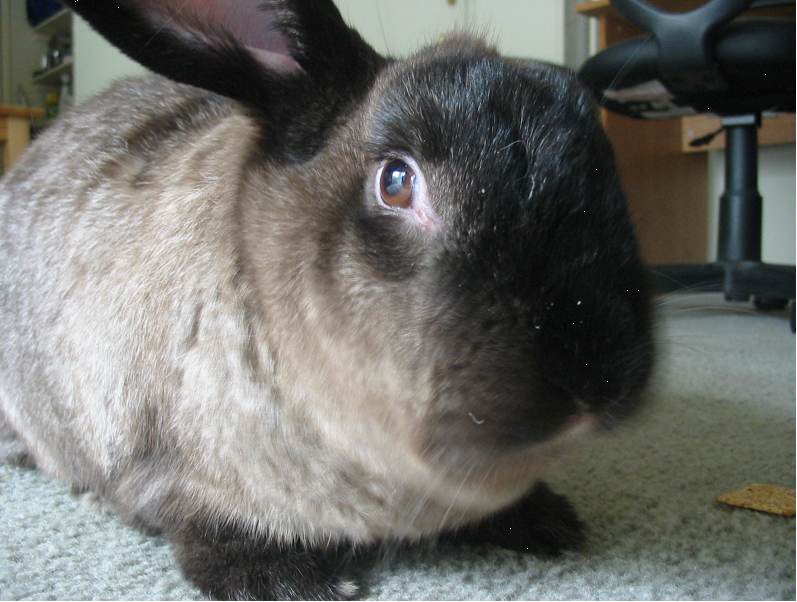
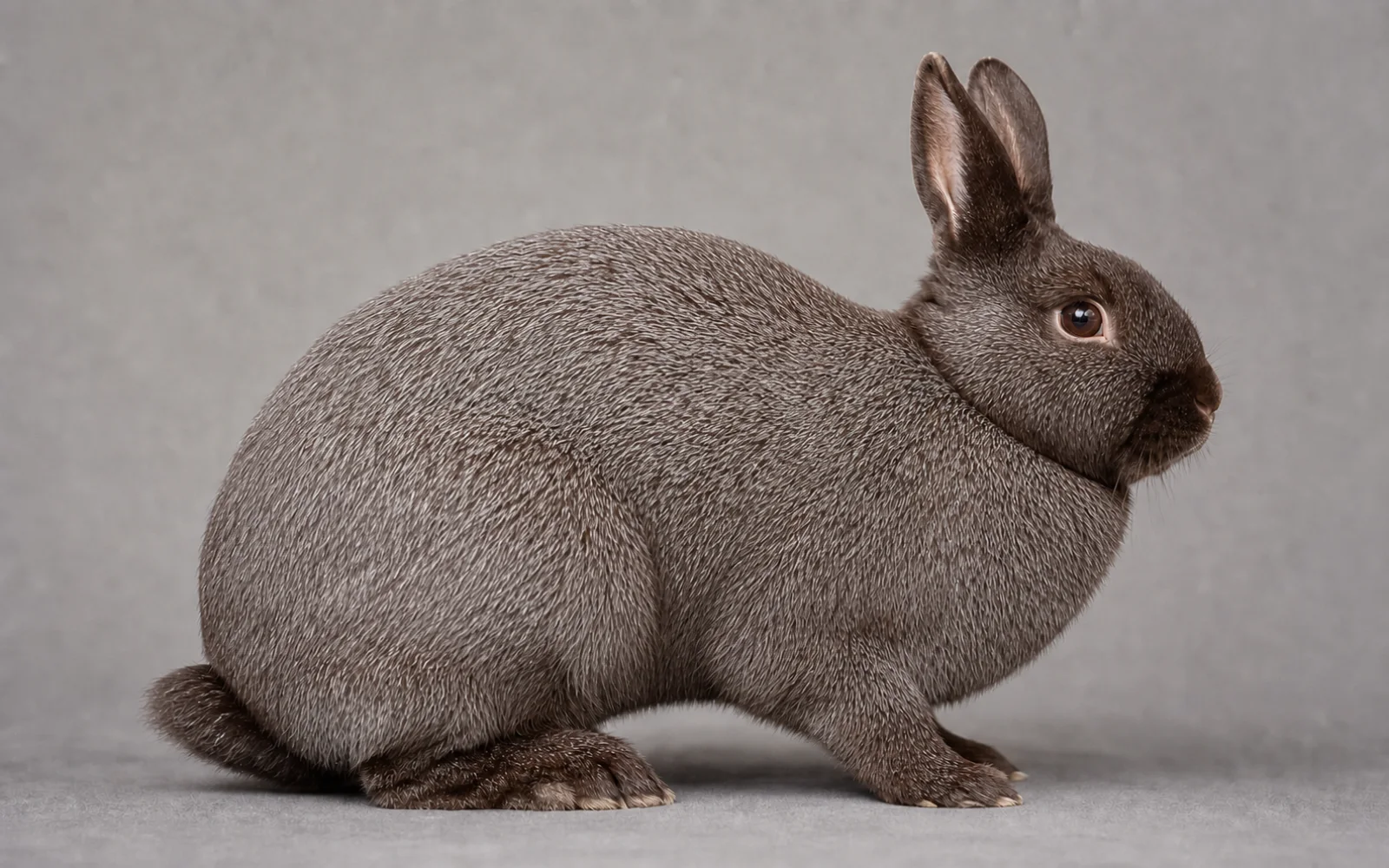
The encyclopedia gives mature live weight as 4.5–5.4 kg, body length 57 cm and chest circumference 37 cm. It describes a silver-blue coat with blue undercolor and guard hairs that are light at the base and black at the tip. Ukrainian research recognizes dark-, medium- and light-silver lines. Silvering is an intermixture of pigmented and unpigmented hairs, not a metallic pigment or proof of pedigree. Kits are initially black; the encyclopedia says the characteristic silver appears after four months. Lighting, molt and age can change the visible effect, so color should be assessed at a documented age under consistent light.
No breed source can promise a calm or stress-proof rabbit
A university paper describes the population as friendly and tractable, but this is not a controlled behavioral comparison and cannot guarantee every individual. Behavior depends on pain, fear, hormones, early experience, housing, handling and the rabbit. Provide hiding places, foraging, predictable routines and a compatible rabbit companion. Work at floor level, reward voluntary contact and never lift by ears or skin. Support the chest and complete hindquarters when lifting is unavoidable. Sudden aggression, withdrawal or reduced activity requires a health and environment review.
A 4.5–5.4 kg rabbit needs space, traction and measured feeding
Provide permanently connected living and exercise space for several full hops, upright standing, stretching, turning, exploration and retreat. Use dry, stable, non-slip flooring and comfortable resting areas that reduce pressure on the feet. Feed unlimited grass hay and constant fresh water, appropriate leafy greens and a measured complete pellet adjusted to age, condition and reproduction. Historic production results came from adequate or intensive feeding; they do not justify unrestricted concentrate. Monitor weight and body condition, appetite, feces, teeth, nails, soles, skin, coat and movement.
Silver coat and local adaptation are not immunity
The reviewed sources do not establish a breed-exclusive disease or prove universal cold, heat or stress resistance. Manage temperature, humidity, ventilation and biosecurity for the local climate and individual animal. A dense-looking coat can conceal weight loss, skin disease or wetness; inspect by touch and part the fur. Reduced eating or feces, drooling, weight loss, diarrhea, abdominal swelling, breathing difficulty, head tilt, urine scald, sore feet, skin lesions or marked lethargy require prompt rabbit-experienced veterinary care. Do not use coat color as a health test.
Preserve a Ukrainian genetic resource with complete records
The 2023 peer-reviewed study examined 200 Poltavske Sriblo rabbits and calculated breeding indices from live weight, body measurements, litter traits and genetic markers under one documented management system. It supports structured selection, not universal DNA or production promises. Record pedigree, shade line, silvering at defined ages, mature weight, body structure, bite, feet, health, mating, every birth and loss, growth, feed conditions and doe recovery. The encyclopedia’s 8–9 kits, 2.5–3.0 kg at three months and 57–61% yield at three to four months are historical population values under intensive feeding, not fixed targets. Current NAAS work on a breed reproducer underscores conservation as well as performance.
- Record dark, medium or light silver line and age at color assessment.
- Compare growth only with matched feed, housing, age and health context.
- Preserve pedigree diversity; do not treat one litter or marker as breeding value.
Frequently asked questions
How much does a Poltava Silver rabbit weigh?
The Encyclopedia of Modern Ukraine gives 4.5–5.4 kg as the adult live-weight reference. This is a population range, not a sex-specific show limit.
When does Poltava Silver fur turn silver?
The Ukrainian encyclopedia says kits are black through early growth and the characteristic silvering appears after four months.
Where was Poltava Silver developed?
At the Petrovsky fur farm in Poltava region, Ukraine, by Ukrainian selectors and rabbit breeders; the breed was approved in 1952.
Does every Poltava Silver litter contain eight or nine kits?
No. Eight to nine is a historical population average in one reference. Litter size varies with line, parity, health, season, nutrition and management.
- GovernmentEncyclopedia of Modern Ukraine / NAS of Ukraine — Ukrainian rabbit breeds
- UniversityMykolaiv National Agrarian University — Productivity of Silver breed color lines
- UniversityMykolaiv National Agrarian University — Genetic resources of farm animals
- Peer reviewedStudia Biologica — Genetic characteristics of Poltavske Sriblo rabbits (2023)
- GovernmentCherkasy Experimental Station of Bioresources NAAS — Poltavske Sriblo breeding unit
- Breed standardWikimedia Commons — Documented Poltava Silver rabbit photograph
- VeterinaryMSD Veterinary Manual — Noninfectious Diseases of Rabbits
- Animal welfareRSPCA — What should I feed my rabbits?
- Animal welfareRSPCA — How to keep rabbits healthy
- Animal welfareRSPCA — The ideal home for rabbits
- VeterinaryMSD Veterinary Manual — Management of Rabbits
- VeterinaryMSD Veterinary Manual — Nutrition of Rabbits
- VeterinaryMSD Veterinary Manual — Routine Health Care of Rabbits
This profile summarizes Ukrainian encyclopedia, university and peer-reviewed sources. It does not authenticate pedigree, guarantee litter size, growth or yield, or replace rabbit-experienced veterinary care.