An uncertain British origin, not a verified Polish origin
ARBA calls the breed’s exact origin obscure, notes references in English literature as early as 1860 and says it is believed to have been developed in Britain, not Poland. The American Polish Rabbit Club says the breed reached the United States around 1912. Its name therefore does not prove a country of origin. A second naming trap crosses the Atlantic: the fine-boned full-arch rabbit called Polish in Britain is registered by ARBA as Britannia Petite, while the American Polish on this page is a separate compact breed. Region, standard and pedigree must always accompany the name.
Compact and small, but not a true dwarf breed
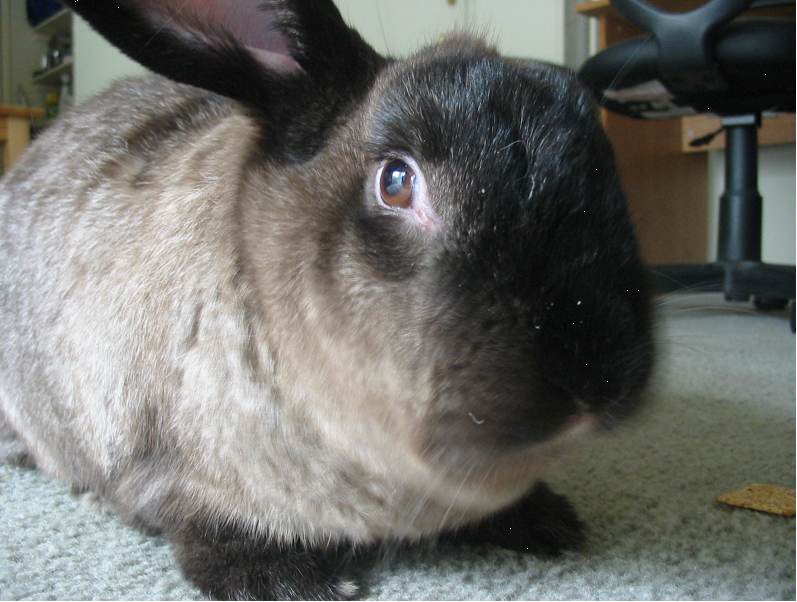
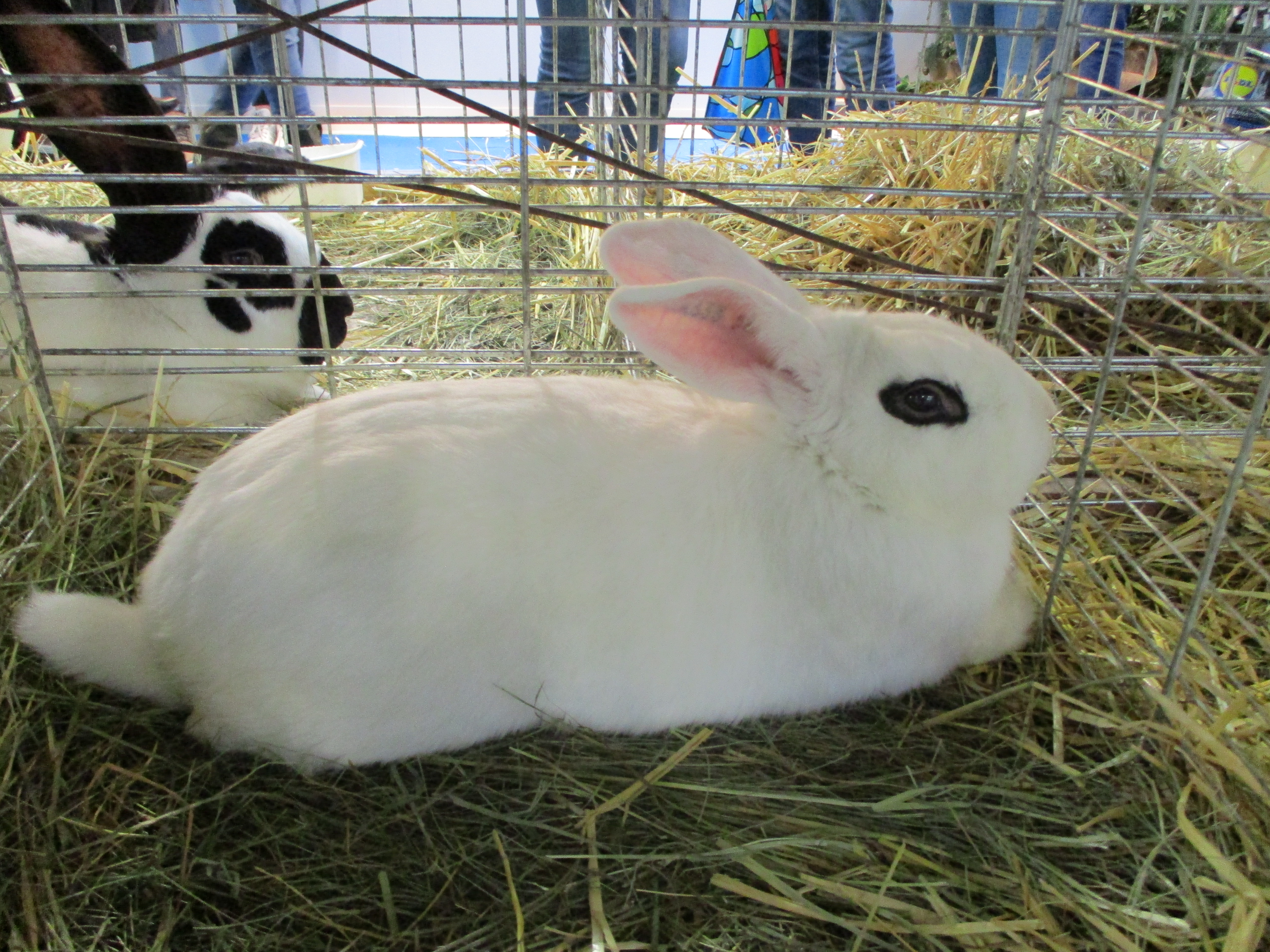
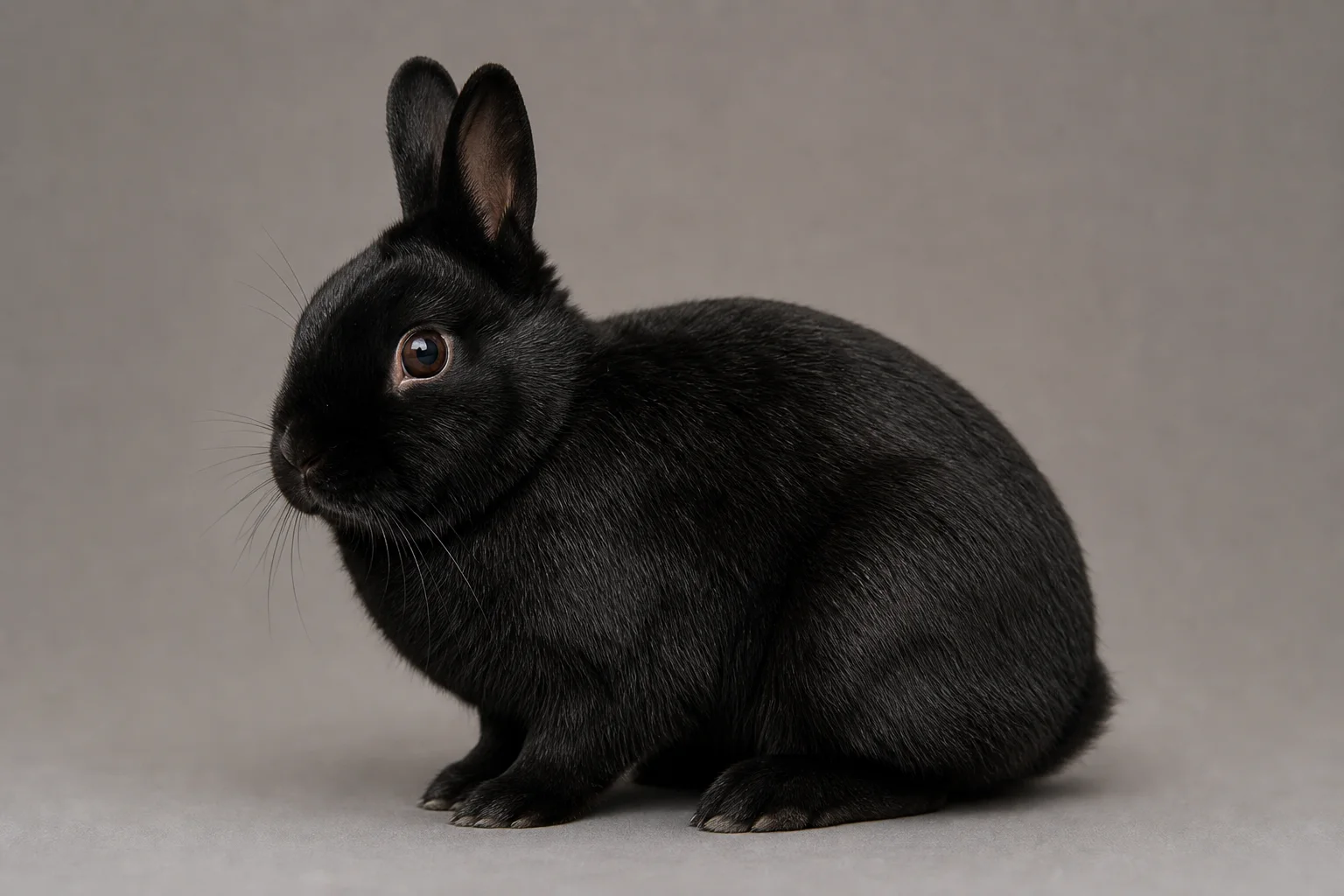
ARBA publishes a 3.5 lb (1.59 kg) maximum and describes Polish as small and compact without the shortened, broad skull of a brachycephalic dwarf. The club-hosted breed description gives 2.5 lb (1.13 kg) as the ideal senior weight, a short close-coupled body, medium full head, upright ears and short flyback coat; exact measurements and points must be checked against the current Standard of Perfection. The January 2026 guide lists Black, Blue, Broken, Chocolate, Lilac, Blue-Eyed White and Ruby-Eyed White showroom groups. Registration subdivides Broken by its base color, so “seven groups” is not the same as seven possible registration labels.
Breed labels cannot guarantee a calm family rabbit
No cited breed standard or controlled study proves that every Polish is calm, friendly, easy to handle or suitable for children. Behavior varies with pain, fear, hormones, early experience, housing, handling and the individual rabbit. Provide hiding places, foraging, predictable routines and a compatible rabbit companion. Build trust at floor level and reward voluntary contact. If lifting is necessary, support the chest and complete hindquarters; never lift by the ears or skin. A sudden change in sociability, posture, appetite or activity warrants a health and environment check.
Small size still requires continuous exercise space
A compact 1–1.6 kg rabbit still needs permanently connected living and exercise areas that permit several full hops, upright standing, stretching, turning, exploring and retreating. Use dry, stable, non-slip flooring and secure small gaps without reducing ventilation. Feed unlimited grass hay and constant fresh water, appropriate leafy greens and a measured complete pellet adjusted to age, condition and reproduction. Check weight and body condition by touch rather than aiming for the smallest possible adult. Inspect appetite, feces, incisors and cheek teeth, nails, soles, skin, coat and movement routinely.
Small breed does not mean a unique diagnosis
The reviewed sources do not establish a Polish-specific disease syndrome. A 2024 VetCompass study found dental disease widely recorded across UK pet rabbits and identified several demographic and breed-associated patterns, but it does not justify diagnosing an individual American Polish by breed alone. Hay-based nutrition, weight monitoring and oral examinations remain important. Reduced eating or feces, drooling, wet chin, weight loss, diarrhea, abdominal swelling, breathing difficulty, head tilt, urine scald, sore feet or marked lethargy require prompt rabbit-experienced veterinary care.
Confirm the registry identity before selecting a line
Record the governing registry, pedigree and exact variety before mating; “Polish” can mean this American compact breed or the British full-arch breed called Britannia Petite by ARBA. Use the current standard for class weights, colors and disqualifications. Record mature weight, functional head and bite, body balance, ears, coat, feet, health, matings, every birth and loss, growth and doe recovery. Do not select for an ever-shorter head or minimum weight at the expense of function. No cited standard supports a universal three-kit litter, inherently low fertility, guaranteed temperament or child suitability.
- Record the registry: American Polish is not ARBA Britannia Petite.
- Use the exact current color group and registration variety.
- Track weight, structure, teeth, health, births, losses and doe recovery.
Frequently asked questions
How much does an American Polish rabbit weigh?
ARBA publishes a maximum of 3.5 lb, about 1.59 kg. The club-hosted breed description gives 2.5 lb, about 1.13 kg, as the ideal senior weight.
Is the Polish rabbit a dwarf breed?
ARBA says no: compared with Netherland Dwarf it has longer ears, a non-brachycephalic head and a less cobby body.
Is American Polish the same as Britannia Petite?
No. ARBA treats them as separate breeds. The rabbit called Polish in Britain is known as Britannia Petite in the United States.
Which American Polish colors are recognized?
The 2026 ARBA guide lists Black, Blue, Broken, Chocolate, Lilac, Blue-Eyed White and Ruby-Eyed White showroom groups.
- Breed standardAmerican Rabbit Breeders Association — Polish
- Breed standardAmerican Polish Rabbit Club — About the Polish
- Breed standardAmerican Polish Rabbit Club — Member resources and published breed description
- Breed standardAmerican Rabbit Breeders Association — Britannia Petite
- Breed standardARBA — Breed ID Guide, updated January 2026
- Peer reviewedVetCompass / Journal of Small Animal Practice — Dental disease in UK pet rabbits
- Animal welfareARBA — Recommendations for the Care of Rabbits and Cavies
- VeterinaryMSD Veterinary Manual — Noninfectious Diseases of Rabbits
- Animal welfareRSPCA — What should I feed my rabbits?
- Animal welfareRSPCA — How to keep rabbits healthy
- Animal welfareRSPCA — The ideal home for rabbits
- VeterinaryMSD Veterinary Manual — Management of Rabbits
- VeterinaryMSD Veterinary Manual — Nutrition of Rabbits
- VeterinaryMSD Veterinary Manual — Routine Health Care of Rabbits
This profile covers the American ARBA Polish and does not replace the current Standard of Perfection, authenticate pedigree or diagnose disease. Confirm regional naming and health decisions with the relevant registry and a rabbit-experienced veterinarian.