A breeder-community project, not an ARBA recognition
The current ARBA list contains 53 rabbit breeds and does not include Mini Plush Lop. The working standard itself says the breed has not been presented to ARBA. A breeder-community account attributes the project to Devie D’Anniballe in the United States from 1995 and describes Holland Lop, Mini Rex, Mini Lop and Netherland Dwarf ancestry over many years. Without an official registry archive, those details should be labelled community history, not treated like an ARBA acceptance record. The database’s 2014 “recognition” date is therefore misleading and has been removed from this editorial profile.
A 4.5 lb working maximum, lopped ears and rex-type rollback fur
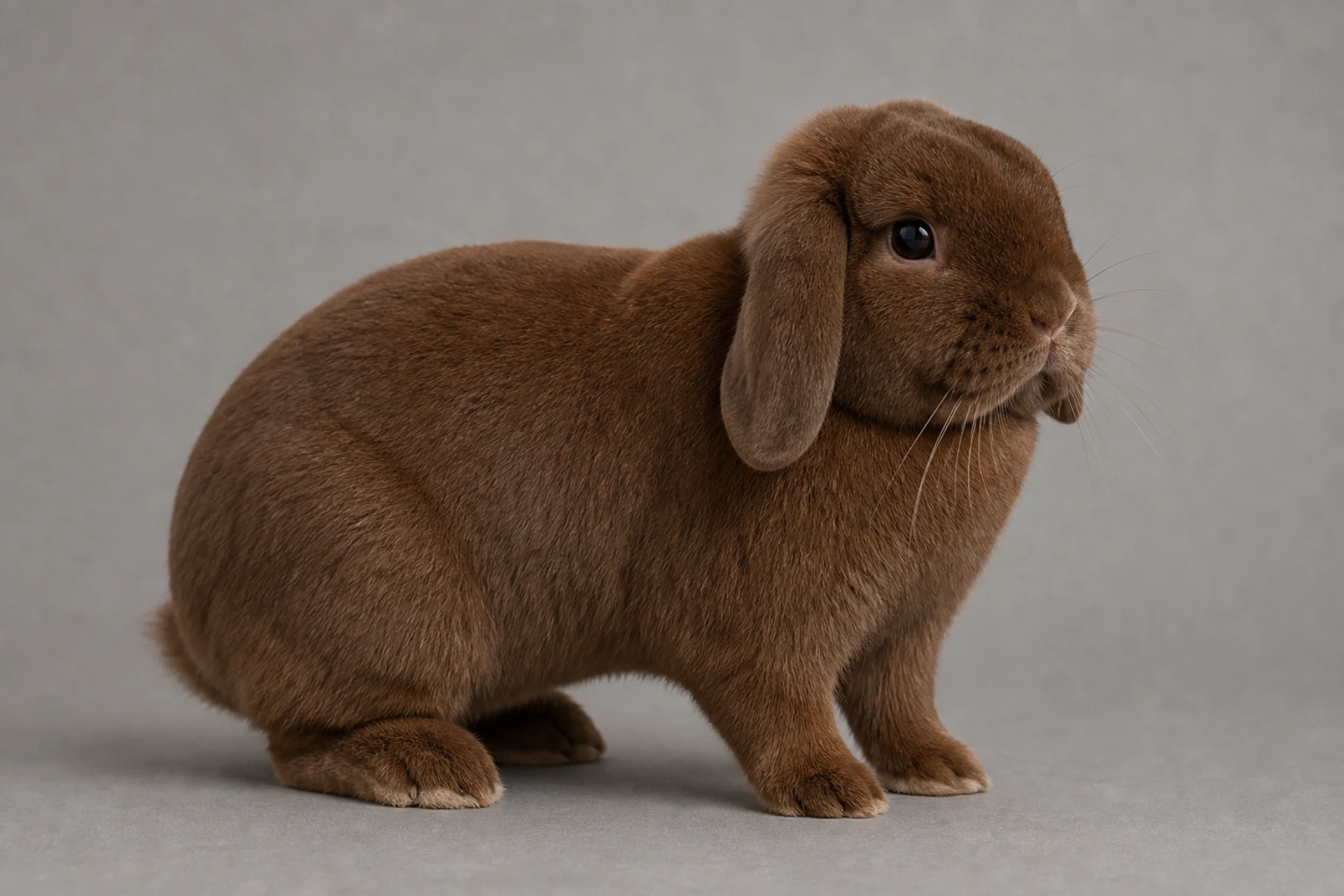
The breeder-maintained standard sets a senior maximum of 4.5 lb (2.04 kg), not the database’s 1.8–3.2 kg range. It calls for a short, balanced, compact body; full rounded hindquarters; a moderate pear-shaped face; a developed crown; fully lopped ears; sturdy straight legs; and dense, soft, lustrous rex-type rollback fur around 1/2 inch long. Many solid, broken and modified colors are included in that working system. A peer-reviewed study identified a recessive LIPH deletion responsible for one rex hair phenotype, characterized largely by soft down hair, but this does not prove that every rabbit sold as Mini Plush Lop carries the same tested genotype.
A developing label cannot guarantee a friendly personality
No recognized standard or controlled behavioral study proves that every Mini Plush Lop is docile, sweet or dependent on frequent human handling. Behavior reflects pain, fear, hormones, early experience, socialization and housing. Provide hiding places, foraging, predictable routines and a compatible rabbit companion. Interact at floor level and use rewards. Avoid forced cuddling and never lift by ears or skin; if lifting is necessary, support the chest and complete hindquarters. A sudden change in behavior should prompt a health and environment review.
Rex fur is short, but the rabbit is not maintenance-free
Provide a permanently connected living and exercise area for several full hops, upright standing, stretching, turning, exploration and retreat. Use dry, stable, non-slip flooring and inspect the thinly protected feet frequently. Feed unlimited grass hay and constant fresh water, suitable leafy greens and a measured complete pellet adjusted for age, condition and reproduction. Short rex-type fur still moults; use gentle hands or a soft grooming tool and avoid abrasive over-brushing that can damage skin or hair. Check weight, appetite, feces, teeth, nails, soles, ears, skin, coat and movement.
Monitor lop ears and teeth; reject the hypoallergenic claim
A 2019 rescue study of 30 rabbits found more ear-canal stenosis, cerumen, inflammation, examination pain and dental abnormalities in the 15 lop-eared rabbits. A much larger 2024 VetCompass study of 161,979 records found dental disease common overall but no significant increase in odds from lop ears, showing why results must not be oversimplified. Routine ear and dental examination remains prudent, especially with discharge, odor, scratching, head shaking, reduced eating or weight loss. Rex fur does not make a rabbit hypoallergenic: researchers identified allergens in saliva, urine and fur, with saliva the most potent extract. Allergy or asthma risk needs medical advice before acquisition.
A developing population needs unusually transparent records
Because there is no ARBA-recognized standard or closed authoritative registry, record the working standard version, breeder and line, complete ancestry, mature weight, body and head shape, crown and ear carriage, fur density and texture, feet, bite, ear findings, matings, every birth and loss, growth and doe recovery. Do not label a first-generation lop × rex cross as an established line merely from appearance. The LIPH study informs rex inheritance but does not replace line-specific testing and records. Select open ear health, sound teeth, feet and movement before extreme head shape or coat. No evidence validates a fixed litter of four, universal friendliness or a production timetable.
- State clearly that the working standard is not ARBA recognition.
- Record line, ancestry, coat phenotype, ears, teeth, feet, births and losses.
- Do not market rex fur as hypoallergenic or a cross as verified purebred stock.
Frequently asked questions
Is Mini Plush Lop recognized by ARBA?
No. It is absent from ARBA’s current recognized-breed list, and the breeder working standard says it has not been presented to ARBA.
How much does a Mini Plush Lop weigh?
The cited breeder working standard gives a senior maximum of 4.5 lb, about 2.04 kg. This is not an ARBA show limit.
Are Mini Plush Lops hypoallergenic?
No evidence establishes that. Rabbit allergens occur in saliva, urine and fur, so short rex-type hair cannot guarantee safety for an allergic person.
Is Mini Plush Lop the same as Mini Lop?
No. Mini Lop is an ARBA-recognized normal-furred breed with its own standard; Mini Plush Lop is a separate developing label centered on rex-type fur.
- Breed standardARBA — Current recognized rabbit breeds
- Breed standardMini Plush Lop breeder community — Working breed standard (not ARBA)
- Breed standardMini Plush Lop breeder community — D’Anniballe project history
- Peer reviewedGenetics Selection Evolution — LIPH deletion responsible for a rex hair phenotype in rabbits (2011)
- Peer reviewedVeterinary Record — Aural and dental problems in lop- and erect-eared rescue rabbits (2019)
- Peer reviewedVeterinary Record — Dental disease frequency and risk factors in 161,979 companion rabbits (2024)
- Peer reviewedClinical & Experimental Allergy — Rabbit allergens in saliva, urine and fur (2001)
- VeterinaryMSD Veterinary Manual — Noninfectious Diseases of Rabbits
- Animal welfareRSPCA — What should I feed my rabbits?
- Animal welfareRSPCA — How to keep rabbits healthy
- Animal welfareRSPCA — The ideal home for rabbits
- VeterinaryMSD Veterinary Manual — Management of Rabbits
- VeterinaryMSD Veterinary Manual — Nutrition of Rabbits
- VeterinaryMSD Veterinary Manual — Routine Health Care of Rabbits
This profile does not certify a developing line, guarantee allergy safety or diagnose ear, dental or skin disease. Verify records and consult rabbit-experienced veterinary and human allergy professionals.