
French origin, an 1887 Paris debut and a changed name
ARBA and the American Harlequin Rabbit Club agree on French origin and the first Paris exhibition in 1887. The breed was historically called Japanese even though it did not originate in Japan. The club history records that the British standard adopted Harlequin in 1946 after the older name fell out of favor during the Second World War, and that the breed returned to the American standard in the 1966–1970 edition. Those dates are more precise than the database’s approximate “France, 1880s” statement and explain why older books use different names and weight ranges.
Japanese and Magpie are pattern groups, not separate breeds
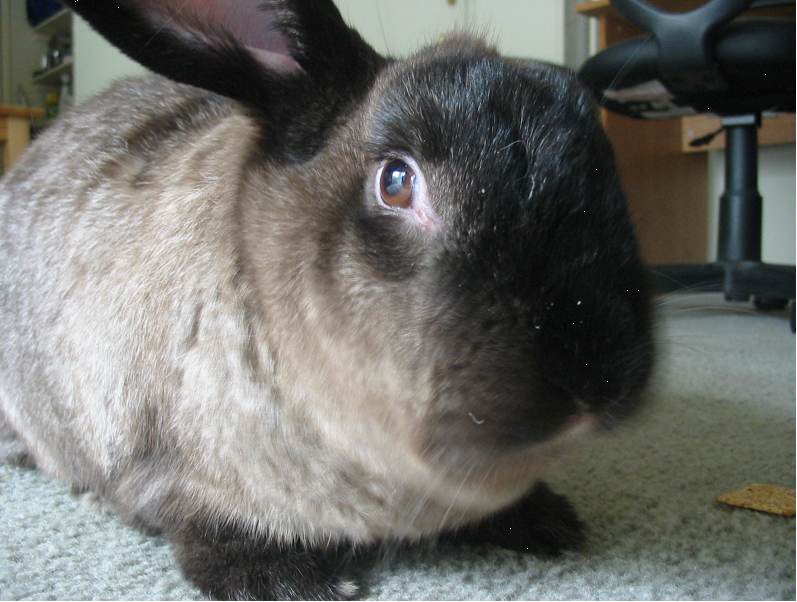
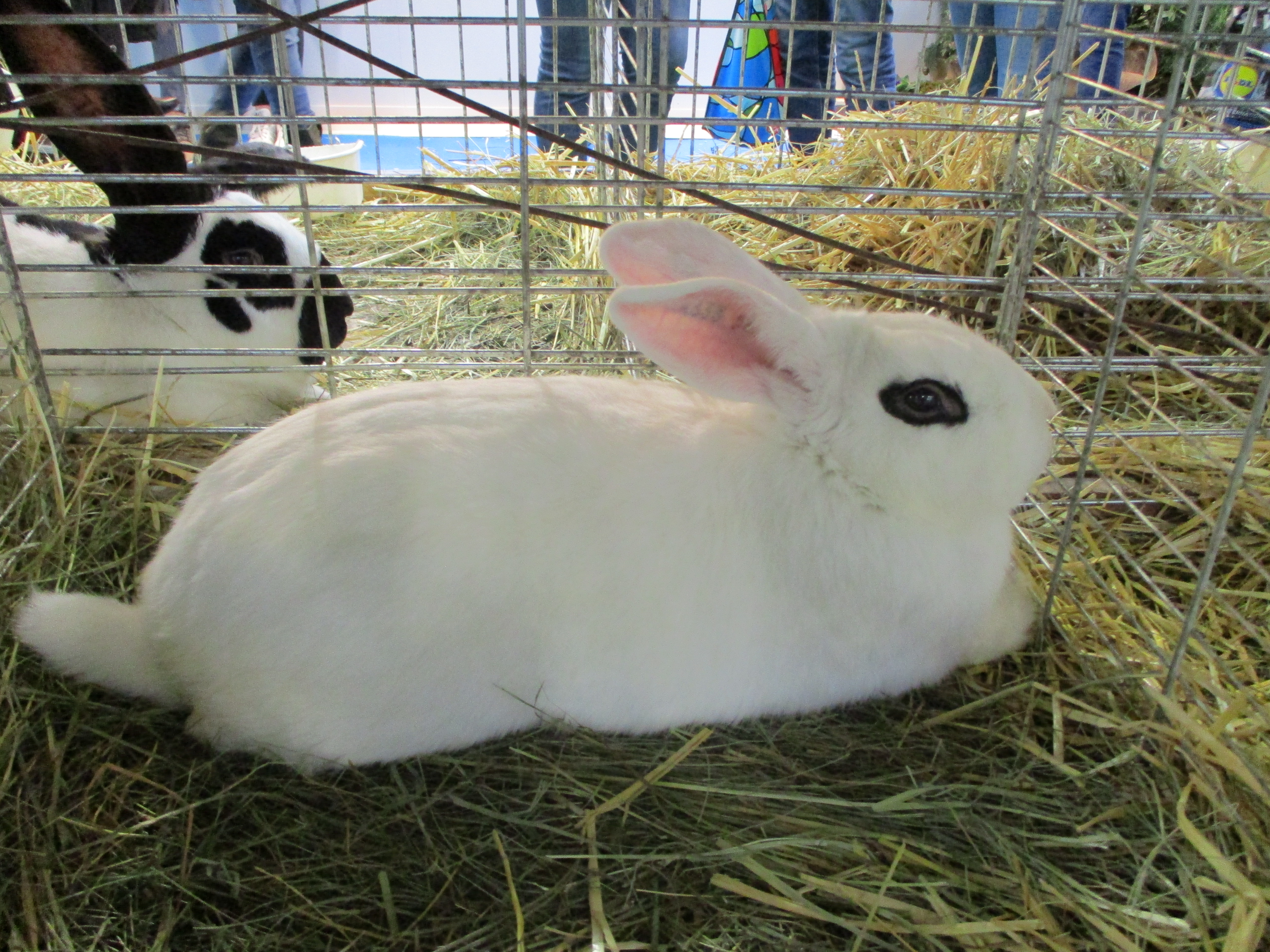
ARBA describes two groups. Japanese pairs orange or fawn with black, blue, chocolate or lilac; Magpie replaces the warm color with white. A highly valued exhibition pattern has a clean division of the head, opposite-colored ears and alternating feet and body sections. The current public maximum is 9.5 lb (4.31 kg), not the database’s unqualified 2.7–4.5 kg range. Peer-reviewed work links Japanese brindling to a composite six-base-pair deletion in MC1R and a mosaic distribution of dark eumelanin and yellow-red pheomelanin. The pattern can also occur in other breeds, so appearance alone does not identify a purebred Harlequin.
Pattern cannot guarantee a calm or friendly temperament
No current breed standard proves that every Harlequin is calm, friendly or suitable for children. Behavior varies with pain, fear, hormones, early experience, handling and environment. Offer hiding places, predictable routines, daily foraging and compatible rabbit companionship. Interact at floor level and use reward-based habituation. If lifting is necessary, support the chest and hindquarters securely and never lift by the ears or loose skin. A sudden change in sociability, posture or willingness to move deserves a health check rather than a breed-based explanation.
Care for the rabbit, not for the decorative pattern
Provide a permanently connected living and exercise area in which the rabbit can make several full hops, stand upright, stretch, turn, explore and withdraw. Use dry, stable, non-slip flooring and enough sheltered resting space. The diet should center on unlimited grass hay and constant fresh water, with suitable leafy greens and a measured complete pellet adjusted for age, body condition and reproductive status. Monitor weight, appetite, feces, teeth, nails, feet, coat and movement. Normal short fur is straightforward to groom, but moulting still requires more frequent brushing and observation.
There is no verified Harlequin-only disease list
The reviewed breed sources do not establish a hereditary jaw disorder, special immunity or a unique disease prevalence for Harlequins. Manage the well-documented rabbit risks instead: dental disease, gastrointestinal slowdown, obesity, heat stress, respiratory signs, parasites and sore hocks. MSD notes that reduced fiber intake and dental problems can contribute to serious digestive disease. Daily observation matters: reduced eating or feces, diarrhea, abdominal distension, breathing difficulty, head tilt, marked lethargy or pain needs prompt rabbit-experienced veterinary care. Coat genotype is not a health diagnosis.
Record pattern inheritance without sacrificing welfare
Use the current registry standard, complete pedigrees and permanent litter records. Document both pattern group and base color, head and ear split, leg alternation, body bands, white marks, mature weight, bite, feet, movement, matings, every birth and loss, growth and doe recovery. The MC1R study helps explain Japanese brindling but does not let a breeder predict every marking or verify ancestry from a photograph. Select sound structure, health and maternal recovery before cosmetic symmetry. No reviewed source validates a fixed litter of six, 45-day production cycle, 12–14-week endpoint or universal meat performance.
- Record Japanese or Magpie group, base color and the full marking map.
- Keep pedigrees, births, losses, growth, health and doe recovery together.
- Select functional structure and health before an unusually dramatic pattern.
Frequently asked questions
How much does a Harlequin rabbit weigh?
ARBA’s current public breed page gives a maximum of 9.5 lb, about 4.31 kg. Exact show classes and ideal weights should be checked in the current standard used by your registry.
What is the difference between Japanese and Magpie?
Japanese combines orange or fawn with black, blue, chocolate or lilac. Magpie combines white with one of those four darker colors.
Did the Harlequin rabbit come from Japan?
No. Official and specialty-club histories place its origin in France and its first exhibition in Paris in 1887; Japanese is the historical name and a current pattern-group name.
Does a harlequin-patterned rabbit belong to this breed?
Not necessarily. The eJ-related pattern occurs outside the Harlequin breed, so pedigree, structure and the applicable registry standard are required.
- Breed standardAmerican Rabbit Breeders Association — Harlequin
- Breed standardAmerican Harlequin Rabbit Club — History: From the Beginning
- Peer reviewedBMC Genetics — MC1R deletion associated with Japanese brindling in rabbits
- VeterinaryMSD Veterinary Manual — Noninfectious Diseases of Rabbits
- Animal welfareRSPCA — What should I feed my rabbits?
- Animal welfareRSPCA — How to keep rabbits healthy
- Animal welfareRSPCA — The ideal home for rabbits
- VeterinaryMSD Veterinary Manual — Management of Rabbits
- VeterinaryMSD Veterinary Manual — Nutrition of Rabbits
- VeterinaryMSD Veterinary Manual — Routine Health Care of Rabbits
This profile cannot authenticate pedigree, predict a litter’s markings or diagnose disease. Use the current registry standard and a rabbit-experienced veterinarian.