
A Ukrainian breed developed in the Poltava region
The Encyclopedia of Modern Ukraine credits the Petrovsky fur farm team in Poltava region, led by zootechnician O. Kaplevsky, with creating Grey Giant and records approval in 1952. It describes reproductive crossing of small black Ukrainian rabbits selected for early maturity and viability with large Belgian Flemish rabbits, followed by breeding within the crossbred population and directed selection for size, growth, fertility and viability. University and peer-reviewed Ukrainian sources confirm the local × Flemish route. This makes Ukraine, not a generic USSR label, the precise geographic origin.
About 5 kg on average, with several documented colors
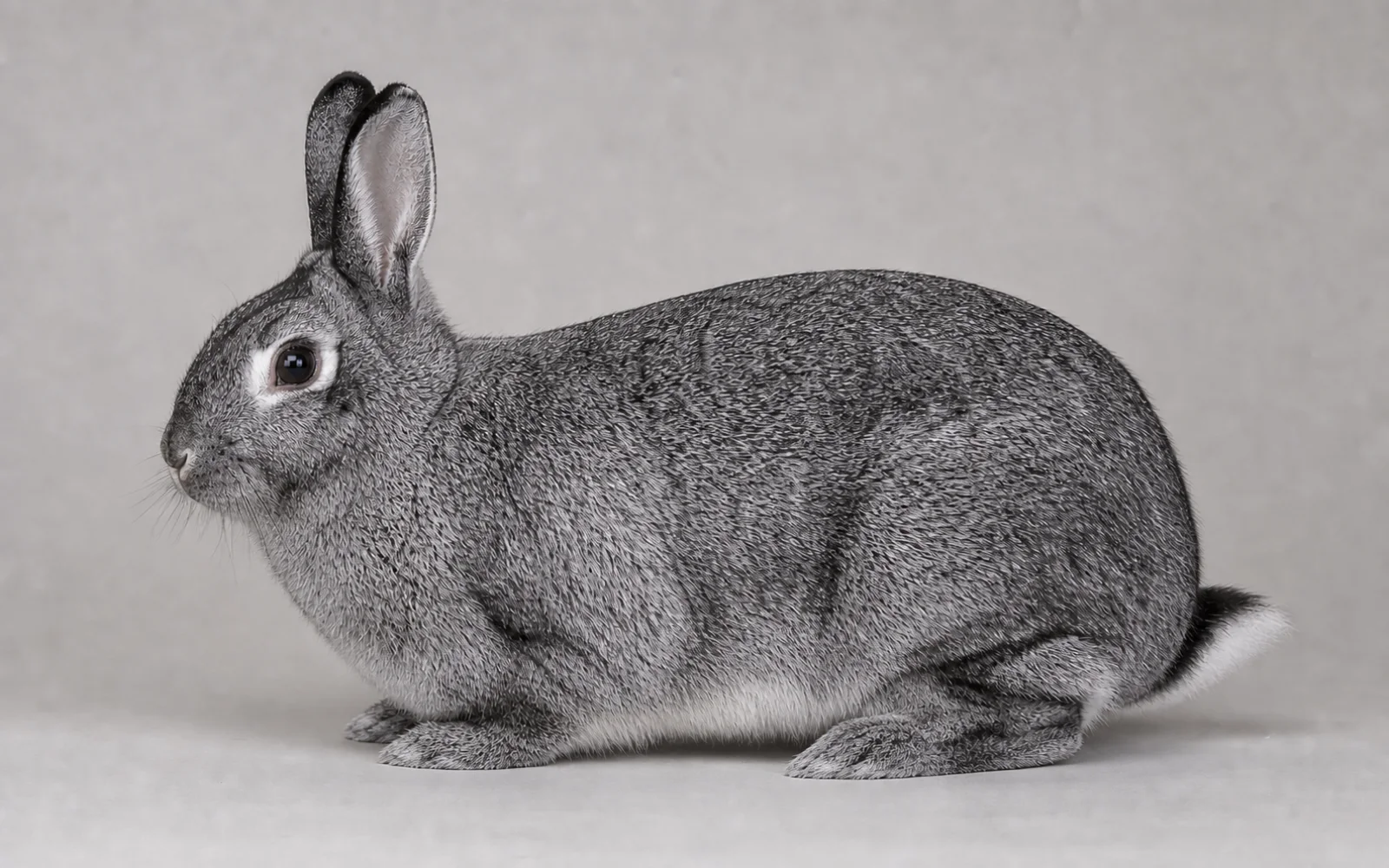
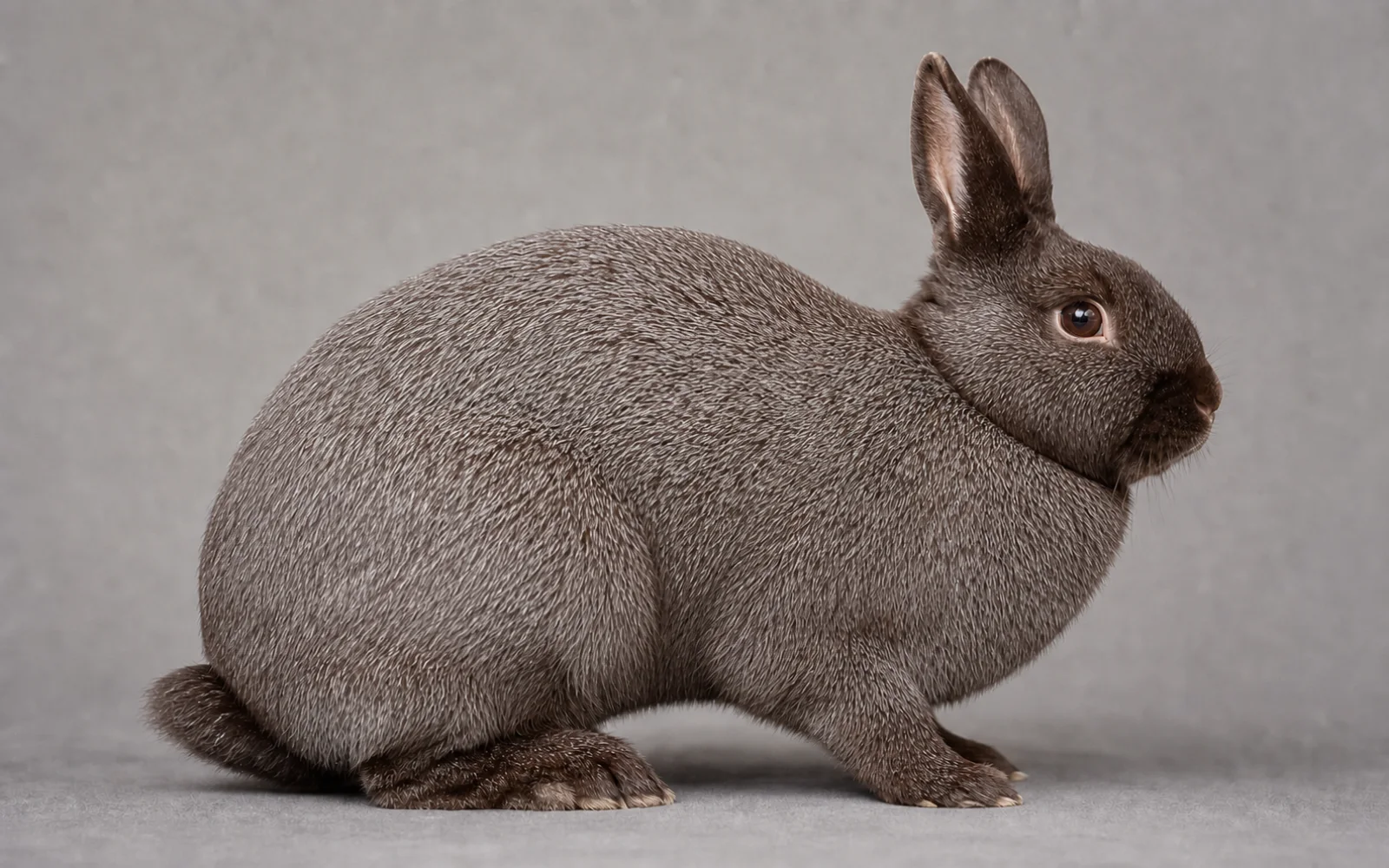
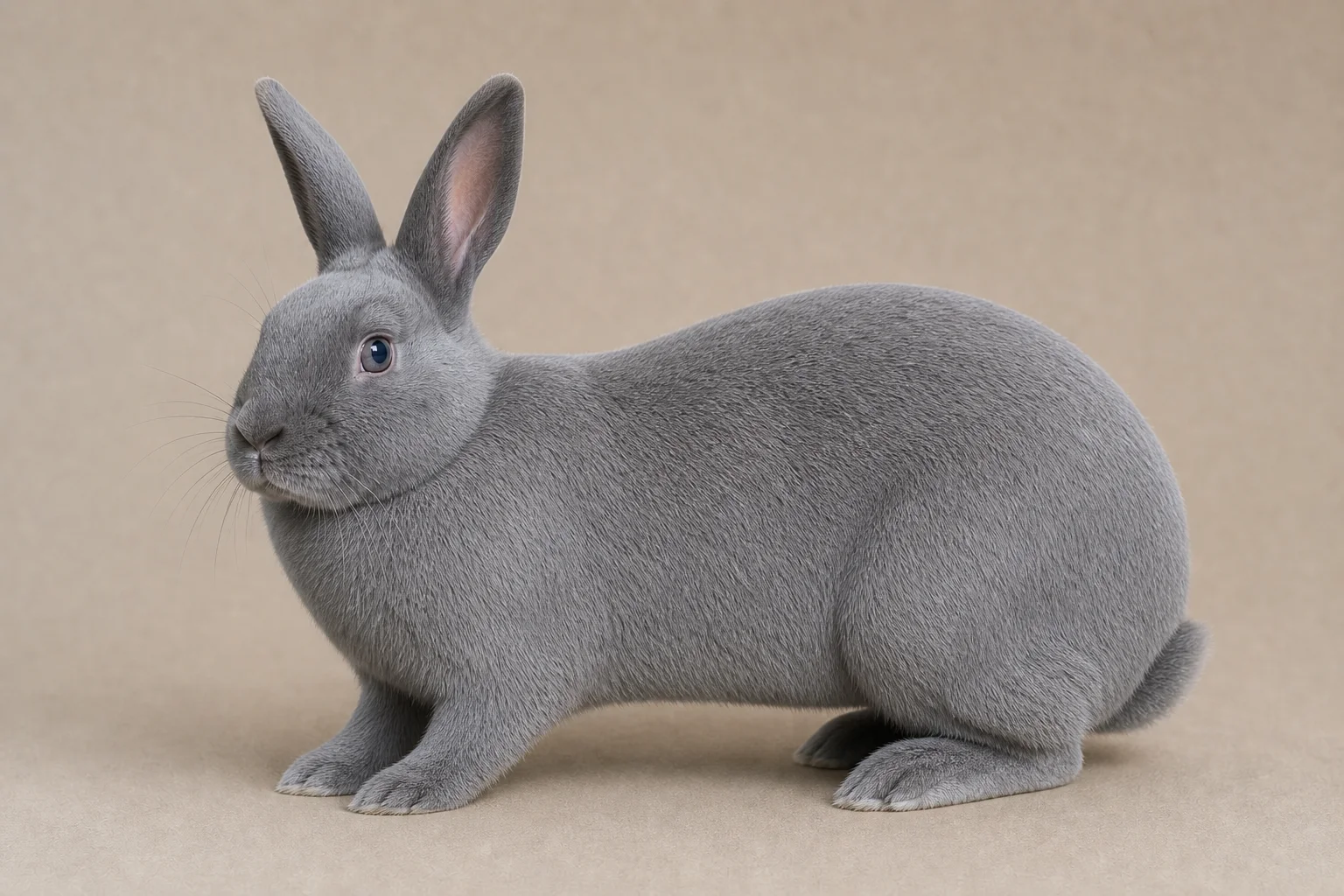
The Encyclopedia reports an average adult live weight of 5 kg, body length about 61 cm and chest circumference 38–40 cm. MNAU teaching material gives a 4.9 kg average and a broad 4.4–7.3 kg range; neither source presents separate modern show ranges for bucks and does. The body is elongated with a broad back, rounded loin, deep chest, substantial bone, a large rounded head and long, broad, separated ears. Documented colors include hare-grey agouti, iron or dark grey and black. Hare-grey hairs form a multi-zone ring from blue near the base through yellow and reddish zones to dark tips; a plain gray coat or large body alone cannot authenticate pedigree.
Hardiness is not a promise of calm behavior
The historical selection narrative discusses viability and adaptation, not a guaranteed calm personality. Behavior still varies with pain, fear, socialization, reproductive state and prior handling. Provide hiding places, predictable routines, forage-based enrichment and compatible rabbit companionship. Work at floor level and reward voluntary contact. For necessary lifting, support the chest and complete hindquarters and use a second trained person for a large or struggling rabbit. Never lift by the ears or loose skin. A sudden change in activity, posture, aggression or handling tolerance warrants a health check.
Adaptation never replaces correct housing and nutrition
The Encyclopedia specifically says the breed is well adapted to a moderately warm climate; that does not justify the database’s promise of extreme cold tolerance or unheated housing in every region. Provide a dry, shaded, ventilated but draft-protected enclosure with enough permanent space for several full hops, upright rearing, stretching, turning, exploration and retreat. Use stable, non-slip, comfortable surfaces. Feed unlimited grass hay, constant fresh water, appropriate leafy greens and measured complete pellets adjusted to age, growth, reproduction and body condition. Coarse local fodder is not nutritionally complete by definition. Check appetite, feces, hydration, weight, coat, nails, feet, teeth and heat or cold stress.
Large size and dense production records need routine surveillance
There is no reliable evidence that Grey Giants are immune to ordinary rabbit disease. MSD describes obesity, traumatic injury, dental disease, gastrointestinal stasis, heat stress and ulcerative pododermatitis as management-relevant problems in rabbits; foot disease is multifactorial and cannot be prevented by breed reputation. Maintain healthy body condition, dry clean bedding or rest areas, traction, room to move and correct nail length. Inspect soles, hocks, gait, incisors, face, underside, urine staining, appetite and fecal output. Reduced eating or feces, distension, breathing difficulty, marked pain, weakness, neurologic signs or heat distress require prompt veterinary care.
Use Ukrainian bonitation principles and contemporary records
Ukraine’s current rabbit bonitation instruction defines individual evaluation by the animal’s own productivity, origin and reproductive ability; that is a better framework than repeating breed averages as promises. Verify pedigree, then record mature weight and body condition, functional movement, feet, bite, body structure, color zones, matings, every birth and loss, kit growth, maternal care and doe recovery. The Encyclopedia’s seven to eight kits, 55–60% slaughter yield and age-weight examples describe referenced populations and feeding conditions, not a result guaranteed to every farm. Do not impose a universal 16-week endpoint, 3.5 kg first-mating threshold or claim that low-quality roughage is sufficient. Select viable, sound animals without driving extreme size.
- Verify Ukrainian Grey Giant pedigree instead of identifying the breed by gray color alone.
- Record function, weight, births, losses, growth and doe recovery for each line.
- Treat historical averages as benchmarks, never as guaranteed production targets.
Frequently asked questions
How much does a Grey Giant rabbit weigh?
Ukrainian references give an adult average near 4.9–5.0 kg and one broad observed range of 4.4–7.3 kg. These are not sex-specific current show limits.
Where was the Grey Giant developed?
At the Petrovsky fur farm in Poltava region, Ukraine, under zootechnician O. Kaplevsky. The breed was approved in 1952.
What colors occur in Grey Giant rabbits?
Ukrainian sources document hare-grey agouti, iron or dark grey and black. Coat color alone does not prove breed identity.
Can Grey Giants live outside without winter protection?
No source supports a universal promise. The Ukrainian encyclopedia says moderately warm climate adaptation. Housing must match local heat, cold, wind, moisture and veterinary guidance.
- Breed standardMinistry of Agrarian Policy of Ukraine — Instructions for rabbit bonitation, Order No. 351
- GovernmentEncyclopedia of Modern Ukraine — Ukrainian rabbit breeds
- UniversityMykolaiv National Agrarian University — Genetic resources of farm animals, rabbit breeds
- Peer reviewedPodilian Bulletin — Organic rabbit production under different housing technologies
- VeterinaryMSD Veterinary Manual — Noninfectious Diseases of Rabbits
- Animal welfareRSPCA — What should I feed my rabbits?
- Animal welfareRSPCA — How to keep rabbits healthy
- Animal welfareRSPCA — The ideal home for rabbits
- VeterinaryMSD Veterinary Manual — Management of Rabbits
- VeterinaryMSD Veterinary Manual — Nutrition of Rabbits
- VeterinaryMSD Veterinary Manual — Routine Health Care of Rabbits
This profile does not authenticate pedigree, prescribe production targets or replace veterinary and local climate advice. Apply current Ukrainian breeding records and welfare requirements.