A Belgian blue rabbit with a genuinely disputed ancestry
Sources agree on Beveren, Belgium, and late-19th-century development, but not on one proven recipe. ARBA and the US specialty club cite Brabançonne, St Nicolas Blue and Blue Vienna crosses; the FFC says the early history is highly disputed and favors selection from local blue stock. The club dates the first blue standard to 1902 and a Norwich exhibition to 1905. The Livestock Conservancy records standard and giant forms reaching America around 1915, and the club reports US recognition in 1925. These accounts should be attributed rather than blended into certainty.
A broad rear, gradual semi-arch and long rollback coat
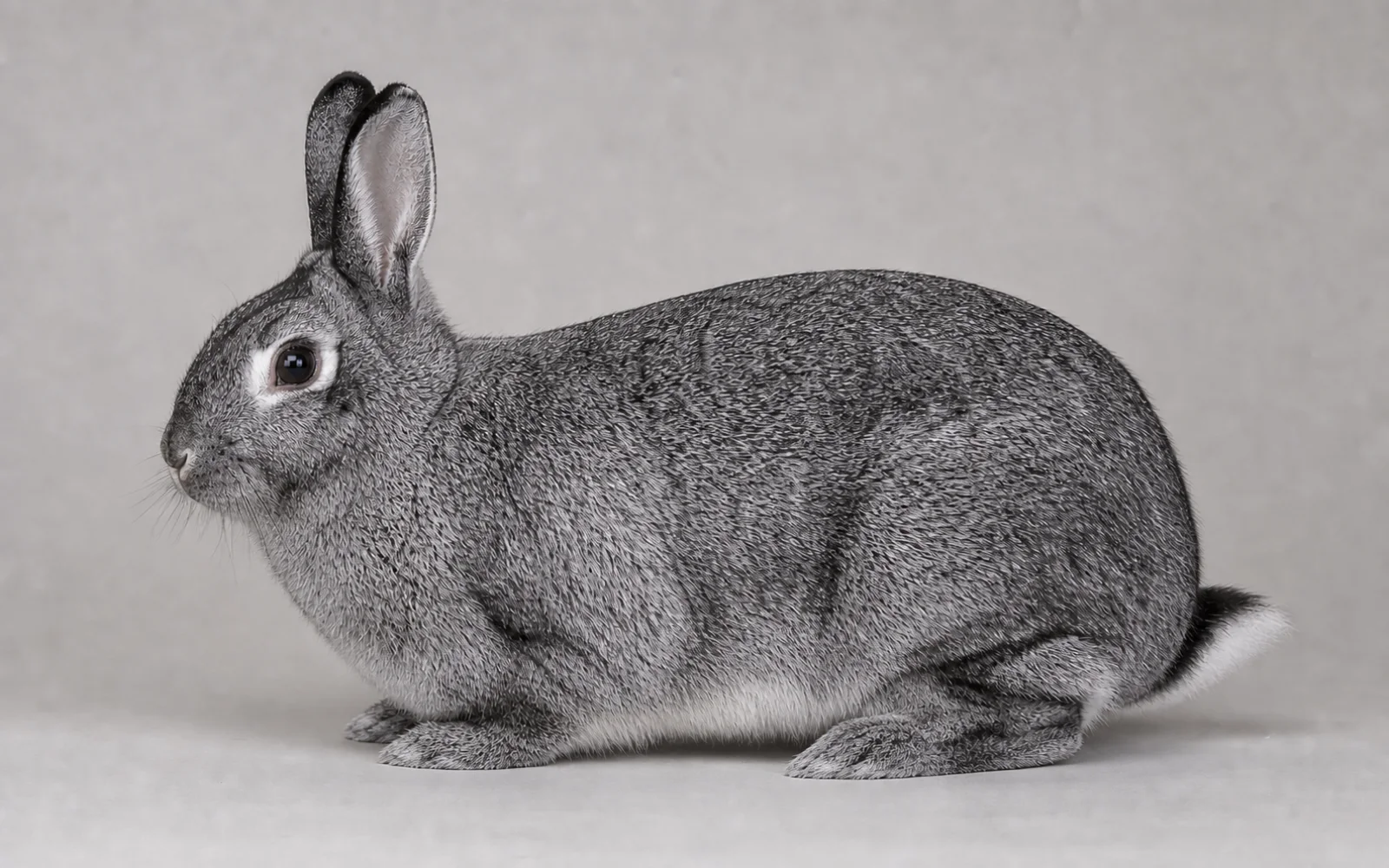
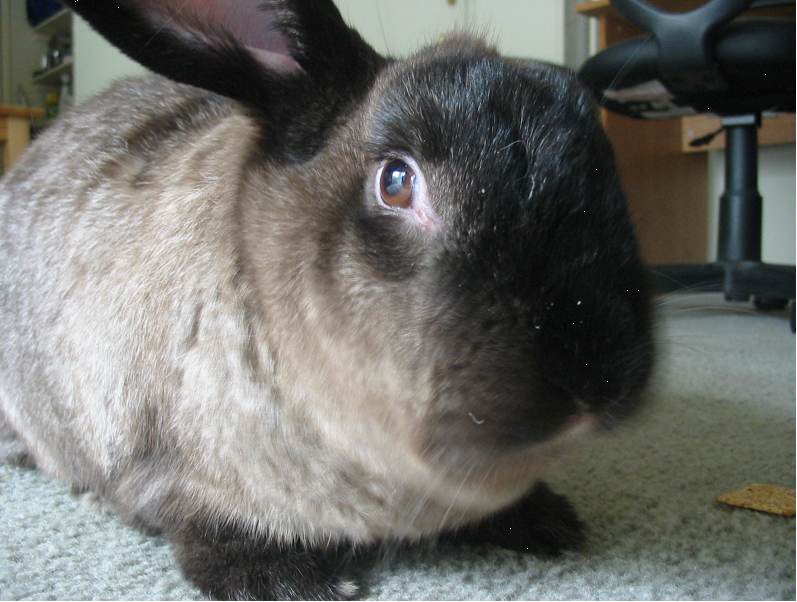
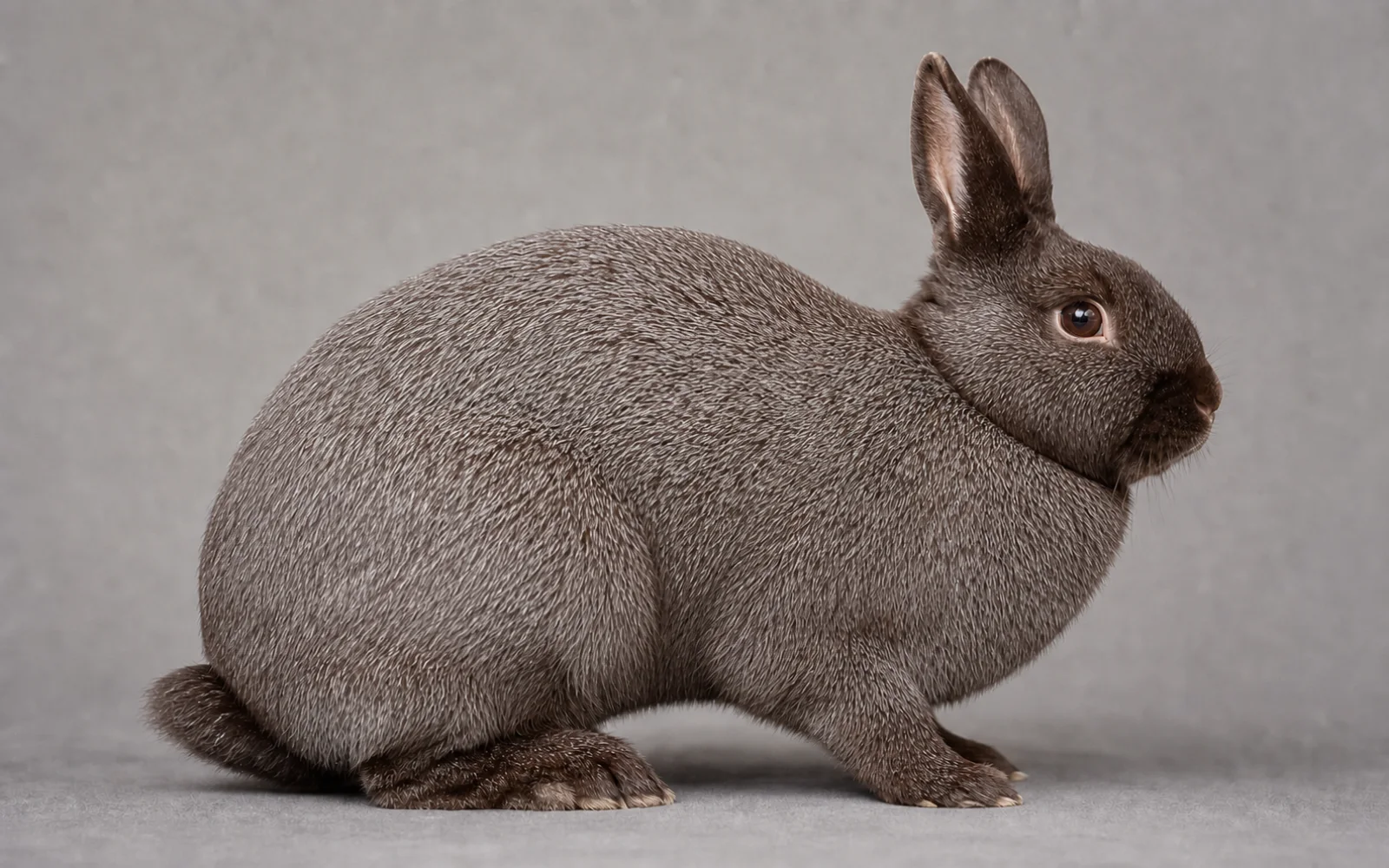
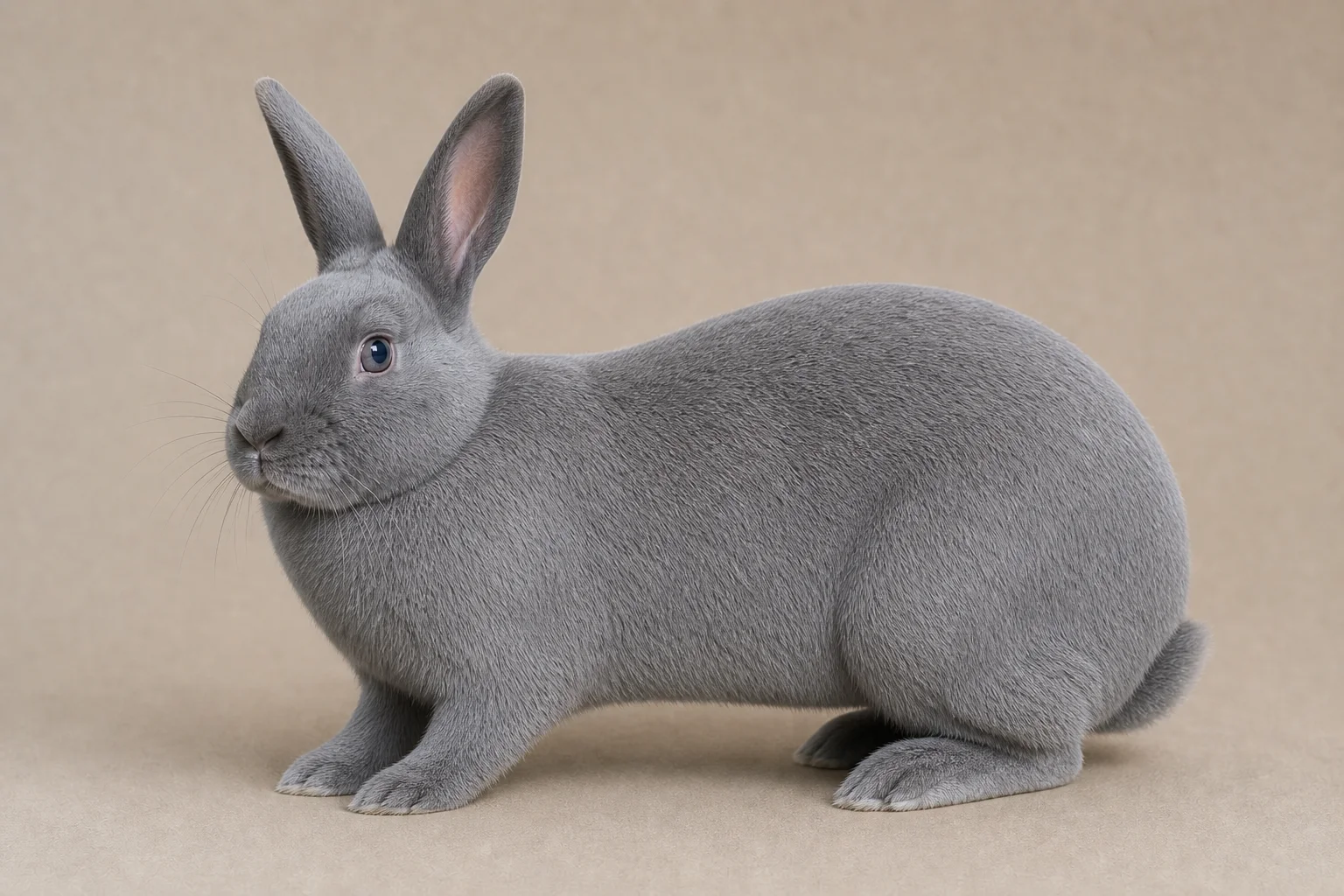
The US club calls for a mandolin or semi-arch body: the topline rises behind the shoulders toward a deep, broad hindquarter, rather than forming a compact commercial block. It gives senior bucks 3.63–4.99 kg and does 4.08–5.44 kg; ARBA’s public maximum is 5.44 kg. US show colors are Black, Blue and Blue-Eyed White. The blue should be an even light lavender-blue without silvering, with blue-gray eyes; the club describes rollback fur about 3.2–3.8 cm long. This labelled AI image illustrates the Blue standard and is not pedigree proof.
Active is a useful management clue, not a guarantee
ARBA describes the Beveren as active and energetic, but club adjectives cannot predict every rabbit’s behaviour. Assess pain, fear, previous handling and response to people and rabbits. Use gradual reward-based habituation, support the large body and hindquarters, and provide enough continuous space to run, stand, stretch, hide and rest with a compatible companion.
Inspect beneath the dense rollback fur
The relatively long, dense coat can hide moisture, matting, skin changes and body-condition loss. Keep bedding and resting surfaces dry, remove loose hair during moulting, and inspect skin, underside, tail, feet and hocks. Provide unlimited grass hay and fresh water, appropriate leafy greens and measured complete pellets. Judge ribs, spine and hindquarters by touch instead of feeding every animal toward the 5.44 kg ceiling.
Heritage status is not a breed-specific diagnosis
Being uncommon or historically selected for fur does not establish a unique Beveren disease list. Monitor appetite, faeces, weight and condition, teeth, breathing, eyes, nose, skin, urine staining, feet and movement. Reduced eating or droppings, abdominal swelling, severe pain, breathing difficulty, weakness or marked lethargy requires prompt assessment by a rabbit-experienced veterinarian.
Record regional standard, coat and health together
Verify pedigree because a self-blue rabbit is not automatically a Beveren. Record mature sex-specific weight, semi-arch structure, hindquarter depth, coat length and rollback, color uniformity, eye color, teeth, feet, recurring disease, behaviour, matings, kindlings, kit survival and doe recovery. Preserve unrelated lines where numbers are small, but do not turn heritage status into unsupported biological claims. Neither standard promises eight kits, 12-week slaughter, 58% yield or universal cold tolerance.
- Attribute the disputed origin instead of presenting one cross as proven.
- Keep US weight and color classes separate from French standards.
- Select body, rollback coat, health and traceable diversity together.
Frequently asked questions
How much does a Beveren rabbit weigh?
The US club lists bucks at 3.63–4.99 kg and does at 4.08–5.44 kg; ARBA publishes a 5.44 kg maximum.
Which Beveren colors does ARBA recognize?
ARBA’s public profile lists Black, Blue and White; the US club specifies Blue-Eyed White.
Where did the Beveren originate?
Sources agree on Beveren, Belgium, but official organizations differ over the exact early crosses.
Was the old database image a Beveren rabbit?
No. Its Wikimedia source identifies a village scene in Beveren, so it is replaced by a clearly labelled reference illustration.
- Breed standardAmerican Rabbit Breeders Association — Beveren
- Breed standardWestern Heritage Beveren Breeders Specialty Club — About Beveren Rabbits
- Breed standardWestern Heritage Beveren Breeders Specialty Club — Beveren History
- Breed standardFédération Française de Cuniculiculture — Beveren
- Breed standardThe Livestock Conservancy — Beveren Rabbit
- VeterinaryMSD Veterinary Manual — Noninfectious Diseases of Rabbits
- Animal welfareRSPCA — What should I feed my rabbits?
- Animal welfareRSPCA — How to keep rabbits healthy
- Animal welfareRSPCA — The ideal home for rabbits
- VeterinaryMSD Veterinary Manual — Management of Rabbits
- VeterinaryMSD Veterinary Manual — Nutrition of Rabbits
- VeterinaryMSD Veterinary Manual — Routine Health Care of Rabbits
This profile does not diagnose an animal or replace the current ARBA or national standard. Confirm show requirements locally and health decisions with a rabbit-experienced veterinarian.