
Edward Stahl’s large-pelt project and a changing standard
ARBA credits Edward H. Stahl with developing the breed in the United States in 1921 and gaining recognition in 1928, producing the “Million Dollar Rabbit” nickname. The Livestock Conservancy places the work in Holmes Park, Missouri and describes a large pure Chinchilla buck bred to New Zealand Whites and other large breeds. The specialty-club history then records major standard changes and Light Gray Flemish Giant introgression by some breeders in the 1940s. That later club account helps explain today’s size and type debate, but it is not proof that the original breed was simply Standard Chinchilla × Flemish or that every modern line has identical ancestry.
Moderately long commercial balance with true ring color
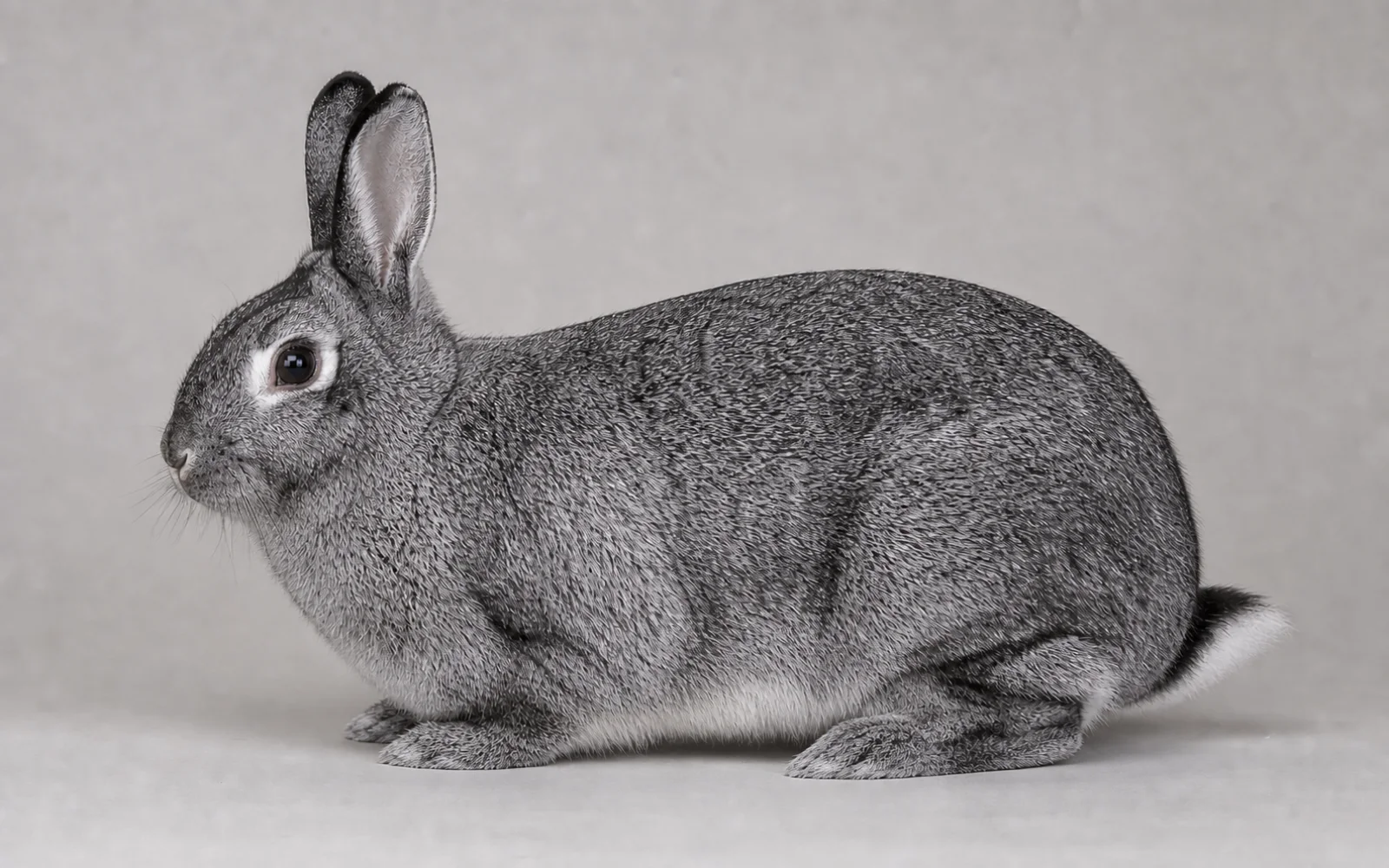
The January 2026 ARBA guide lists one Standard variety and six-class competition. The Livestock Conservancy gives adult males 12–15 lb (5.44–6.80 kg) and females 13–16 lb (5.90–7.26 kg); ARBA’s public maximum is 16 lb (7.26 kg). The club’s judging material calls for a moderately long, massive but balanced commercial body with a gradual arch, not a stretched Flemish outline or compressed compact pose. Fur should be flyback normal fur. Chinchilla color depends on a dark slate-blue base, a pearl ring with black definition and a wavy gray/black surface, not flat “salt and pepper.” Size or gray ticking alone cannot establish pedigree.
A docile breed description is not a handling guarantee
The Livestock Conservancy labels the breed docile, useful population-level guidance but not a promise for every 7 kg rabbit. Pain, fear, socialization, reproductive state and restraint history still shape behavior. Work at floor level and reward voluntary contact. Plan transfers before lifting; use two capable handlers when necessary and support the chest and entire hindquarters without twisting the spine. Never lift by ears or loose skin alone. Provide large hiding areas, predictable routines, forage-based enrichment and compatible rabbit companionship. A powerful frightened individual requires more preparation, not force.
Large size demands space, traction and weight control
Provide a permanently connected enclosure long, wide and high enough for several full hops, upright rearing, turning, complete stretching, exploration and retreat. Surfaces must be dry, stable, non-slip and comfortable at rest; a board or mat can be one option but must remain clean and cannot replace movement space. Feed unlimited grass hay, constant fresh water, appropriate leafy greens and measured complete pellets adjusted to age, growth, reproduction and body condition. Do not feed toward maximum size. Inspect the dense normal coat during moulting and check nails, foot soles, hocks, gait, underside, urine staining, teeth, appetite, feces and weight routinely.
Sore hocks are multifactorial, not solved by one platform
MSD identifies pressure from wire or hard surfaces, trauma, wet contamination, body weight, paralysis, nervousness and genetics among ulcerative pododermatitis factors; peer-reviewed welfare evidence also finds greater frequency in heavier breeds and associations with age, weight, kindling history and claw length. Therefore, the old instruction that a solid platform is mandatory and preventive is incomplete. Use dry yielding rest, traction, room to change posture, correct nails, healthy body condition and frequent sole inspection. Redness, hair loss, callus, ulceration, altered gait or weight shifting needs veterinary assessment. Reduced appetite or feces, bloating, breathing difficulty, severe pain, weakness or lethargy are urgent.
Preserve a threatened breed with records, not output promises
Use verified Giant Chinchilla pedigrees and the current standard, especially because the Livestock Conservancy lists the population as Threatened and the club documents historical type drift. Record sex-specific mature weight, moderately long balance, movement, feet and hocks, flyback coat and each color band, bite, condition, behavior, matings, all births and losses, kit growth and doe recovery. Do not select extreme size at the cost of feet, mobility or reproduction. Conservation does not justify breeding unfit animals or close matings without managing relatedness. No reviewed standard proves a universal nine-kit litter, 56% yield, fixed 9–14-week market age, 2.3 kg fryer result, “exceptional” growth or a 10:1 doe-to-buck rule.
- Verify pedigree and manage relatedness in this Threatened heritage population.
- Select balanced movement, sound feet and flyback ring-colored fur before extreme size.
- Record every birth, loss and growth result; do not publish fixed production promises.
Frequently asked questions
How much does a Giant Chinchilla rabbit weigh?
The Livestock Conservancy gives males 12–15 lb (5.44–6.80 kg) and females 13–16 lb (5.90–7.26 kg). ARBA’s public maximum is 16 lb.
Who developed the Giant Chinchilla?
Edward H. Stahl developed it in the United States in 1921, and ARBA recognized it in 1928. The foundation was broader than the database’s simple two-breed formula.
What should Giant Chinchilla fur look like?
It is flyback normal fur with dark slate-blue undercolor, a light pearl ring edged by black and a wavy gray-and-black surface. A large gray rabbit is not automatically this breed.
Does a solid platform prevent sore hocks?
Not by itself. Pododermatitis is multifactorial. Dry comfortable rest, traction, movement, nail and weight control, hygiene and frequent foot inspection must work together.
- Breed standardAmerican Rabbit Breeders Association — Giant Chinchilla
- Breed standardGiant Chinchilla Rabbit Association — Giant Chin history
- Breed standardGiant Chinchilla Rabbit Association — Judging Giant Chinchillas
- Breed standardGiant Chinchilla Rabbit Association — Evaluating your Giant Chinchilla
- Breed standardThe Livestock Conservancy — Giant Chinchilla Rabbit
- Breed standardARBA — Rabbit Breed ID Guide (January 2026)
- Peer reviewedAnimals — Health and welfare of rabbits in production systems (2020)
- VeterinaryMSD Veterinary Manual — Noninfectious Diseases of Rabbits
- Animal welfareRSPCA — What should I feed my rabbits?
- Animal welfareRSPCA — How to keep rabbits healthy
- Animal welfareRSPCA — The ideal home for rabbits
- VeterinaryMSD Veterinary Manual — Management of Rabbits
- VeterinaryMSD Veterinary Manual — Nutrition of Rabbits
- VeterinaryMSD Veterinary Manual — Routine Health Care of Rabbits
This profile does not authenticate pedigree, diagnose foot disease or guarantee production. Confirm the current standard and make health or breeding decisions with a rabbit-experienced veterinarian.