A Florida project for a smaller working rabbit
The official club credits ARBA judge Orville Miliken with combining an albino American Dutch, a white Polish and a small but typey white New Zealand, followed by selection and linebreeding for a cobby, compact animal. It says the original aims were a smaller laboratory rabbit and a small fryer for smaller households. ARBA accepted the breed in 1967. The club also credits Fibber McGehee’s work from 1978 with improving type through Polish, New Zealand White and an unidentified small rabbit. These statements document purpose and development, but they do not prove a modern animal’s laboratory suitability, feed efficiency or carcass yield.
Compact type first, with one ruby-eyed white presentation
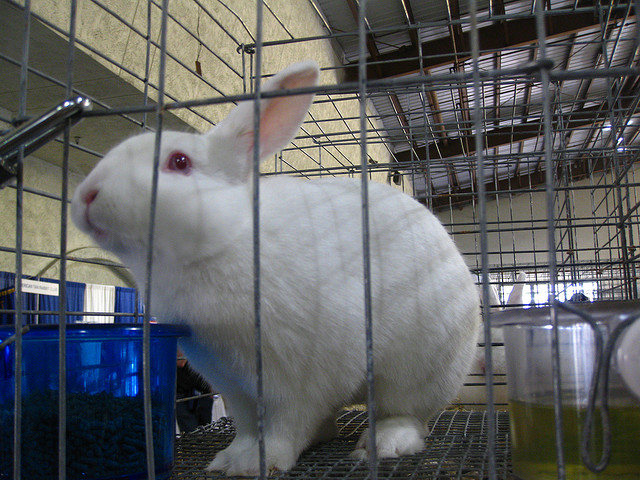
ARBA gives a maximum weight of 6 lb (2.72 kg), and the January 2026 guide places Florida White in a single Standard showroom and registration variety with four classes. The club says body or type carries 55 points, making compact balance and firm condition more decisive than whiteness alone. The coat is uniformly white and the eyes ruby/red in the breed phenotype. Rabbit molecular research shows that TYR variants can produce albinism by disrupting melanin production, but a ruby-eyed white phenotype occurs outside Florida Whites. Without pedigree and standard-conforming type, color alone is not breed identification.
Show success does not guarantee one universal temperament
Neither the public ARBA description nor the club history establishes that every Florida White is calm, docile or safe for unsupervised children. Behavior varies with pain, fear, socialization, reproductive state, environment and prior restraint. Work at floor level, allow voluntary approach and reward calm interaction. Avoid chasing and scruff-only lifting; when lifting is essential, support the chest and hindquarters. Provide hiding places, forage-based enrichment, predictable routines and compatible rabbit companionship. Judge suitability from the individual’s body language and recovery after handling, not from the old database label.
A smaller show rabbit still needs full movement space
The breed’s smaller frame does not justify compact housing. Provide a permanently connected dry, non-slip area where the rabbit can run, make several hops, rear upright, turn, stretch fully, forage and retreat. Feed unlimited grass hay, constant fresh water, appropriate leafy greens and measured complete pellets adjusted to age, growth, reproduction and body condition. Do not feed toward 2.72 kg; that number is a show ceiling. Inspect the normal short coat, underside and tail, remove loose hair during moulting, and monitor teeth, nails, feet, eyes, face symmetry, appetite, feces and weight. Adapt light and layout if the individual shows difficulty navigating.
Albino phenotype is relevant, but it is not a diagnosis
The reviewed veterinary sources do not define a disease unique to Florida Whites. Experimental rabbit studies show that deficient TYR function causes loss of melanin and that retinal development differs in albino research strains, but those findings do not mean every Florida White is blind or predict an individual’s functional vision. Observe navigation, startle responses, persistent head scanning, eye discharge, redness, cloudiness or apparent light discomfort and seek a rabbit-experienced veterinarian when function changes. General urgent signs include reduced eating or droppings, abdominal distension, breathing difficulty, severe pain, weakness or marked lethargy.
Breed for verified compact function, not production folklore
Use verified pedigrees and the current standard. Record mature weight and compact balance, coat and eye phenotype, bite and teeth, eyes and navigation, feet, body condition, handling response, digestive and reproductive history, every mating and birth, losses, kit growth and doe recovery. TYR research explains an albino phenotype but does not replace pedigree or prove Florida White identity. The original development for laboratory and fryer use is historical context, not evidence that every modern line achieves 65% dressing yield or superior feed conversion. No reviewed standard validates a universal seven-kit litter, first mating at four months, 8:1 ratio, fixed weaning age or processing at 8–10 weeks. Base timing on maturity, health, welfare and veterinary guidance.
- Verify pedigree: ruby-eyed white color occurs in multiple breeds and crosses.
- Select compact balance, teeth, eyes, feet, condition and behavior together.
- Record real herd outcomes instead of copying fixed litter or yield promises.
Frequently asked questions
How much does a Florida White rabbit weigh?
ARBA publishes a maximum show weight of 6 lb (2.72 kg). It is a judging ceiling, not a target weight or proof of breed identity.
Who developed the Florida White?
The official club credits ARBA judge Orville Miliken and records albino American Dutch, white Polish and a small white New Zealand in the foundation. ARBA accepted the breed in 1967.
Is every ruby-eyed white rabbit a Florida White?
No. Albino or ruby-eyed white phenotypes occur in several breeds and crosses. Pedigree, mature size and standard-conforming compact type are needed for breed identity.
Are Florida White rabbits blind because they are albino?
Do not assume blindness. Research shows albinism can alter retinal development, but functional vision varies and an individual needs observation and veterinary assessment rather than diagnosis from coat and eye color.
- Breed standardAmerican Rabbit Breeders Association — Florida White
- Breed standardFlorida White Rabbit Breeders Association — Breed history
- Breed standardARBA — Rabbit Breed ID Guide (January 2026)
- Peer reviewedScientific Reports — Functional validation of rabbit TYR albinism variant (2018)
- Peer reviewedDevelopmental Brain Research — Tyrosinase and retinal development in albino rabbits (1997)
- VeterinaryMSD Veterinary Manual — Noninfectious Diseases of Rabbits
- Animal welfareRSPCA — What should I feed my rabbits?
- Animal welfareRSPCA — How to keep rabbits healthy
- Animal welfareRSPCA — The ideal home for rabbits
- VeterinaryMSD Veterinary Manual — Management of Rabbits
- VeterinaryMSD Veterinary Manual — Nutrition of Rabbits
- VeterinaryMSD Veterinary Manual — Routine Health Care of Rabbits
This profile does not identify pedigree, diagnose vision or guarantee production. Confirm show rules with the current standard and health or breeding decisions with a rabbit-experienced veterinarian.