
Two German strains, not a French miniaturization date
ARBA says the “Eye of the Fancy” was developed in Germany from two distinct strains that were eventually combined. This establishes Germany and a multi-line development, while avoiding unsupported founder names or treating the breed as a direct scale copy of the French Blanc de Hotot. The larger Blanc contributed the visual idea of a white rabbit with dark eye bands, but the Dwarf Hotot is an independently standardized dwarf breed. ARBA recognized it in 1983, the same year the American Dwarf Hotot Rabbit Club says it was founded. The old database’s 1979 “recognition” may refer to an earlier European milestone, but it is not the ARBA date and is removed from the American profile.
A dwarf-type rabbit first, with a precise eye band
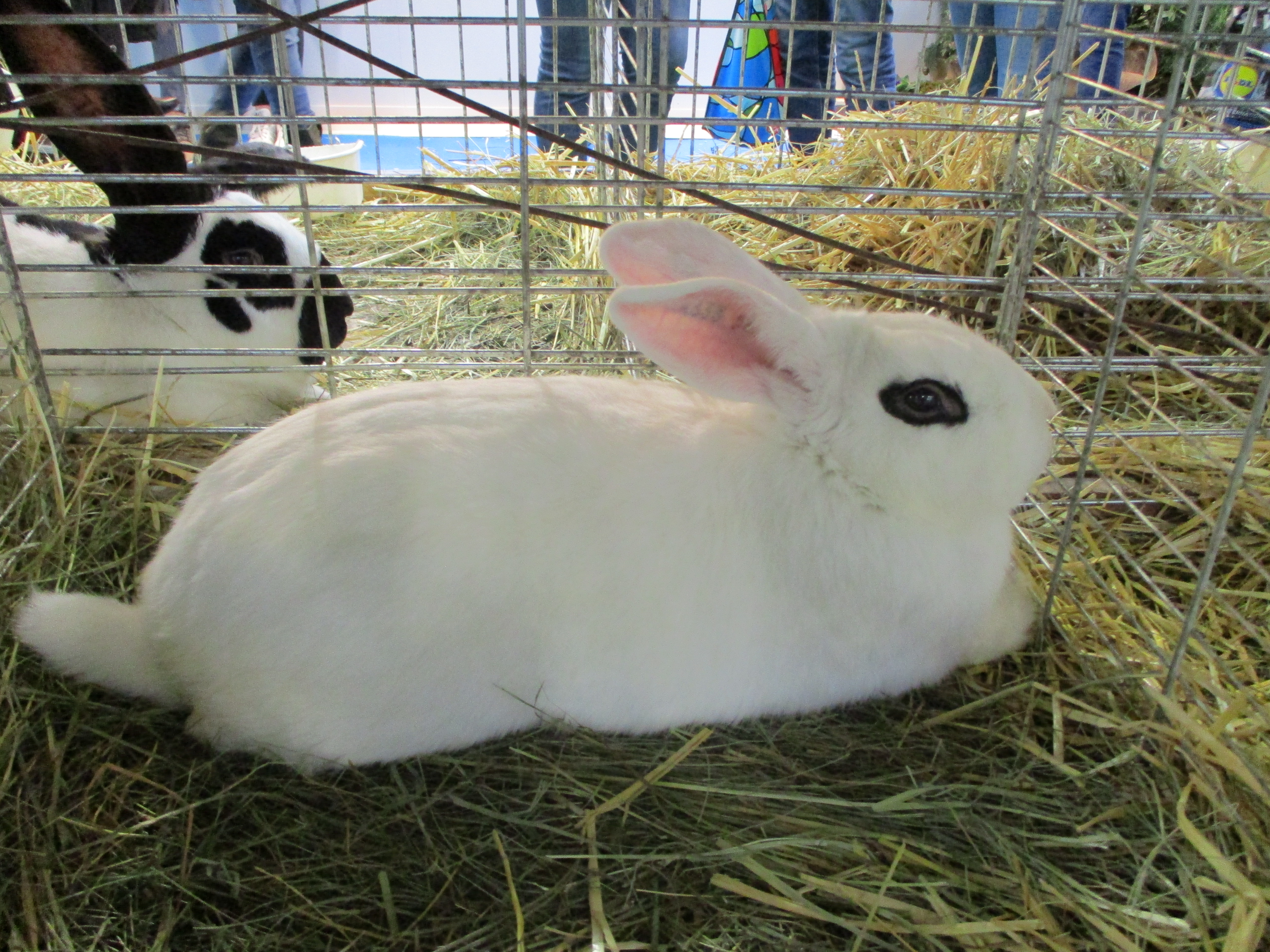
The club’s judging article emphasizes that Dwarf Hotots are not judged as a marked breed: 65 points concern body, head and ears, while the eye band receives 15. It should be a narrow, complete, well-defined band of colored fur following the eyelids, not pigment confined to the lid; breaks, missing bands and heavy feathering are serious faults or disqualifications under the cited guidance. The remainder of the coat is white. ARBA publishes a 3 lb (1.36 kg) maximum and four-class competition. Its January 2026 guide records Black, Blue, Chocolate and Lilac registration colors within the Standard showroom variety. These are show identifiers, not proof that an unpedigreed white pet with dark eye markings belongs to the breed.
Small and handleable does not mean child-proof
ARBA calls the breed easy to handle for children, but that short registry description cannot guarantee the behavior of every Dwarf Hotot or make unsupervised handling safe. Temperament varies with the individual, pain, fear, socialization, reproductive state and previous restraint. Work on the floor, let the rabbit approach, reward voluntary contact and avoid chasing or scruff-only lifting. When lifting is essential, support the chest and hindquarters despite the small size. Provide full-size hiding options, predictable routines, enrichment and compatible rabbit companionship. Select and house by observed body language, not by the “friendly,” “curious” or “playful” labels in the old card.
A small body still needs continuous movement space
Dwarf size does not justify a small enclosure. Provide a connected area where the rabbit can run, make successive hops, rear upright, turn, stretch fully, forage and hide on a dry, stable, non-slip surface. Feed unlimited grass hay, constant fresh water, appropriate leafy greens and measured complete pellets adjusted to age, growth, reproduction and body condition. Small animals can be overfed when portions are estimated by eye, so track condition and weight rather than feeding toward 1.36 kg. Inspect the short coat and underside routinely and remove loose hair during moulting. Also check incisors, face symmetry, eyes, tear staining, chin moisture and ability to chew and groom normally.
Do not turn the word dwarf into an unverified diagnosis
The reviewed sources do not define a disease unique to Dwarf Hotots. RSPCA warns that extreme shortened heads can affect teeth and tear drainage, so selection and daily checks should protect function rather than exaggerate roundness. A 2017 study identified a lethal homozygous HMGA2 deletion in dwarf rabbits, but a 2026 multi-breed study showed that the allele is not carried by every dwarf or small rabbit and did not establish Dwarf Hotot status from name alone. Therefore, do not label every neonatal loss a “peanut” or infer genotype visually; use line records and testing where relevant. Urgent warning signs include reduced eating or droppings, swelling, breathing difficulty, severe pain, weakness or marked lethargy.
Select complete function and verify genetics, not eyeliner alone
Use the current ARBA standard and verified pedigrees. Record adult type and weight, head and ear balance, eye-band color and continuity, white coat, bite, teeth, eyes, tear staining, breathing, movement, recurring illness, temperament, matings, all births and early losses, kit survival, growth and doe recovery. The 2026 ARBA guide should control current color naming, while the club’s point allocation prevents overselecting bands at the expense of sound type. Because HMGA2 research shows both a serious homozygous outcome and uneven distribution among breeds, genotype should be tested or inferred only from reliable line evidence—not assumed from “dwarf.” No source supports a universal litter of three, and a small average in one herd is not a species rule. Plan pairings under veterinary and welfare guidance.
- Verify pedigree: dark eye bands alone do not authenticate a Dwarf Hotot.
- Select body, head, ears, bite, eye health and temperament alongside the band.
- Record every birth and early loss; do not guess HMGA2 status from appearance.
Frequently asked questions
How much does a Dwarf Hotot rabbit weigh?
ARBA publishes a maximum show weight of 3 lb (1.36 kg). That is a judging ceiling, not a feeding target or proof of breed identity.
When was the Dwarf Hotot recognized by ARBA?
ARBA gives 1983, not the 1979 date in the old database. The official American specialty club also says it was founded in 1983.
What eye-band colors are current?
The January 2026 ARBA guide lists Black, Blue, Chocolate and Lilac registration colors within one Standard showroom variety. Check later standard updates before showing.
Does every Dwarf Hotot carry a lethal dwarf gene?
That cannot be concluded from the name or appearance. HMGA2 dwarf alleles can have lethal homozygous effects, but 2026 research confirms that not all dwarf and small rabbits carry the allele. Use verified line data or testing.
- Breed standardAmerican Rabbit Breeders Association — Dwarf Hotot
- Breed standardAmerican Dwarf Hotot Rabbit Club — Official club
- Breed standardAmerican Dwarf Hotot Rabbit Club — Judging the Dwarf Hotot
- Breed standardARBA — Rabbit Breed ID Guide (January 2026)
- Peer reviewedGenetics — HMGA2 deletion and dwarfism in rabbits (2017)
- Peer reviewedLivestock Science — HMGA2 dwarf allele distribution across rabbit breeds (2026)
- Animal welfareRSPCA — Extreme conformations in rabbits
- VeterinaryMSD Veterinary Manual — Noninfectious Diseases of Rabbits
- Animal welfareRSPCA — What should I feed my rabbits?
- Animal welfareRSPCA — How to keep rabbits healthy
- Animal welfareRSPCA — The ideal home for rabbits
- VeterinaryMSD Veterinary Manual — Management of Rabbits
- VeterinaryMSD Veterinary Manual — Nutrition of Rabbits
- VeterinaryMSD Veterinary Manual — Routine Health Care of Rabbits
This profile does not diagnose an animal, determine genotype or replace the current ARBA or national standard. Confirm health and breeding decisions with a rabbit-experienced veterinarian.