A documented 1877 French record and a distinct US branch
The Crème d’Argent Rabbit Federation reports that rabbits of this type were known in France by the mid-to-late 1800s and cites the first written description in the Live Stock Journal: an 1877 exhibition near Paris. That is more precise than inventing a single creation year of 1880. The club says the breed arrived in the United States before 1924, was kept both pure and in crosses, appeared at the 1936 Fort Wayne show and gained a working American standard in 1938. Selection produced the deeper-bodied American commercial form, distinct from the original European type. Current conservation relevance is substantial: The Livestock Conservancy lists Crème d’Argent as Watch in its 2026 priority list.
Cream surface, orange cast and orange undercolor
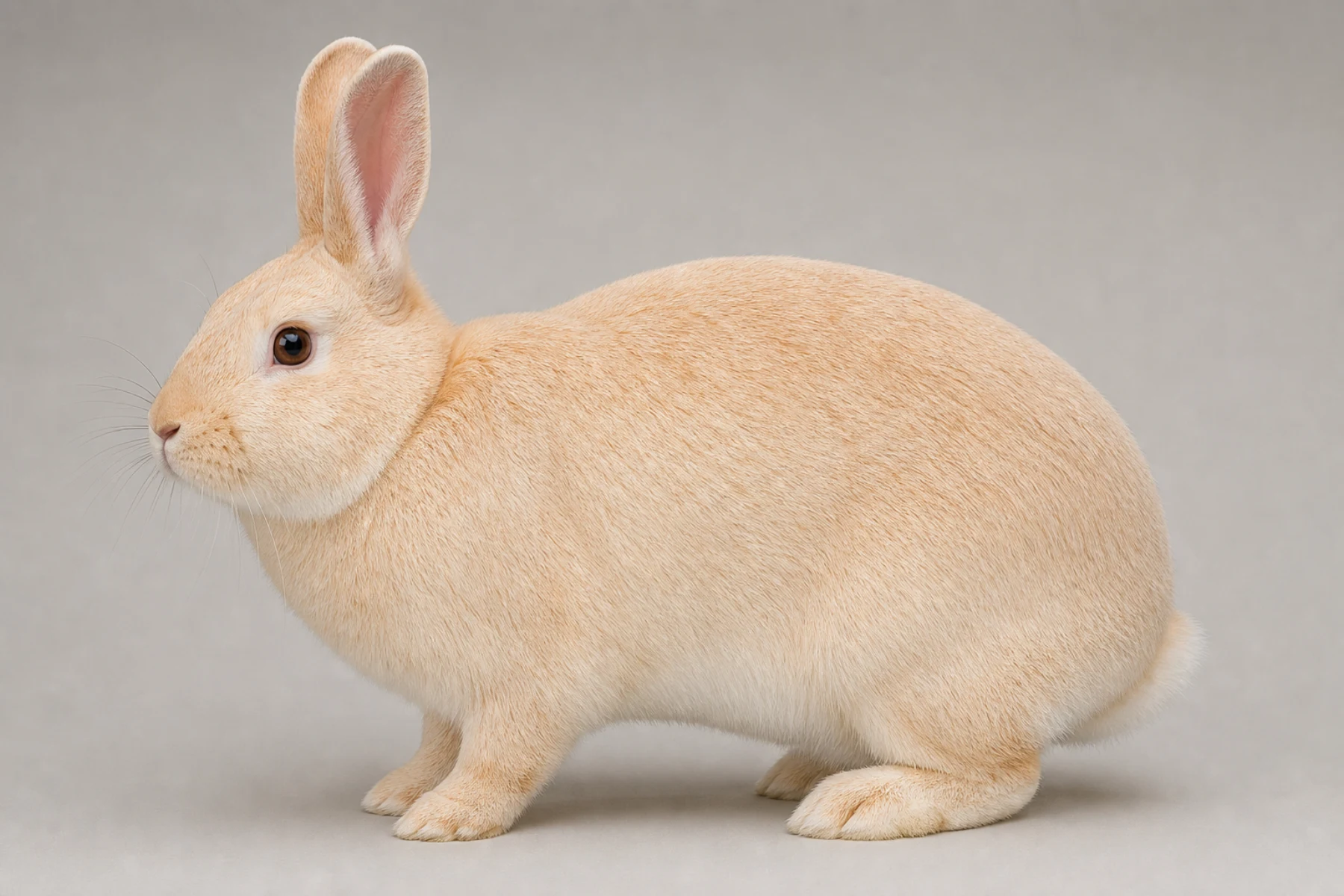
ARBA calls for creamy-white surface color with a bright orange undercolor, while the federation adds an orange cast and orange guard hairs distributed through the coat. The January 2026 ARBA identification guide lists one Standard variety in six-class competition. Senior bucks are 8–10.5 lb (3.63–4.76 kg), senior does 8.5–11 lb (3.86–4.99 kg), and ARBA’s public maximum is 11 lb. This is not simply a pale Champagne d’Argent: the Crème’s orange undercolor and guard hairs are defining clues, although color or a photograph alone cannot prove pedigree. American selection also changed body type from the earlier European population, so standards must be matched to country.
A favorable breed reputation is not a promise
The US federation describes Crèmes as generally calm and easy to handle, but this is a club characterization rather than evidence that every animal is docile or safe for children. Temperament varies with pain, fear, socialization, reproductive state and handling history. Let the rabbit approach at floor level, use rewards and avoid chasing or scruff-only restraint. When lifting is essential, support both chest and hindquarters. Provide hiding places, predictable routines, enrichment, enough continuous space and compatible rabbit companionship. Select breeding animals for recorded handling response and maternal behavior instead of assuming that coat color guarantees personality.
Feed body condition, not the top of the show range
Provide unlimited grass hay, constant fresh water, appropriate leafy greens and measured complete pellets adjusted to age, growth, reproduction and body condition. Do not feed every adult toward the 4.99 kg maximum. The normal coat needs regular hands-on inspection and removal of loose hair during moulting; silvered appearance does not create a special grooming method. Housing must allow running, successive hops, rearing, turning, fully stretched rest, foraging and hiding on a dry, stable, non-slip surface. Supply shade, ventilation and weather protection. A heritage or meat history does not reduce the rabbit’s welfare needs, and a commercial label is not a target for rapid forced growth.
No verified disease exclusive to the Crème d’Argent
The reviewed breed and veterinary sources do not define a Crème-specific disease syndrome. Monitor the same high-value rabbit indicators: appetite, faecal output, weight and body-condition trend, teeth, breathing, eyes, nose, skin, underside, urine staining, feet and movement. Pododermatitis and obesity are management-sensitive problems influenced by flooring, moisture, activity, diet and anatomy, not automatic breed diagnoses. Reduced eating or droppings, abdominal distension, breathing difficulty, severe pain, weakness or marked lethargy requires prompt care from a rabbit-experienced veterinarian. Breeding stock should be assessed for recurring health problems, not selected on rare color alone.
Conserve a rare population with pedigrees and measured records
Use the current national standard, verified pedigrees and a plan that limits avoidable loss of genetic diversity. Record mature commercial type, sex-specific weight, creamy-white surface, orange cast, bright orange undercolor, guard hairs, coat condition, teeth, feet, recurring illness, temperament, matings, kindlings, kit survival, growth and doe recovery. The Livestock Conservancy’s 2026 Watch status makes accurate identity and coordination between breeders more important than producing color-only crosses. The club notes typical litters of five to eight and a reputation for good mothering, but neither is guaranteed. No reviewed authority supports a fixed seven kits, 58% carcass yield, 14-week market endpoint, 10:1 ratio or universal breeding calendar; measure each line under local welfare and veterinary rules.
- Verify pedigree: pale silvering alone does not identify a Crème d’Argent.
- Select the orange-undercolor standard together with health, feet and maternal records.
- Coordinate pairings to preserve diversity instead of chasing fixed output formulas.
Frequently asked questions
How much does a Crème d’Argent rabbit weigh?
The US club gives senior bucks as 3.63–4.76 kg and senior does as 3.86–4.99 kg. ARBA’s public maximum is 4.99 kg.
When did the Crème d’Argent originate?
The official club places it in mid-to-late nineteenth-century France and cites an 1877 exhibition near Paris as the first written account. “Created in 1880” is not sufficiently documented.
How is Crème d’Argent different from Champagne d’Argent?
The American Crème standard emphasizes a creamy-white surface, orange cast, bright orange undercolor and orange guard hairs. Champagne has a different silvered color pattern and is a separate breed.
Why was the old Crème d’Argent photo replaced?
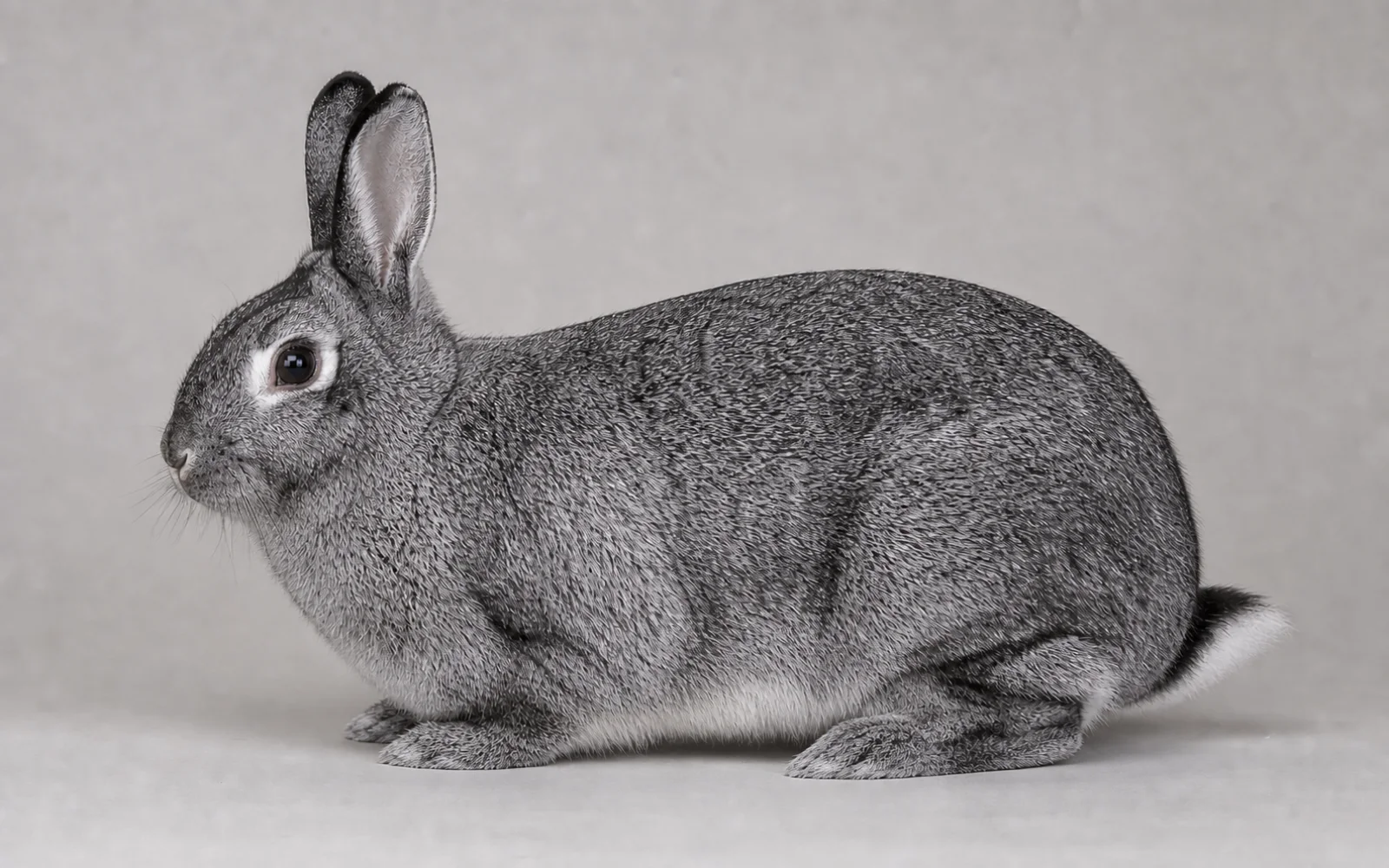
Wikimedia identifies the pictured young rabbits as Champagne d’Argent. No exact licensed Crème photo was verified, so this page uses a clearly labelled reference illustration.
- Breed standardAmerican Rabbit Breeders Association — Crème d’Argent
- Breed standardCrème d’Argent Rabbit Federation — Breed history and characteristics
- Breed standardARBA — Rabbit Breed ID Guide (January 2026)
- Breed standardThe Livestock Conservancy — 2026 Conservation Priority List
- Animal welfareARBA — Recommendations for the Care of Rabbits and Cavies
- VeterinaryMSD Veterinary Manual — Noninfectious Diseases of Rabbits
- Animal welfareRSPCA — What should I feed my rabbits?
- Animal welfareRSPCA — How to keep rabbits healthy
- Animal welfareRSPCA — The ideal home for rabbits
- VeterinaryMSD Veterinary Manual — Management of Rabbits
- VeterinaryMSD Veterinary Manual — Nutrition of Rabbits
- VeterinaryMSD Veterinary Manual — Routine Health Care of Rabbits
This profile does not diagnose an animal or replace the current ARBA or national standard. Confirm show rules locally and health decisions with a rabbit-experienced veterinarian.