A documented Montana family project, not a 1960 breed
The Cinnamon Rabbit Breeders Association republishes an April 1979 interview with Ellis Houseman. It says Belle and Fred Houseman received a Chinchilla doe at Easter 1962, crossed her with a New Zealand buck and retained a crossbred buck. Through 4-H they later obtained a Checkered Giant doe and a crossbred Californian doe; russet young appeared, and a selected pair produced a high proportion of similar color. The family presented the developing breed at ARBA conventions from 1969 and achieved recognition at Tacoma in 1972. That primary club account resolves the database’s conflicting 1960/1962 dates in favor of 1962.
Russet is only the base of a layered Cinnamon coat
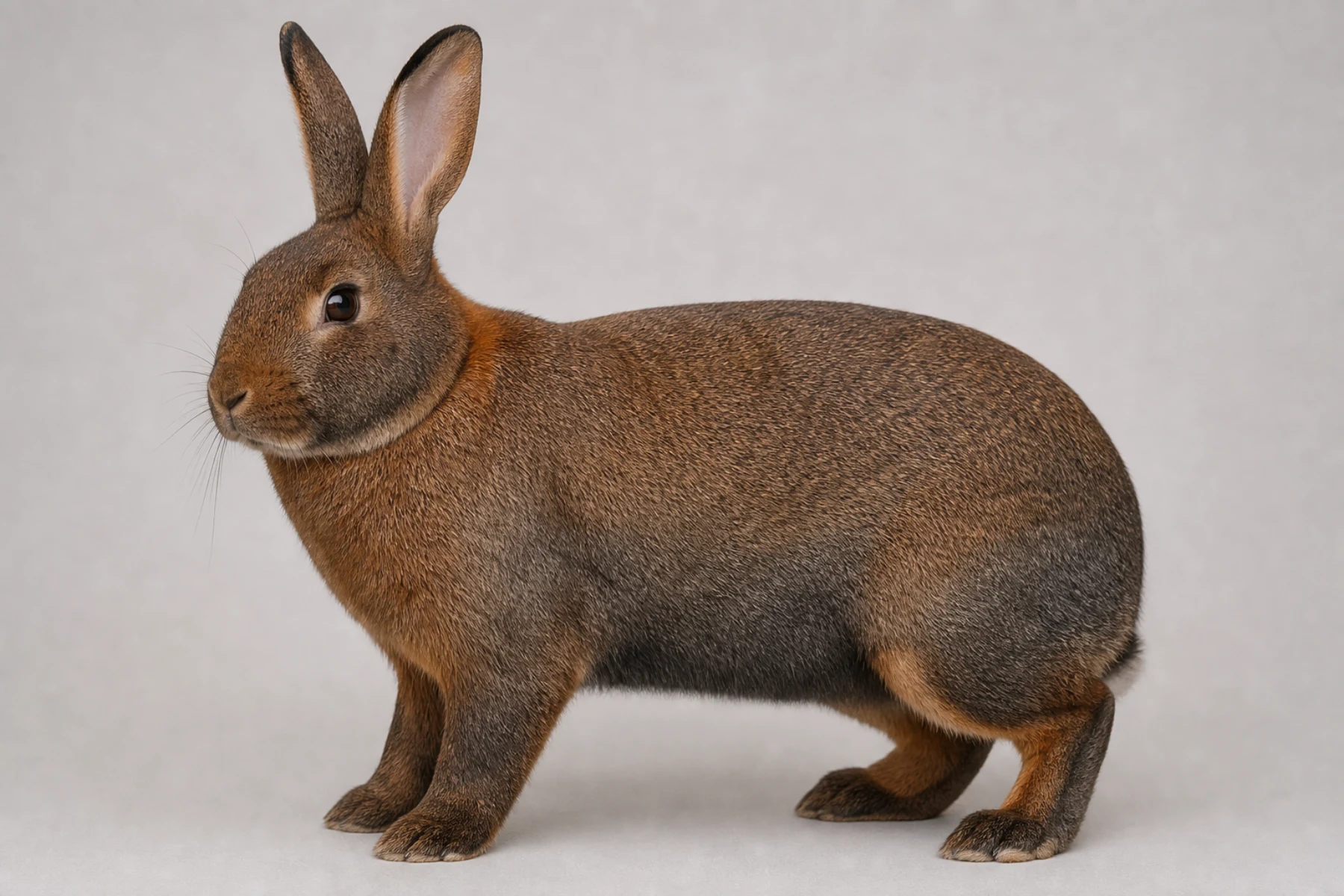
ARBA describes a commercial breed with a rust or ground-cinnamon surface, uniform gray ticking over the back, smoky-gray sides, a dark underbelly and orange undercolor throughout. This layered effect is why a generic red, chestnut or wild-agouti rabbit is not automatically a Cinnamon. The January 2026 ARBA guide lists one Standard variety and six-class competition. Ohio State’s ARBA profile gives adult bucks as 8.5–10.5 lb (3.86–4.76 kg) and does as 9–11 lb (4.08–4.99 kg); ARBA’s public page gives the 11 lb maximum. These are show contexts, not feeding targets or proof of pedigree.
No standard can promise a universally calm rabbit
The current ARBA description covers history, color, commercial type and meat value, but does not establish that every Cinnamon is calm, friendly, lazy or ideal for children. Temperament depends on the individual, pain, fear, socialization, reproductive state and handling history. Let the rabbit approach at floor level, use rewards, support the chest and hindquarters when lifting is essential, and avoid chasing or scruff-only restraint. Provide hiding places, predictable routines, enrichment and continuous space with a compatible rabbit rather than selecting or housing by a breed stereotype.
Manage the commercial body by condition, not maximum weight
Provide unlimited grass hay, fresh water, appropriate leafy greens and measured complete pellets adjusted for age, growth, reproduction and body condition. Do not feed every adult toward the 4.99 kg show maximum. The normal coat needs routine hands-on checks and extra loose-fur removal during moulting, but not Rex or Angora grooming assumptions. Give dry, non-slip resting surfaces and continuous room to run, hop, rear, stretch, forage and hide. The database’s claim of special frost resistance is not established by the standard; all rabbits need shade, ventilation, weather protection and gradual environmental adaptation.
No verified Cinnamon-exclusive disease syndrome
The reviewed breed, university and veterinary sources do not define a unique Cinnamon disease list. Obesity and sore hocks are rabbit health problems influenced by diet, activity, body condition, flooring, moisture and individual anatomy; they are not enough to label every Cinnamon predisposed or every buck lazy. Check appetite, faecal output, weight trend, teeth, breathing, eyes, nose, skin, underside, urine staining, feet and movement. Reduced eating or droppings, abdominal distension, breathing difficulty, severe pain, weakness or marked lethargy requires prompt care from a rabbit-experienced veterinarian.
Preserve the layered color with health and production records
Use the current ARBA standard and verified pedigrees. Record mature body type and sex-specific weight, rust surface, even gray ticking, smoky sides, dark belly, orange undercolor, coat condition, teeth, feet, recurring illness, handling response, matings, kindlings, kit survival, growth and doe recovery. Color alone cannot authenticate a Cinnamon, and historical founder crosses are not instructions to recreate the breed from first-generation mixes. No cited authority supports one buck per eight does, weaning universally at four to five weeks, a 42-day remating cycle, a fixed litter of seven, 59% yield or guaranteed market weight at 12 weeks; measure outcomes under local welfare and veterinary rules.
- Distinguish the Cinnamon breed from a generic cinnamon-colored rabbit.
- Select layered color, commercial type, sound feet, health and maternal records together.
- Replace fixed production promises with measured line-specific records.
Frequently asked questions
How much does a Cinnamon rabbit weigh?
Ohio State’s ARBA profile lists adult bucks at 8.5–10.5 lb (3.86–4.76 kg) and does at 9–11 lb (4.08–4.99 kg). ARBA’s public maximum is 11 lb.
When and where was the Cinnamon rabbit created?
The official club documents Belle and Fred Houseman’s project beginning in Missoula, Montana in 1962. ARBA recognized the breed in 1972.
What does a true Cinnamon coat look like?
It combines a rust or ground-cinnamon surface with even gray back ticking, smoky-gray sides, a dark belly and orange undercolor. Brown color alone does not prove the breed.
Why was the database photograph replaced?
Wikimedia identifies it as a broken castor Rex, not a Cinnamon. With no suitably licensed exact-breed photograph verified, this profile uses a clearly labelled reference illustration.
- Breed standardAmerican Rabbit Breeders Association — Cinnamon
- Breed standardCinnamon Rabbit Breeders Association — Breed Information and Houseman Interview
- Breed standardARBA — Rabbit Breed ID Guide (January 2026)
- UniversityOhio State University Extension 4-H — ARBA Rabbit Breed Profiles
- Animal welfareARBA — Recommendations for the Care of Rabbits and Cavies
- VeterinaryMSD Veterinary Manual — Noninfectious Diseases of Rabbits
- Animal welfareRSPCA — What should I feed my rabbits?
- Animal welfareRSPCA — How to keep rabbits healthy
- Animal welfareRSPCA — The ideal home for rabbits
- VeterinaryMSD Veterinary Manual — Management of Rabbits
- VeterinaryMSD Veterinary Manual — Nutrition of Rabbits
- VeterinaryMSD Veterinary Manual — Routine Health Care of Rabbits
This profile does not diagnose an animal or replace the current ARBA or national standard. Confirm show rules locally and health decisions with a rabbit-experienced veterinarian.