European Giant Papillon roots, then an American standard
ARBA verifies recognition in 1919, and the American club says the breed was developed in Europe, where the related population is known as Giant Papillon. A 1958 club bulletin gives a more specific historical account: it places early development in France, describes later German work on markings and records arrival in the United States around 1918. That retrospective account is useful but is not the same as a modern genetic pedigree. The database’s one-country “Germany” origin therefore overstates certainty. Use European or Giant Papillon background for the broad history, and distinguish today’s US standard because the club says American and European markings are not identical.
A full-arch running giant with defined markings
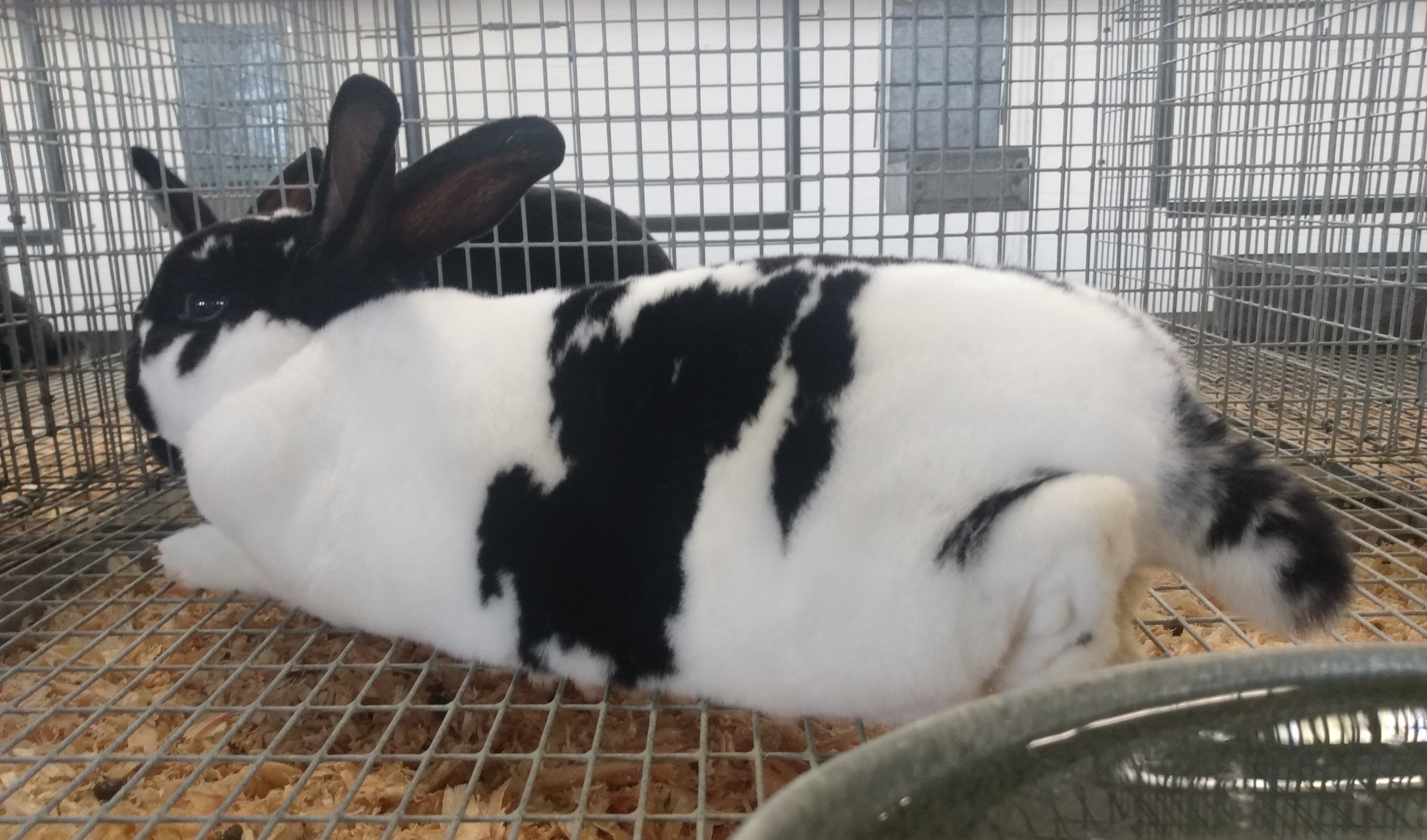
ARBA describes an arched body and a running breed: the animal is evaluated in an extended, moving posture rather than as a compact commercial block. The club publishes mature minimums of 11 lb (4.99 kg) for bucks and 12 lb (5.44 kg) for does, with no maximum, so the database’s 7–7.5 kg ceilings are incorrect. US varieties are Black and Blue. Historically codified pattern elements include a butterfly nose marking, eye circles, cheek spots, colored ears, a spine stripe and separated side spots on white. Those features help identification, but only pedigree and the current standard establish breed and show quality; a spotted coat by itself does neither.
“Running breed” describes type, not a guaranteed temperament
ARBA’s term running breed refers to how the full arch and movement are presented. It supports expecting an active rabbit and planning generous exercise room, but it does not establish that every Checkered Giant is nervous, difficult or unsuitable as a companion. Judge the individual’s pain, fear, socialization and handling history. Work at floor level, reward voluntary approach, support the chest and powerful hindquarters when lifting is essential, and avoid chasing or scruff-only restraint. A compatible rabbit companion, hiding choices and predictable routines support normal behavior.
Extra floor length and height are essential for this giant
ARBA’s care table places Checkered Giants in the largest weight group and adds an asterisk for breeds needing extra floor space or height because of their desire to move; it also calls for exercise when a larger enclosure cannot be provided. Treat that table as a minimum reference, not an ideal home. Provide continuous non-slip space for several full strides, upright rearing, turning, stretching and hiding. Feed unlimited grass hay, fresh water, appropriate leafy greens and measured complete pellets according to age, body condition and reproductive state. Alfalfa is not universally forbidden: MSD distinguishes richer legume hay from grass hay and diet should be chosen for the individual.
Large size changes monitoring, not the diagnosis
The reviewed breed sources do not establish a unique Checkered Giant disease syndrome. A large body makes traction, dry resting surfaces, nail care, safe lifting and regular inspection of the feet and hocks especially important; MSD discusses sore hocks as a multifactorial rabbit problem rather than a breed destiny. Track appetite, faeces, weight and body condition, teeth, breathing, eyes, nose, skin, underside, urine staining and gait. Reduced eating or droppings, abdominal swelling, breathing difficulty, severe pain, weakness or marked lethargy needs prompt rabbit-experienced veterinary assessment.
Select health, movement and pattern without invented output guarantees
Use the current registry standard and keep pedigrees distinct from European Giant Papillon populations where rules differ. Record mature sex-specific weight, full arch, sound movement, feet and hocks, teeth, body condition, facial and body markings, color, temperament during handling, matings, kindlings, kit survival and doe recovery. Pattern selection should never justify breeding animals with poor function or chronic illness. The cited standards do not verify a universal litter of eight, 52% carcass yield, slaughter at 16 weeks or a fixed production purpose; those outcomes depend on line, management, nutrition, market and welfare constraints.
- Apply minimum weights: 4.99 kg for bucks and 5.44 kg for does; there is no ARBA maximum.
- Record full-arch movement, feet, health and markings together.
- Do not transfer European marking rules automatically to US show stock.
Frequently asked questions
How much does a Checkered Giant rabbit weigh?
For mature ARBA stock, bucks must be at least 11 lb (4.99 kg) and does at least 12 lb (5.44 kg). ARBA publishes no maximum.
Is Checkered Giant the same as Giant Papillon?
They share the European breed background, and the US club uses Giant Papillon for the European population. However, it also warns that American and European marking requirements differ.
What colors and markings does ARBA recognize?
The US varieties are Black and Blue. The pattern includes characteristic facial, ear, spine and side markings on white; use the current standard for exact show tolerances.
Is the database photo an exact Checkered Giant?
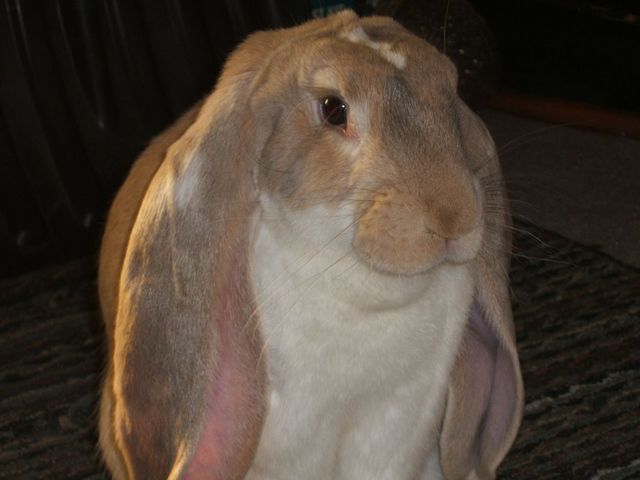
No. It is labelled on Wikimedia as a German Giant Spotted rabbit, a European counterpart. This profile uses a photograph explicitly identified as a Checkered Giant.
- Breed standardAmerican Rabbit Breeders Association — Checkered Giant
- Breed standardAmerican Checkered Giant Rabbit Club — Breed history, weight and varieties
- Breed standardARBA Digital Library — Checkered Giant club bulletin (1958)
- Breed standardARBA Digital Library — Standard for Checkered Giants (1926)
- Breed standardARBA — Rabbit Breed ID Guide (January 2026)
- Animal welfareARBA — Recommendations for the Care of Rabbits and Cavies
- VeterinaryMSD Veterinary Manual — Noninfectious Diseases of Rabbits
- Animal welfareRSPCA — What should I feed my rabbits?
- Animal welfareRSPCA — How to keep rabbits healthy
- Animal welfareRSPCA — The ideal home for rabbits
- VeterinaryMSD Veterinary Manual — Management of Rabbits
- VeterinaryMSD Veterinary Manual — Nutrition of Rabbits
- VeterinaryMSD Veterinary Manual — Routine Health Care of Rabbits
This profile does not diagnose an animal or replace the current ARBA or national standard. Confirm show rules locally and health decisions with a rabbit-experienced veterinarian.