
An old Champagne population with an uncertain starting date
ARBA cautiously says the breed may have been present in France by the mid-1600s but that its specific origins are unknown. FFC’s current record gives Champagne, France as the origin, regional silver rabbits as the ancestry, an archival illustration from 1912 and the first approved standard on 30 December 1920. Those are different levels of evidence. A modern profile should describe the breed as old without turning the database’s exact 1631 date into a verified document. The French name is Argenté de Champagne; ARBA uses Champagne d’Argent.
Old-silver surface over a dark slate-blue undercolor
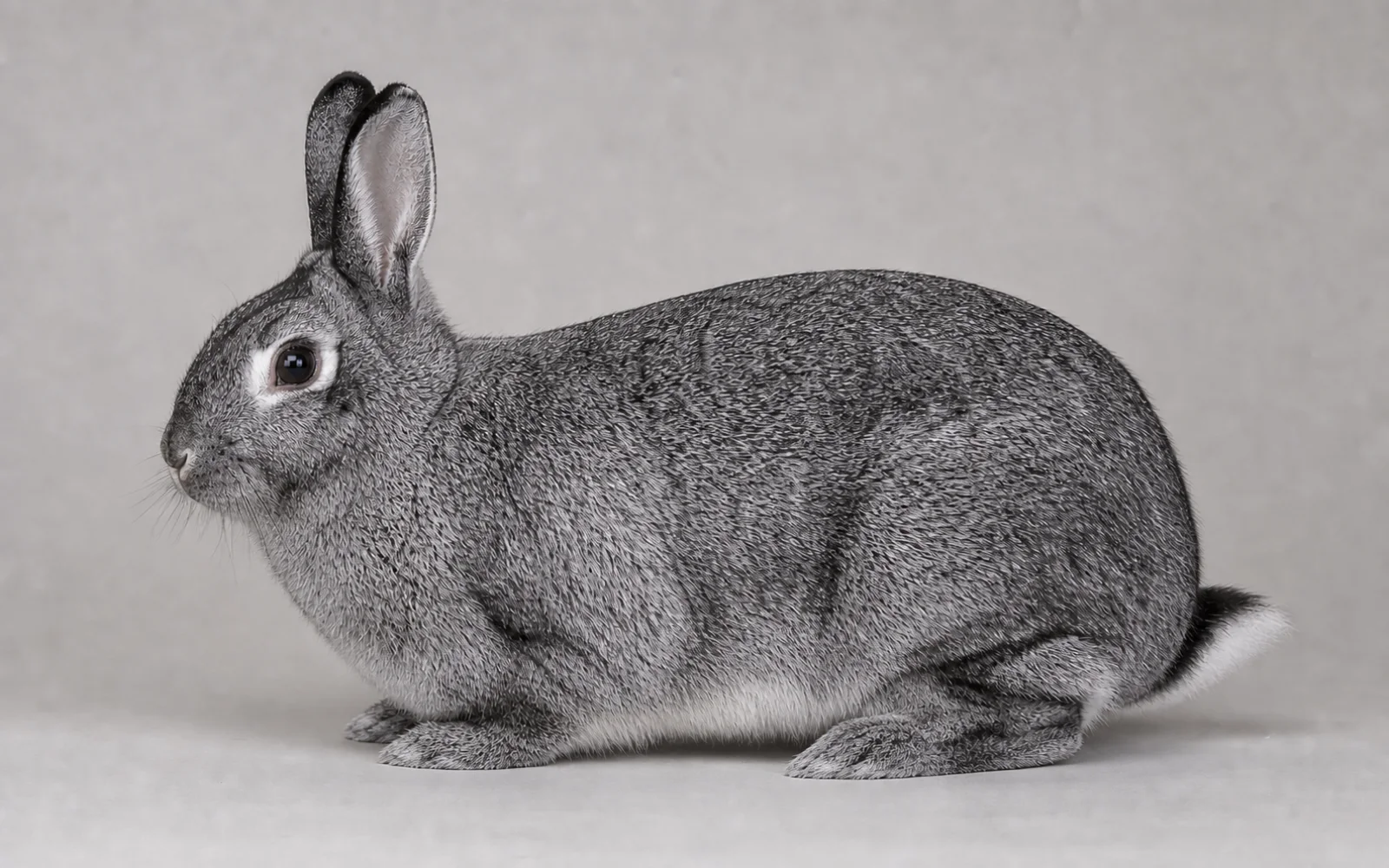
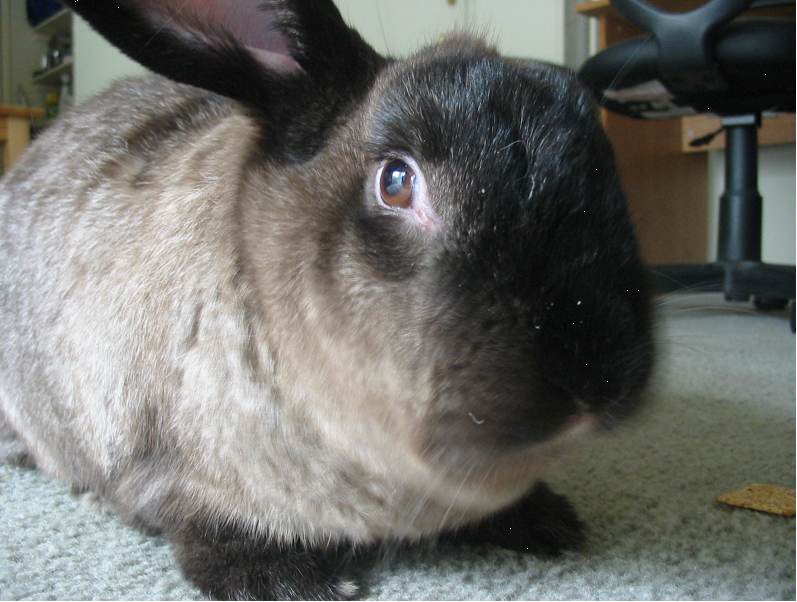
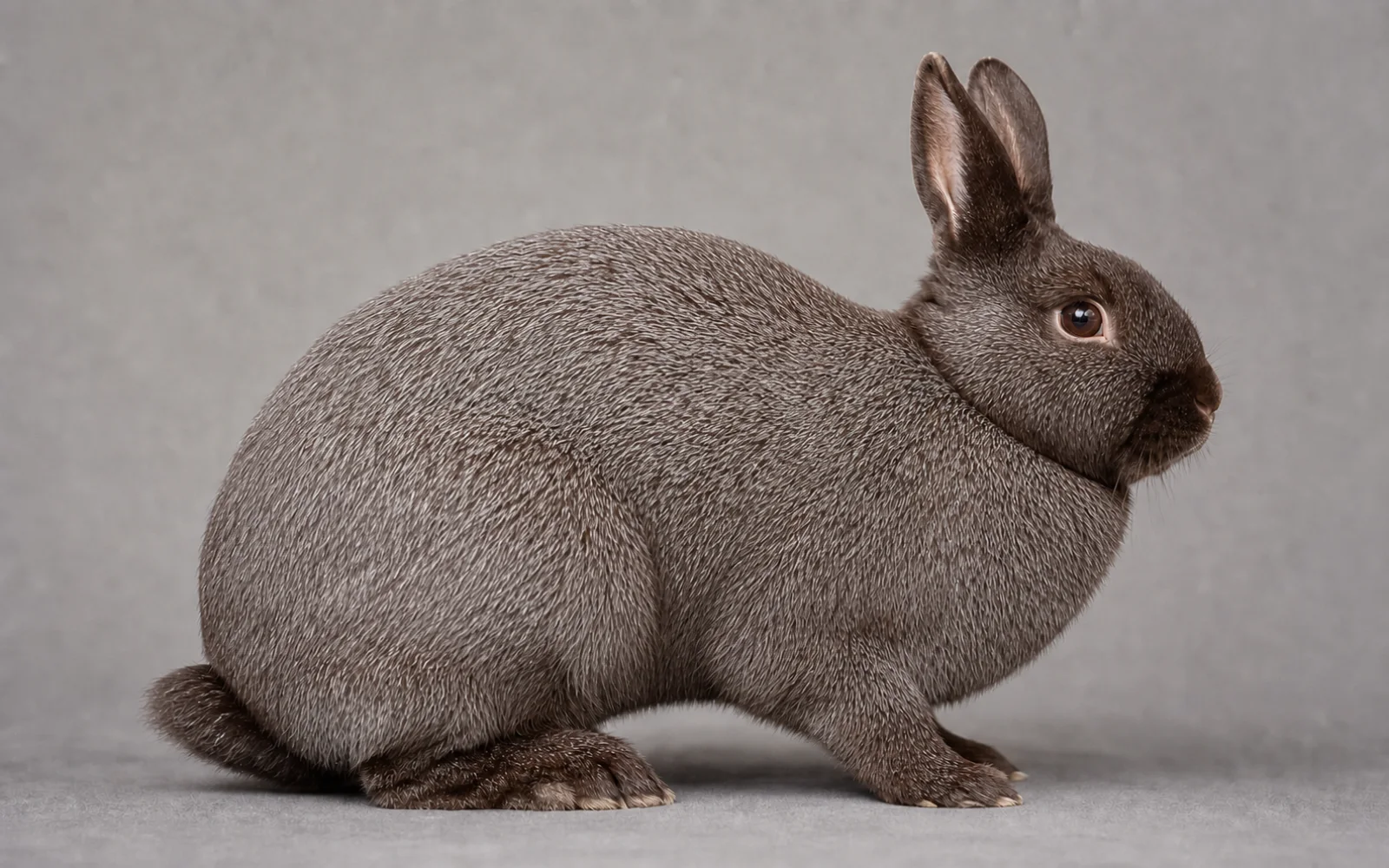
FFC calls for a harmoniously rounded, massive-looking body, short nape, arched topline peaking at the hips and a full rounded rump. The fairly long, very dense coat should remain supple. Numerous hairs with depigmented tips, black guard hairs and the visible dark slate-blue undercolor create a uniform pale bluish-gray old-silver effect; the undercolor continues across the belly. Agriculture Canada documents that kits are black at birth and become silver gradually. OSU Extension notes that silvering places white hairs among a darker coat and that the causal gene has not yet been identified, so a visual silver coat alone does not verify pedigree.
A calm reputation is not a behavioral guarantee
The current ARBA and FFC public breed descriptions do not establish that every Champagne is calm, docile or automatically suitable for a beginner. Evaluate the individual’s pain, fear, handling history and response to people and rabbits. Habituate with rewards, support the large body and hindquarters, and avoid chasing or scruff-only restraint. Provide continuous space to run, rear, hide and rest with a compatible rabbit; a large commercial body still needs choice and enrichment.
Manage a large body and a dense coat by condition
Provide unlimited grass hay, fresh water, suitable leafy greens and measured complete pellets, adjusting energy to growth, reproduction and body condition rather than feeding every rabbit toward the 5.44 kg maximum. During moulting, remove loose fur and inspect the dense coat, skin, underside, tail, feet and hocks. Use dry, clean resting surfaces and enough non-slip room for full strides and upright posture. The French ideal and US maximum are show references, not feeding targets or universal healthy weights.
No verified Champagne-specific disease syndrome
The cited standard, university and genomic sources do not define an exclusive Champagne d’Argent disease list. Monitor appetite, faecal output, weight trend, teeth, breathing, eyes, nose, skin under the dense coat, urine staining, feet and movement. Reduced eating or droppings, abdominal distension, breathing difficulty, severe pain, weakness or marked lethargy requires prompt assessment by a rabbit-experienced veterinarian. Coat silvering is pigmentation, not by itself illness or premature age-related greying.
Record the development of silvering instead of promising output
Evaluate mature animals against the relevant registry: rounded body, full rump, uniform old-silver surface, dark slate undercolor including the belly, guard-hair distribution, coat density, eyes, teeth, feet and health. Photograph kits at consistent ages because the coat changes from black toward silver; do not cull healthy young solely because adult silvering is incomplete early. OSU says the causal silvering gene is still unidentified, and a 2023 genomic study found breed-level selection signals rather than a simple farm-side DNA rule. No standard supports guaranteed five-to-eight kits, 12–16-week slaughter, 58% yield, fixed 80-day cycles or universal calmness.
- Separate the uncertain mid-1600s history from the verified 1920 standard.
- Judge mature silvering, slate undercolor, body and health together.
- Record litter and growth outcomes locally instead of using database promises.
Frequently asked questions
How much does a Champagne d’Argent weigh?
FFC’s current ideal is 4.5–5.25 kg. ARBA publishes a maximum of 12 lb (5.44 kg); these are registry contexts, not a target for every rabbit.
Are Champagne d’Argent kits born silver?
No. Agriculture Canada documents black newborns that gradually become silver as the coat develops.
Is the breed documented from 1631?
The reviewed primary sources do not verify that exact year. ARBA says it may date to the mid-1600s but the origin is unknown; FFC verifies the 1920 French standard.
Is the database photograph a real Champagne d’Argent?
Yes. Wikimedia explicitly identifies the subjects as young Champagne d’Argent rabbits and releases the photograph to the public domain.
- Breed standardFédération Française de Cuniculiculture — Argenté de Champagne (2026)
- Breed standardAmerican Rabbit Breeders Association — Champagne d’Argent
- GovernmentAgriculture Canada — Raising Meat Rabbits
- UniversityOregon State University Extension — Rabbit Coat Color Genes: Silvering
- Peer reviewedJournal of Animal Breeding and Genetics — Population Genomics of Rabbit Breeds (2023)
- VeterinaryMSD Veterinary Manual — Noninfectious Diseases of Rabbits
- Animal welfareRSPCA — What should I feed my rabbits?
- Animal welfareRSPCA — How to keep rabbits healthy
- Animal welfareRSPCA — The ideal home for rabbits
- VeterinaryMSD Veterinary Manual — Management of Rabbits
- VeterinaryMSD Veterinary Manual — Nutrition of Rabbits
- VeterinaryMSD Veterinary Manual — Routine Health Care of Rabbits
This profile does not diagnose an animal or replace the current ARBA, FFC or national standard. Confirm show requirements locally and health decisions with a rabbit-experienced veterinarian.