
A documented Tatarstan breeding program, not a generic black cross
The federal research institute credits F.V. Nikitin at the Biryulinsky fur farm with the 1942–1948 program and approval in 1948. It describes a complex reproductive cross of Flemish, White Giant and Vienna Blue, followed by breeding the first-generation population within itself without further foundation-breed input. The Great Russian Encyclopedia independently lists the same three breeds. The database claim involving White Vienna and Gray Giant therefore needs correction, and Chinchilla should not be added without evidence.
A black veil over zoned dark-brown fur
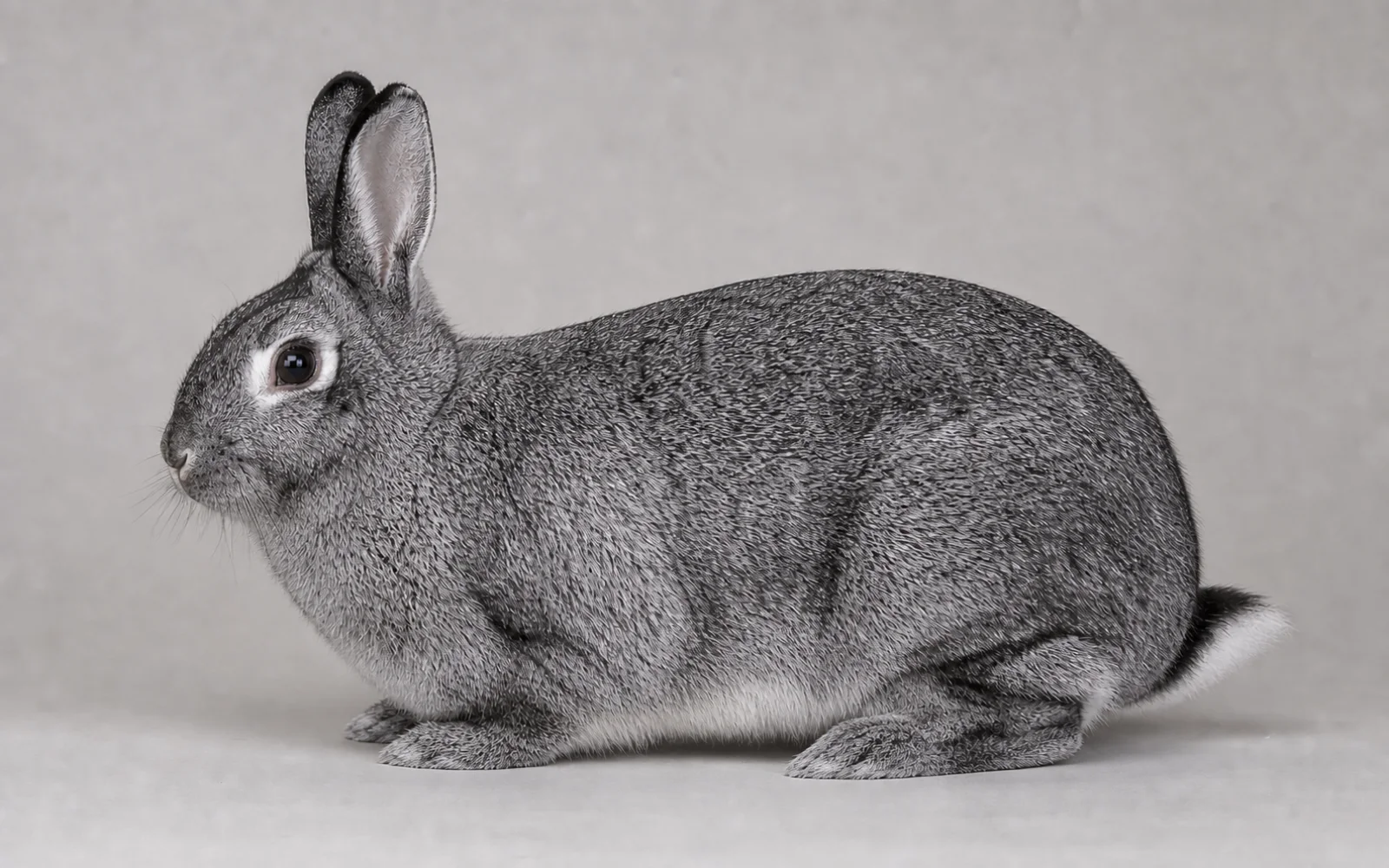
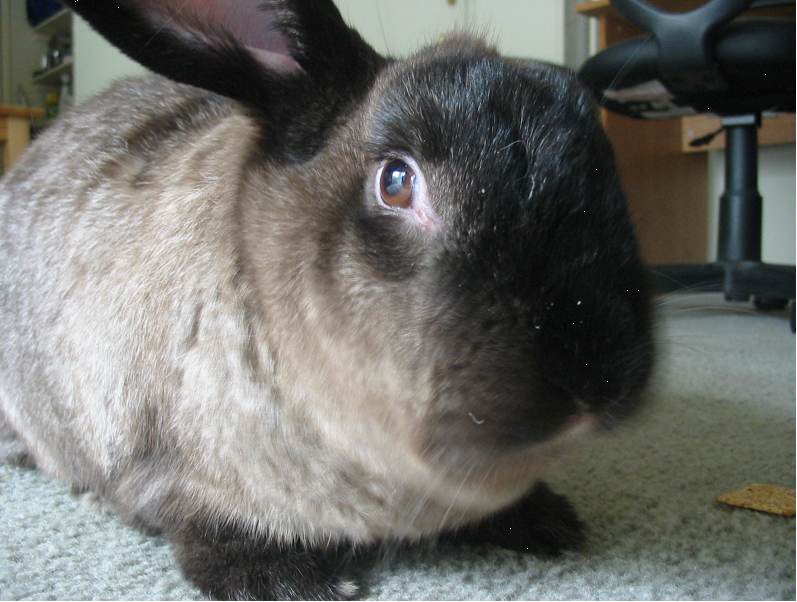
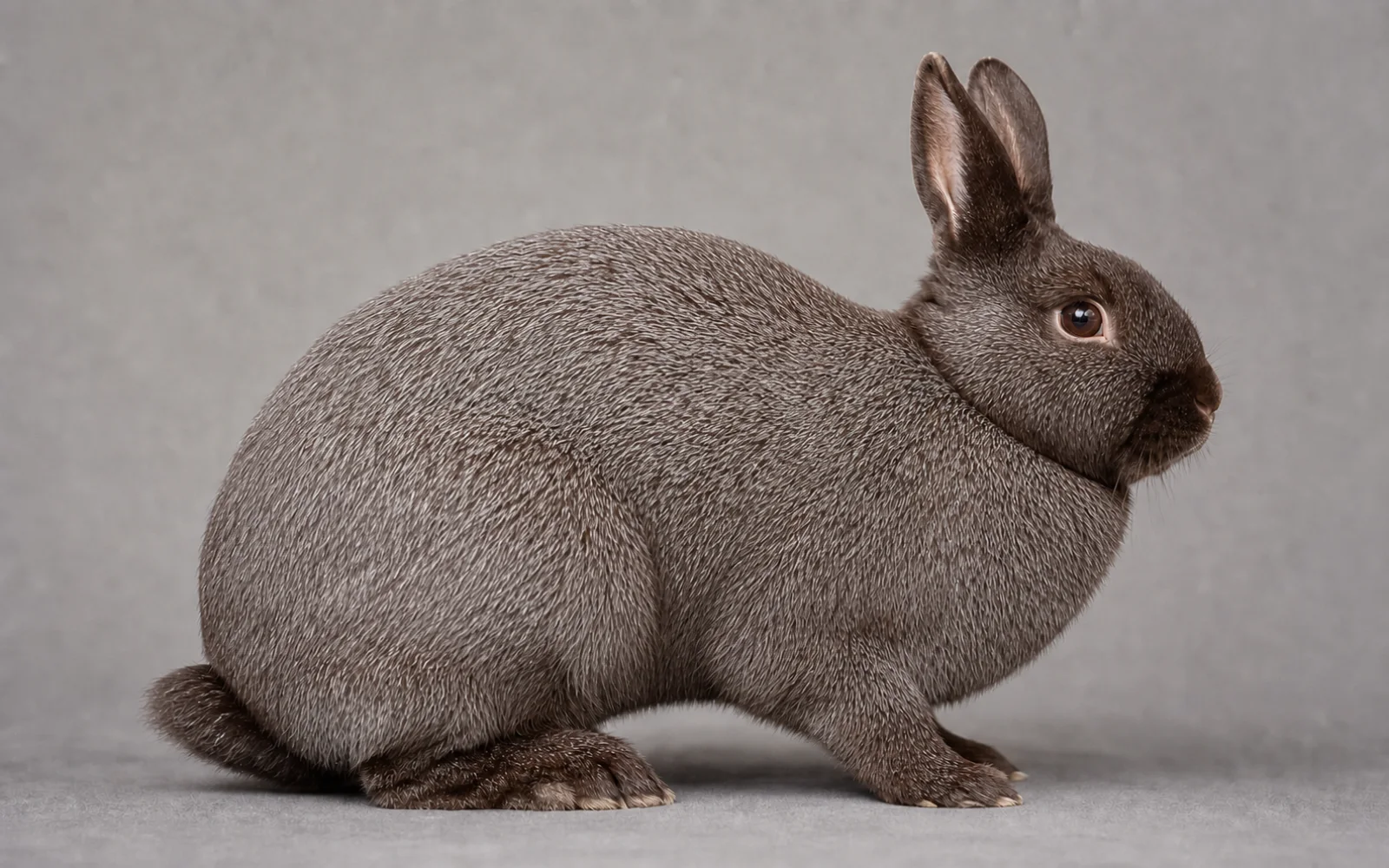
GOST defines a large normal-haired combined-purpose rabbit averaging 5.0 kg. The institute describes an elongated massive body, developed bone, broad deep chest, long broad back, rounded rump, straight muscular limbs, brown eyes and 13–17 cm ears. The neck, back and rump appear uniformly black; zoned side hairs show blue at the base, then dark brown, a lighter band and a black tip forming the veil. Kits are dark gray, then appear black, and the mature brown background and veil complete after the second molt at roughly 7–8 months.
One study shows variation, not a fixed calm temperament
A 2026 peer-reviewed comparison found behaviour differed by sex and breed group under one Kashmir farm system; it does not justify calling every Black-Brown calm or hardy. Assess the individual’s pain, fear, handling history and responses. Use gradual reward-based habituation, support the large body and hindquarters, and provide room to run, stand, stretch, hide and rest with a compatible rabbit.
Historic climate adaptation does not remove welfare needs
The institute notes that the population was developed in outdoor housing through Tatarstan winters and summers, but that history is not permission to expose any rabbit to heat, frost, wind or wet bedding. Provide dry shelter, shade, ventilation without drafts, non-slip resting areas and temperature monitoring. Offer unlimited grass hay and water, suitable leafy greens and measured complete pellets. Inspect the dense coat, skin, underside, feet and body condition by touch.
No verified breed-specific disease list
The cited standard and institute sources do not establish unique Black-Brown diseases. Monitor appetite, faeces, weight and condition, teeth, breathing, eyes, nose, skin, urine staining, feet and movement. Reduced eating or droppings, abdominal swelling, severe pain, breathing difficulty, weakness or marked lethargy requires prompt assessment by a rabbit-experienced veterinarian.
Treat old production figures as context, not promises
Verify pedigree and wait for mature color before judging the veil; a dark kit or black adult is not automatically Black-Brown. Record adult weight against the current 5.0 kg GOST average, structure, four-zone color, veil uniformity, molt stage, teeth, feet, recurring illness, matings, kindlings, kit survival and doe recovery. The institute reports historical averages and yields from particular management, while the 2026 study shows breed, age, season and their interactions affect outcomes. Do not guarantee eight kits, a 16-week slaughter age, 56–61% yield or universal climate tolerance.
- Use Flemish, White Giant and Vienna Blue as the sourced founders.
- Separate the 5.0 kg average from the reported 7.6 kg maximum.
- Judge mature zonation, health and pedigree after the second molt.
Frequently asked questions
How much does a Black-Brown rabbit weigh?
The current Russian GOST gives an average adult live weight of 5.0 kg. The institute’s 7.6 kg figure is an observed maximum, not a target range.
Where was the Black-Brown rabbit developed?
At the Biryulinsky fur farm in Tatarstan from 1942 to 1948 under breeder F.V. Nikitin.
Which breeds created the Black-Brown?
The federal institute and encyclopedia identify Flemish, White Giant and Vienna Blue.
When does the final Black-Brown color appear?
The institute says the mature brown background and black veil finish after the second molt, around 7–8 months.
- Breed standardGOST R 70141-2022 — Rabbit husbandry terms and state-register breeds
- GovernmentV.A. Afanasyev Research Institute of Fur Farming and Rabbit Breeding — Black-Brown breed
- GovernmentGreat Russian Encyclopedia — Black-Brown rabbit breed
- Peer reviewedWorld Rabbit Science — Comparative performance of five rabbit breeds in Kashmir (2026)
- VeterinaryMSD Veterinary Manual — Noninfectious Diseases of Rabbits
- Animal welfareRSPCA — What should I feed my rabbits?
- Animal welfareRSPCA — How to keep rabbits healthy
- Animal welfareRSPCA — The ideal home for rabbits
- VeterinaryMSD Veterinary Manual — Management of Rabbits
- VeterinaryMSD Veterinary Manual — Nutrition of Rabbits
- VeterinaryMSD Veterinary Manual — Routine Health Care of Rabbits
This profile does not diagnose an animal or replace the current national breeding standard. Confirm registry requirements locally and health decisions with a rabbit-experienced veterinarian.