
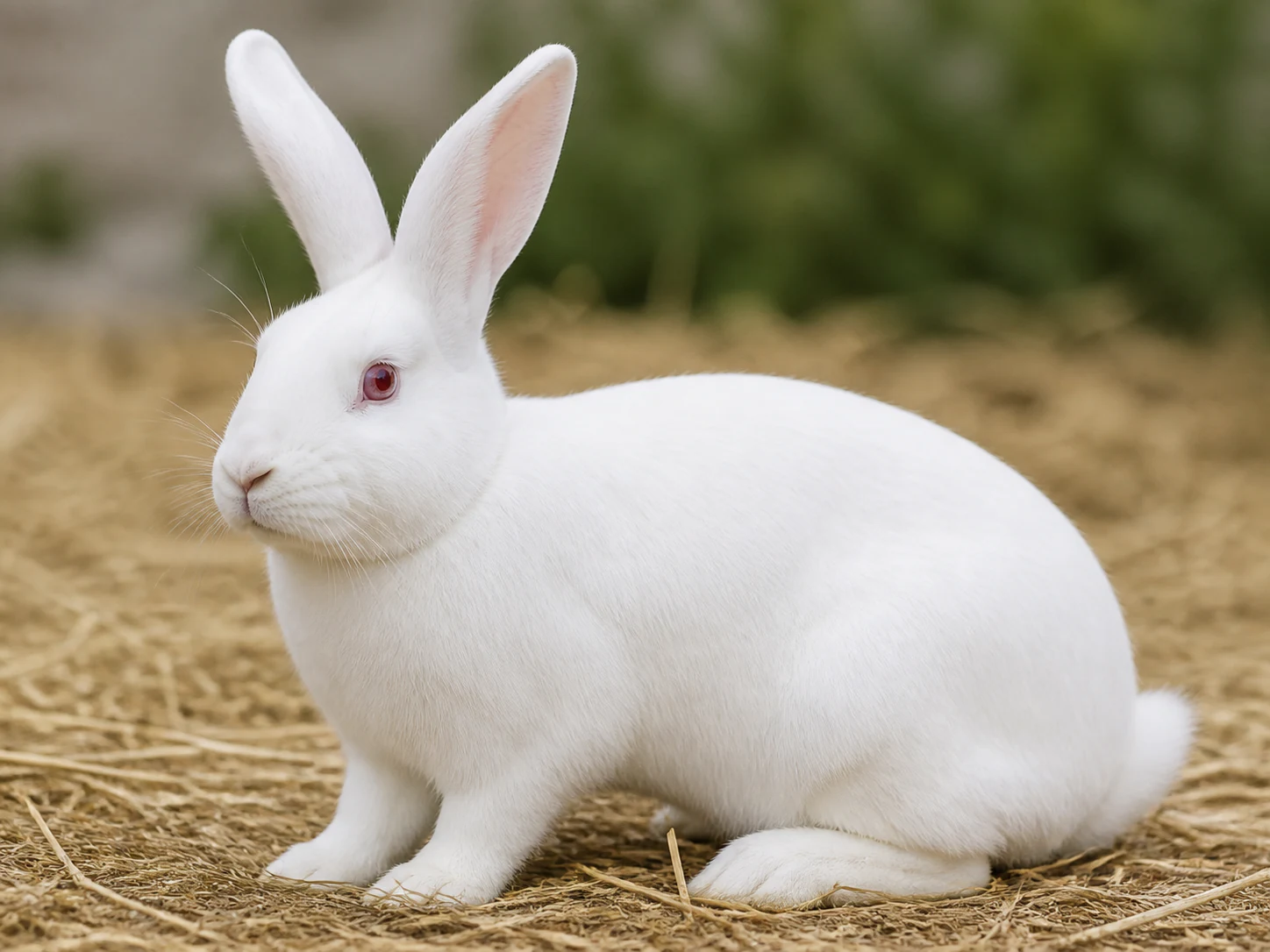
A Dendermonde breed shaped by the pelt trade
The breed took shape in the countryside around Dendermonde in Belgium. In the late nineteenth century slaughter rabbits were shipped to England in quantity and the fur trade paid well for single-colour white and blue pelts — well enough that working-class keepers across the region bred single-colour animals from the local land rabbits on a large scale.
Its precise ancestry remains unresolved. The sources below offer four different accounts, and the Flemish register explicitly warns that many versions circulate. No reliable publication gives a creation year; the often repeated 'around 1920' appears only on sources excluded by this article. The first securely dated event came later: in 1977 the first rabbits were imported to the Institute of Animal Production station at Chorzelów in Poland.
- Flemish heritage register: an extinct Witte van Tervuren, a white Van Beveren, or the Flemish Giant.
- Italian agricultural atlas: descended from the Flemish Giant.
- Polish research literature: bred from Belgian White rabbits, a breed the Polish herdbook keeps separate from the Belgian White Giant.
Always albino, long in the head, ears carried in a V
Every Blanc de Termonde is an albino: an immaculate white coat and ruby-red eyes with a pale iris. Claw colour is the one point where the descriptions part — white in the Italian atlas, white or flesh-coloured in the Polish one. The coat is medium in length and reasonably dense, silky, rich in undercoat, with guard hairs of about 3 cm.
The head is long and fine in the doe and rounder in the buck; a round, full head on a doe is a light fault. Ears run 13.5–15 cm, large and strong, rounded at the tips and carried in a V; Polish sources citing Frindt give 13–15 cm. The body is long and stretched with an ascending topline, a broad chest, well-fleshed hindquarters and a rounded rump. Bucks carry no dewlap at all, does at most a slight one after their first year — this one circulates the other way round.
- Serious faults: eyes other than ruby; hair of any colour but white; ears over 15 cm; lop or folded ears; a body too short; excessive weight; a coarse or woolly coat; dental deformity.
- Light faults: hair too long; heavy bone; a short head; a round, full head on a doe.
Medium by the standard, large by the weight scale
The European standard files the breed among the medium rabbits at 4.0–5.5 kg (8.8–12.1 lb), ideally 4.5–5.0 kg for a buck and 4.0–5.5 kg for a doe. The Flemish register gives an average adult near 4.5 kg (9.9 lb); the Polish standard is wider at 3.5–5.7 kg (7.7–12.6 lb) from eight months.
English-language references often call the breed large. Under the MSD Veterinary Manual's weight bands — small 0.9–2.7 kg, medium 2.7–4.1 kg, large 4.1–5.0 kg and giant above 5.0 kg — the breed's range covers the upper end of medium, all of large and the beginning of giant. This catalogue groups it as large for consistency, although the breed standard itself says medium. Weight above the standard maximum is a serious fault.
Litters, fertility and milk
The latest audited figures come from Poland. In 2024 the national herdbook covered 383 litters: 2,900 kits were born and 2,229 were reared, equal to 7.6 born and 5.8 reared per litter and a 76.9% rearing rate. In 2023 the corresponding figures were 7.6 born, 5.2 reared and 69.1%. Across all recorded Polish breeds in 2024, the averages were 6.7 born and 5.6 reared, with an 83.3% rearing rate. Blanc de Termonde therefore produced more kits at birth but reared a smaller proportion of them.
The 2016 herdbook recorded 2.9 litters, 21.2 kits born and 18.2 reared per doe per year, compared with 1.8 litters and 11.0 births across all recorded rabbits. About 80% of matings were successful over the year. The does' milk-yield coefficient rose from 3.51 after the first litter to 3.72 after the fifth. The standard's figure of 8–10 kits per litter is higher than every published average.
Fast growth, a light carcass and protein-rich meat
Growth is the best-documented production trait. Mean live weight was 612 g at 28 days, 909 g at 35 days and 2,587 g at 90 days. A second trial recorded 2,600 g at 93 days and an average daily gain of 32.48 g. In that comparison Blanc de Termonde grew faster than Alaska, Giant Chinchilla, Californian and New Zealand White.
Carcass results were less straightforward. Dressing percentage was 59.7%, and the average 1,155 g carcass contained 76.3% meat, 15.9% bone and 7.2% fat. Despite the rapid growth, these were the lightest carcasses in the trial; only New Zealand White and the synthetic line had a lower dressing percentage. The meat contained 22.6% protein, the highest value in the study, and 4.9% fat. Among the medium breeds it was also the darkest and had the firmest texture.
- 612 g at 28 days, 909 g at 35 days, 2,587 g at 90 days.
- 59.7% dressing; 1,155 g carcass at 76.3% meat, 15.9% bone, 7.2% fat.
- 22.6% meat protein and 4.9% fat — the highest protein in that trial.
A calm reputation supported by limited evidence
Only one accepted source describes the breed's temperament. The Flemish living-heritage register calls it dependable and calm. With no other verified evidence, this should be treated as a general description rather than a promise about every animal. Previous handling, housing, pain and fear influence an individual rabbit's behaviour far more than its breed name.
The same register records no special housing requirements. Even so, accommodation must be sized for a 4–5 kg rabbit and allow it to stand upright, stretch fully, hide and move freely. It also needs a dry resting area and ventilation that removes moisture and ammonia without creating a constant draught. Assess body condition by palpation, not from weight alone.
Rare in Belgium and recorded in six Polish herds
The British Rabbit Council lists Blanc de Termonde among the Rare Varieties in its Fur section. That list is framed as examples rather than a complete index, and no BRC standards document with weights or points is published, so it supports rare-variety status and nothing more. ARBA does not recognise it: neither Termonde nor Dendermonde appears on its recognised-breeds page.
The Flemish register calls the breed rare today and the Italian atlas says it is now very hard to find. Poland keeps the clearest count: 6 herds and 153 does under official recording in 2024, up from 5 herds and 148 does in 2023 but still below the 4 farms and 207 does of 2016.
What to record if you keep the breed
Accurate individual records are especially important in a population this small. Weigh young rabbits at fixed ages so the results can be compared with published data, and record kits born and reared separately for every litter. During selection, check eye colour, ear length and carriage, and any coloured hair. Non-ruby eyes, ears longer than 15 cm and coloured hair are serious faults that can become established quickly in a small herd.
- Weigh at 28, 35 and 90 days against 612 g, 909 g and 2,587 g.
- Record born and reared separately; rearing rate is the weak point.
- Log ear length, eye colour and coloured hair at every selection.
- Track litters per doe per year against the herdbook figure of 2.9.
Frequently asked questions
How big does a Blanc de Termonde rabbit get?
The European standard gives 4.0–5.5 kg (8.8–12.1 lb), ideally 4.5–5.0 kg for bucks and 4.0–5.5 kg for does; the Flemish register puts the average adult near 4.5 kg. Excess weight is a serious fault, so the top of the range is a limit, not a target.
Is the Blanc de Termonde recognised by ARBA or the British Rabbit Council?
The BRC lists it among the Rare Varieties in its Fur section. ARBA does not recognise it — neither Termonde nor Dendermonde appears on its recognised-breeds page. No BRC standards document with weights or points is currently published.
How many kits does a Blanc de Termonde doe have per litter?
The Polish national herdbook measured 7.6 born and 5.8 reared per litter across 383 litters in 2024, a 76.9% rearing rate against 83.3% for all recorded rabbits. The standard's 8–10 kits sits above every counted average.
What dressing percentage does the Blanc de Termonde give?
Polish trials measured 59.7% overall, on a 1,155 g carcass of 76.3% meat, 15.9% bone and 7.2% fat. The same work notes these were the lightest carcasses of any breed tested despite the fast growth.
Where can I still find Blanc de Termonde stock, and how long do they live?
Poland recorded 6 herds and 153 does under official supervision in 2024, and the breed is also considered rare in Flanders. None of the reliable sources used here gives an average lifespan for Blanc de Termonde, so this article does not repeat the unverified figures found on general pet websites.
- Breed standardBritish Rabbit Council — Rabbit Breeds (Rare Varieties, Fur section)
- Breed standardAmerican Rabbit Breeders Association — Recognized Breeds
- UniversityAgraria.org — Atlante delle razze di conigli: Bianco di Termonde / Blanc de Termonde (ISSN 1970-2620)
- Animal welfareSteunpunt Levend Erfgoed vzw — Wit van Dendermonde (Flemish living-heritage breed register)
- Peer reviewedPałka S. et al. (2017) — Characteristics of productive traits and meat quality of Termond White rabbits raised in Poland, Roczniki Naukowe Zootechniki 44(2): 177–181
- GovernmentKrajowe Centrum Hodowli Zwierząt — Hodowla zwierząt futerkowych w 2024 roku (Warsaw 2025)
- VeterinaryMSD Veterinary Manual — Description and Physical Characteristics of Rabbits
Published averages do not predict the result in every herd. Growth, litter size and carcass traits vary with line, diet, season, parity, health and husbandry. Almost all figures in this article were measured in Polish research herds. Discuss herd health and breeding decisions with a veterinarian experienced in rabbit medicine.