A European spotted family, not a single-country invention
The French federation traces large spotted rabbits through Belgium, France and Germany and calls the breed’s European identity multinational. It records the first French standard on 8 November 1925 and says the name Géant Papillon Français unified Papillon Français and Papillon de l’Est in 1954. German Riesenschecke, Dutch Lorrain and Swiss spotted populations are related national forms, not proof that every registry uses an identical standard. The BRC currently lists Giant Papillon as a rare Fancy variety. This evidence replaces the database’s unqualified German origin and approximate 1900 recognition date.
A 5 kg minimum, 6 kg ideal and a precise marking map
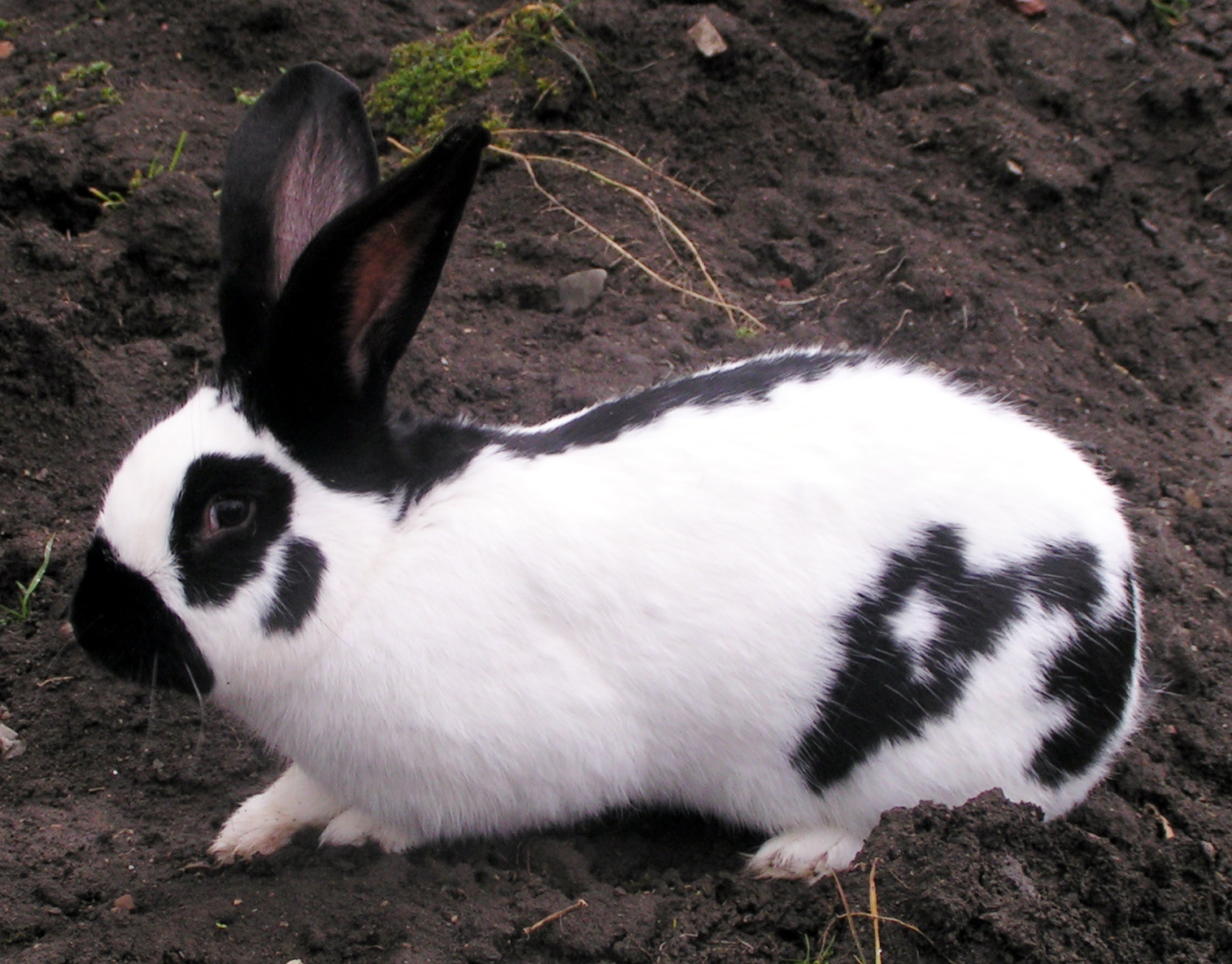
The current French standard sets 5.0 kg as the minimum for both sexes and awards ideal weight from 6.0 kg, without a stated maximum. It asks for a powerful elongated body, medium bone, balanced muscle, a gently arched topline and a full rounded rump. Ears are erect and well furred, at least 16 cm and ideally 17–19 cm. The white ground carries pure, sharply bounded colored markings: butterfly nose, complete eye circles, cheek spots, colored ears, a continuous dorsal stripe and separated flank spots. Black and blue are common, but France permits other officially recognized colors. The peer-reviewed European description gives six to eight rounded side spots as ideal; that is a show pattern, not a litter or productivity number.
Size and pattern do not predict a calm personality
Neither the current French standard nor the reviewed research establishes a universally calm temperament. Individual behavior depends on pain, fear, socialization, reproductive state and prior handling. Use floor-level interaction, hiding places, predictable routines, foraging and compatible rabbit companionship. Before lifting a large rabbit, plan the destination and support the chest and complete hindquarters; use two trained handlers when needed. Never lift by the ears or loose skin. A rabbit that resists handling needs a safer setup and medical assessment when behavior changes suddenly, not force.
A giant runner needs permanent usable space
Provide a permanently connected enclosure that allows several full hops, upright rearing, complete stretching, turning, exploration and retreat without striking ears or spine. Flooring should be dry, stable, non-slip and comfortable for resting; hygiene and movement matter more than one material. Feed unlimited grass hay, constant fresh water, suitable leafy greens and a measured complete pellet according to age, growth, reproduction and body condition. Do not feed toward maximum weight. Check nails, soles and hocks, gait, underside, coat, teeth, appetite, feces and weight, and increase grooming during moulting.
Separate general giant-rabbit risks from spotting genetics
Large size raises the practical consequences of obesity, poor traction, long nails and pressure on the feet, but it does not diagnose disease. MSD describes pododermatitis as multifactorial, so dry yielding rest, movement, weight control and frequent sole inspection must work together. A PLOS study in Checkered Giant rabbits linked homozygous English spotting (En/En), an almost-white phenotype, with congenital megacolon; it did not measure prevalence in every national Giant Papillon population. Breeders working with this spotting family should understand the inheritance and seek specialist advice rather than identify genotype by appearance alone. Reduced food or feces, abnormal stool, abdominal distension, pain or lethargy needs prompt veterinary care.
Select function first and understand the spotting locus
Use pedigrees and the current registry standard for the exact national population; do not merge French Giant Papillon and American Checkered Giant records merely because the background is related. Record mature weight, body balance, movement, feet, bite, ears, every component of the marking map, matings, all births and losses, growth and doe recovery. Avoid selecting extreme weight or pattern at the cost of mobility, digestion or maternal health. The Checkered Giant KIT study shows why mating decisions around the English spotting complex require genetic literacy, but its findings must not be overstated as a measured disease rate for this breed. No reviewed source validates the database’s fixed eight-kit litter, 53% yield, 16-week endpoint, 7–9-month first mating or 80-day cycle.
- Keep national standards and pedigrees distinct from the American Checkered Giant.
- Record the complete marking phenotype, function, births, losses and recovery.
- Learn English spotting inheritance and never infer health or genotype from color alone.
Frequently asked questions
How much does a Giant Papillon rabbit weigh?
The current French standard sets a 5.0 kg minimum for both sexes and regards 6.0 kg or more as ideal. It does not publish an upper limit on the cited page.
Is Giant Papillon the same as Checkered Giant?
They share European spotted ancestry, but the American and European populations use different names and marking requirements. Use the standard and pedigree authority for the rabbit’s actual registry.
What markings should a Giant Papillon have?
A white ground with colored ears, eye circles, cheek spots, a butterfly nose mark, a dorsal stripe and separated flank spots. Exact permitted colors and fault rules depend on the registry.
Does every mostly white kit have megacolon?
No conclusion should be made by appearance alone. Research found congenital megacolon in homozygous English-spotted Checkered Giants, but did not establish prevalence in every Giant Papillon population.
- Breed standardFédération Française de Cuniculiculture — Géant Papillon Français (January 2026)
- Breed standardClub Français des Lapins Géants — Géant Papillon Français standard
- Breed standardBritish Rabbit Council — Rabbit breeds
- Peer reviewedWorld Rabbit Science — Comparison of exterior traits in selected giant and medium rabbit breeds (2020)
- Peer reviewedPLOS ONE — KIT, English spotting and congenital megacolon in Checkered Giant rabbits (2014)
- VeterinaryMSD Veterinary Manual — Noninfectious Diseases of Rabbits
- Animal welfareRSPCA — What should I feed my rabbits?
- Animal welfareRSPCA — How to keep rabbits healthy
- Animal welfareRSPCA — The ideal home for rabbits
- VeterinaryMSD Veterinary Manual — Management of Rabbits
- VeterinaryMSD Veterinary Manual — Nutrition of Rabbits
- VeterinaryMSD Veterinary Manual — Routine Health Care of Rabbits
This profile does not authenticate pedigree, infer spotting genotype or diagnose disease. Confirm the current national standard and consult a rabbit-experienced veterinarian or genetic adviser.